Suspending the event host 1,500 meters above the clouds, Insta360’s panoramic drone launch was nothing short of spectacular—an unmistakable signal of how seriously the company viewed this long-anticipated debut.
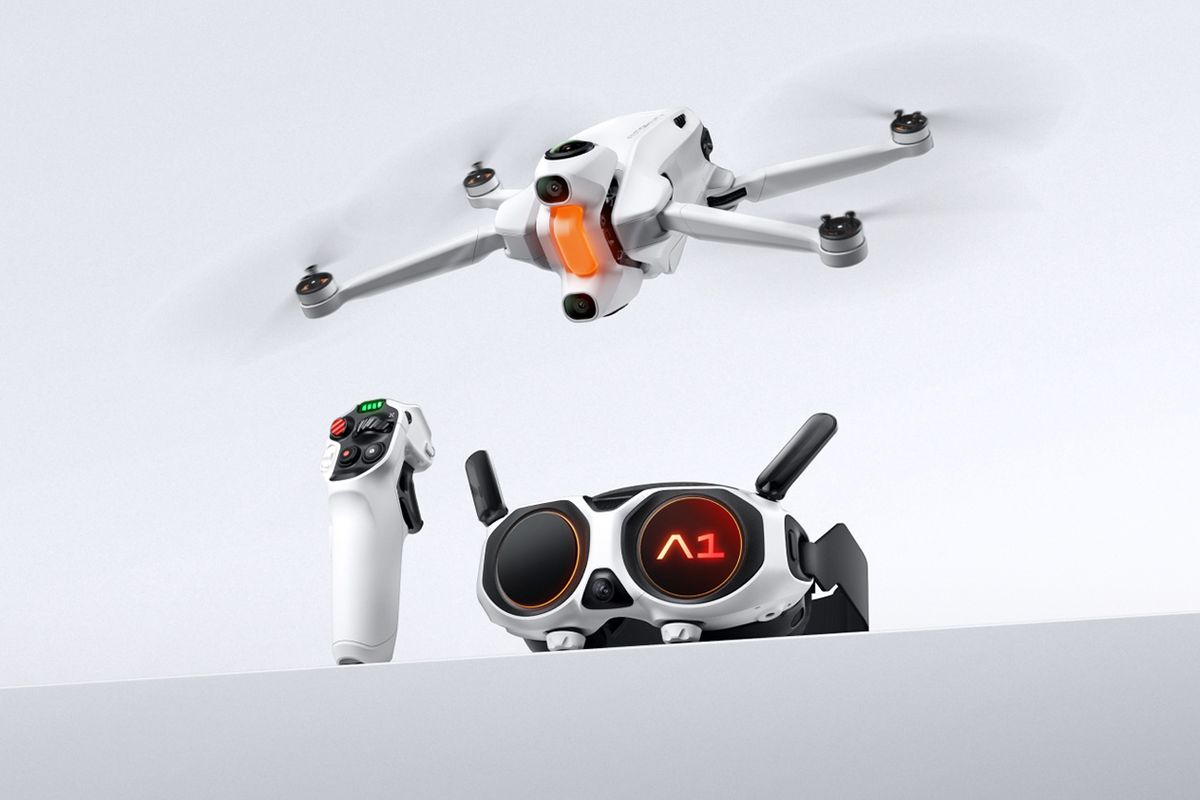
On the evening of December 4 at 8 p.m., Insta360 officially unveiled the Yingling A1 panoramic drone, a cross-industry product five years in the making. With a starting price of 7,999 yuan—still 6,799 yuan after national subsidies—the product positioned itself firmly in the premium segment. At an investor meeting, one of Yingling’s lens suppliers even set an ambitious target of 300,000 units in sales.
Yet despite the massive hype and high expectations, the highly anticipated product stumbled right out of the gate.
According to sources close to the company cited by Sina Finance, the Yingling A1 generated over 20 million yuan in domestic sales on its first day and topped multiple platform category rankings on launch day. However, data from Business Data Insight across major e-commerce platforms shows a very different picture: in the days following launch, the A1 consistently fell outside the top 10 best-sellers. Combined sales across JD.com, Taobao, and Douyin over the first three days totaled only around 1,500 units.
The most direct reason behind the weak debut lies in a serious mismatch between product capability and pricing. Consumers were asked to pay a “professional productivity tool” price for what many described as a “consumer entertainment experience.” The absence of a 4G module further fueled criticism, with some users bluntly calling it a “toy drone.”
This was supposed to be a milestone product that would “leave its mark on technological history,” according to Insta360’s founder. Marketed as the key driver for the company’s second growth curve, the A1 instead fell into a dual crisis of quality doubts and disappointing sales on its very first day.
Negative feedback quickly spread across short-video platforms and tech forums. What worried the market even more was that this setback was not an isolated incident. As early as the company’s Q3 2025 financial report, warning signs of “rising revenue but falling profit” had already emerged.
Once a dominant leader controlling 85% of the global panoramic camera market, Insta360 is now facing unprecedented challenges—especially after DJI’s rapid 60-day market offensive.
Quality–Price Imbalance: A Trust Crisis From Day One
To counter DJI’s growing pressure, the launch of the Yingling A1 now appears rushed.
Ahead of the release, an internal employee complaint surfaced online—only to be quickly deleted—suggesting unresolved battery-critical bugs and unfinished app features just days before launch.
For marketing, however, Insta360 spared no expense. The entire launch event took place aboard a hot air balloon 1,500 meters above the ground. The A1 was branded as the world’s first panoramic drone, capable of 8K 360-degree video capture and designed specifically for professional content creators.
But the premium price failed to deliver a matching experience.
Generally speaking, drones priced above 5,000 yuan are considered productivity tools. Yet the Yingling A1 leaned heavily toward entertainment, with relatively weak competitiveness. Before launch, professional photographer Nan Xiang—signed across multiple platforms—already pointed out that despite its 8K resolution, leaked footage showed noticeable quality gaps compared with DJI drones, especially in night scenes.
These concerns were confirmed after launch. A night-shooting test video released by Douyin tech reviewer “Suimo 31” under automatic ISO in 8K quickly became the flashpoint of public debate.
The footage showed that the A1’s image cleanliness at night was inferior to DJI products at the same price level. Many users criticized it sharply, saying, “Flagship pricing, entry-level night performance.”
Well-known digital reviewer “Mechanic’s Name” went further, stating that the real-world image quality of the A1 only matched DJI’s Neo or entry-level Mini series. Despite claiming 8K, its effective output clarity resembled 1080P, sitting somewhere between Insta360’s X4 and X5 action cameras.
Multiple tech bloggers have since released test reports. Compared with mainstream and flagship drones from established brands, the A1 relies only on front and bottom sensors for obstacle avoidance. It lacks side and rear detection entirely, making sharp turns and reverse flight highly collision-prone. In strong lighting conditions, obstacle avoidance delays can reach up to one full second.
This limitation is the direct trade-off for its ultra-lightweight design.
At just 249 grams, the A1 successfully avoids flight regulation thresholds in many countries. However, teardown analysis of its aviation-grade magnesium alloy frame reveals the cost of this weight reduction: only front and bottom sensors are installed, leaving the sides and rear completely unprotected.
Actual tests show that in strong light, the obstacle avoidance response lags by up to one second, and the recognition rate for transparent surfaces like glass walls falls below 30%.
Thermal performance poses another critical issue. To control weight, the drone uses an ultra-thin cooling system. After 20 minutes of continuous shooting, overheating warnings frequently appear. In a test conducted at –5°C, one tech blogger found that the drone automatically returned due to cold-triggered protection, which Insta360 later explained was done to “protect battery performance.”
By comparison, DJI’s Air 3 offers full omnidirectional obstacle avoidance, operates reliably between –10°C and 40°C, and weighs only 121 grams more than the A1.
Additionally, the A1’s dual fisheye lens stitching shows visible color discrepancies, with edge resolution dropping over 30%. At night, image noise is 2.3 times higher than competitors. Even more awkward is its image transmission system: the beta version begins to stutter at just 200 meters. The promised “invisible in the sky” effect frequently turns into aerial pixelation.
As quality controversy intensified, it quickly translated into a harsh sales reality.
According to real-time data from Analysys, total sales across JD, Taobao, and Douyin reached only slightly over 1,500 units in the first three days, suggesting revenue of roughly 10 million yuan.
On the resale market, the situation looked even more alarming. By the second day after launch, over 200 brand-new A1 units appeared on Xianyu at discounted prices ranging from 5,799 to 6,399 yuan—400 to 1,000 yuan below the official price. Some listings were marked as “urgent resale, unopened,” with discounts reaching 12.6%.
Following the disappointing launch, Insta360’s stock price plunged 8% at one point after market opening.
Rising Revenue, Falling Profit: The Pressure on the Core Business
The failure of the drone project exposes a deeper issue in Insta360’s operations: strong revenue growth without corresponding profitability, compounded by a high-risk investment in drones that has yet to pay off.
In Q3, the company reported a dramatic 92.64% year-on-year revenue surge to 2.94 billion yuan. Yet net profit attributable to shareholders fell 15.9% to just 272 million yuan.
Behind this imbalance lies a deliberate strategic gamble.
R&D spending in the third quarter skyrocketed 164.81% to 524 million yuan—nearly double the quarter’s net profit. Much of this funding went into “chip customization and strategic projects,” highly likely centered on the Yingling Antigravity panoramic drone. This heavy investment is a key reason behind the decline in profitability.
Insta360’s founder Liu Jingkang has long planned the company’s entry into drones. Since July 2020, the company has registered multiple drone-related patents covering structural design, propellers, and power systems. In Q3 alone, R&D made up 17.8% of total revenue—normally a positive for tech firms, but in this case, input-output efficiency has become highly imbalanced.
For a newly listed company whose share price once surged 274% on debut and whose market value exceeds 120 billion yuan, this financial report signals the start of a costly war for a “second growth curve,” fought at the expense of short-term profits.
Meanwhile, the core panoramic camera business is also under heavy siege.
Before 2024, Insta360 dominated over 85% of the global market through patents, software ecosystems, and UGC communities. Competitors like GoPro and Ricoh survived only in niche segments.
That balance changed when DJI launched a price war following Insta360’s Ace Pro 2 action camera release, slashing Osmo Action 4 prices to as low as 1,500 yuan.
By late July, DJI unleashed the Osmo 360. According to sources cited by Science and Technology Innovation Board Daily, DJI shipped 290,000 panoramic cameras in Q3 alone, generating 860 million yuan in revenue.
This near “dimensional-level” market entry speed delivered a severe shock to Insta360’s longtime dominance.
Data from Jiuqian Platform shows that in Q3 2025, Insta360’s global panoramic market share dropped sharply from 85–92% to just 49%, while DJI surged to 43%, nearly tying the former leader.
However, a report by Frost & Sullivan painted a drastically different picture, claiming Insta360 still held 75% global share while DJI stood at 17.1%. Notably, that report has since been taken offline twice and has yet to be republished.
Despite conflicting data, one trend is undeniable: Insta360’s most critical market is under sustained pressure, while DJI’s panoramic products serve merely as ecosystem extensions within its larger imaging empire. Combined with weakening profit growth in 2025’s first three quarters, alarm bells are clearly ringing.
The weak performance of the Yingling A1 triggered panic selling in the capital market. On December 5, Insta360’s stock dropped as much as 8% intraday and closed down 6.01% at 262.56 yuan.
A Hard Truth: A Panoramic Drone Is Not Simply “Drone + Camera”
The failure of the Yingling A1 underscores a harsh reality: a panoramic drone is far more complex than simply combining a drone with a panoramic camera.
Even with future iterations and refinements, Insta360’s drone business must overcome two massive barriers—breaking DJI’s entrenched market dominance and building long-term technical depth and ecosystem support.
Market competition is healthy, but as a latecomer, only tenfold innovation offers a real chance to win.
The leap from “panoramic camera” to “panoramic drone” is not a cosmetic upgrade—it is a multidimensional, system-level technological transformation.
While Insta360 leads in panoramic image processing for static and handheld scenarios, drones operate in high-speed, high-vibration, multi-attitude flight environments. This introduces entirely new technical challenges involving flight stability control, high-altitude adaptability, and dynamic image optimization.
These challenges significantly exceed the complexity of static imaging.
GoPro’s failed attempt at drone expansion serves as a stark warning. Its Karma drone collapsed after repeated crash incidents in 2016, forcing the company’s complete withdrawal from the market by 2018 and damaging its core business in the process.
Insta360 now faces an even tougher reality: while still battling fiercely in its core camera business, it must also sustain long-term, capital-intensive drone development.
For Insta360, drones are not a financial “lifeline.”
Only by stabilizing its leadership in panoramic cameras and addressing the structural issue of rising revenue but shrinking profit can the company secure the capital reserves and time window required for new ventures to mature.