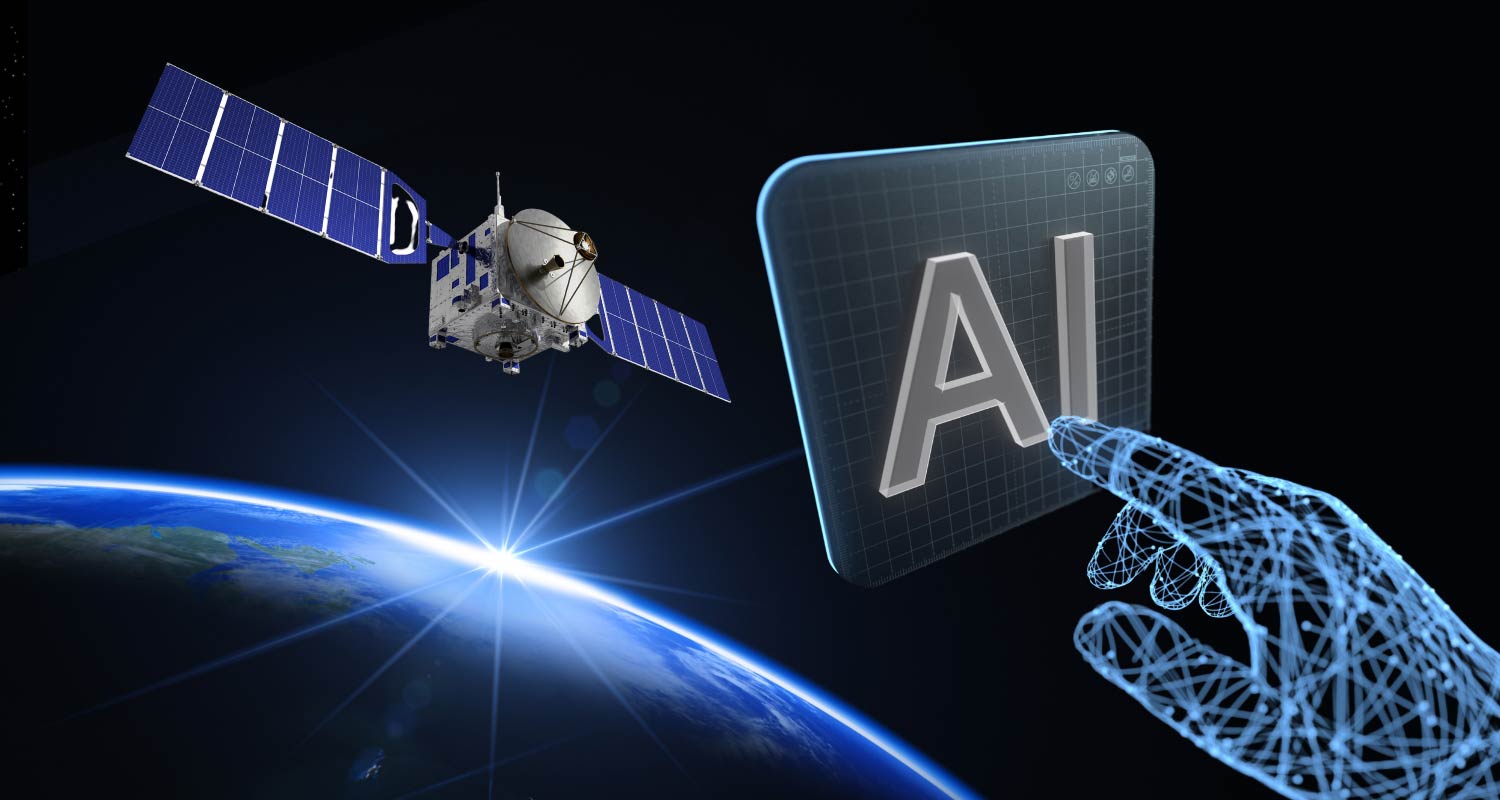
As the global artificial intelligence boom begins to encounter mounting constraints in infrastructure and energy supply, the next major leap in AI may no longer happen on Earth—it may unfold in space.
This bold vision was recently put forward by Elon Musk in a post on X.
On Sunday U.S. Eastern Time, Musk wrote that localized AI computing satellites operating in low-latency sun-synchronous orbit—transmitting only computation results back to Earth—could become the lowest-cost way to generate AI data streams within just three years.
He added that because readily available power resources on Earth are already scarce, space-based systems could scale far more rapidly. By launching one million tons of satellites annually, each equipped with 100 kilowatts of power, humanity could add 100 gigawatts of AI computing capacity every year—without operational or maintenance costs—while connecting to the Starlink constellation via high-bandwidth lasers.
Looking even further ahead, Musk envisioned building satellite factories on the Moon and using mass drivers (electromagnetic launch systems) to accelerate AI satellites to lunar escape velocity—completely eliminating the need for rockets. This, he suggested, could push AI computing capacity beyond 100 terawatts per year and propel humanity one major step toward a Kardashev Type II civilization.
The “Kardashev Scale,” proposed in 1964 by Soviet astronomer Nikolai Kardashev, classifies civilizations based on their energy usage: Type I controls planetary energy, Type II harnesses the power of an entire star system, and Type III commands the energy of a full galaxy.
In another post, Musk expanded on this future, stating that once the Moon hosts factories, robots, and large-scale mass drivers, the entire system could become a closed loop—potentially decoupled from traditional currency and operating autonomously based on watts and tonnage as its core units of value.
In recent months, Musk is far from alone in pointing toward space as the next frontier for AI. Google’s “Project Suncatcher” and Amazon’s “Leo” satellite internet constellation initiative also align with this broader vision, signaling a shared industry belief that the future of AI may extend beyond Earth.
At first glance, moving AI into space may sound almost fantastical. Yet behind the glossy announcements and ambitious rhetoric lies a very real and pressing challenge: as AI models grow ever larger and demand surges, the world’s data centers, fiber-optic networks, and power grids are already under visible strain. The pace of developing new energy sources simply cannot keep up. At the same time, concerns such as latency, climate risk, and geopolitical barriers continue to complicate terrestrial expansion.
Google’s Project Suncatcher aims to construct orbital computing nodes powered by near-constant solar exposure and cooled by the vacuum of space. The idea is that these satellites, loaded with large numbers of Google TPUs, could eventually outperform ground-based data centers in running machine-learning workloads—especially for tasks that do not require real-time human interaction. In orbit, solar panels operate more efficiently, cooling is easier, and systems are immune to storms and power outages.
Amazon, through its LEO project, is building a global broadband network composed of thousands of low-Earth-orbit satellites that will ultimately link directly into cloud and AI infrastructure. Some of these satellites may one day provide edge-computing services to regions that lack—or cannot reliably access—traditional cloud resources, allowing AI tasks to be processed locally in space.
Meanwhile, Musk is developing the concept of “orbital computing farms” for xAI and SpaceX to address these same systemic limitations. These facilities would not only run AI models but also train them—a far more technically demanding challenge. Yet for workloads that require uninterrupted power, physical isolation, and immense resource consumption, this approach may prove both practical and transformative.