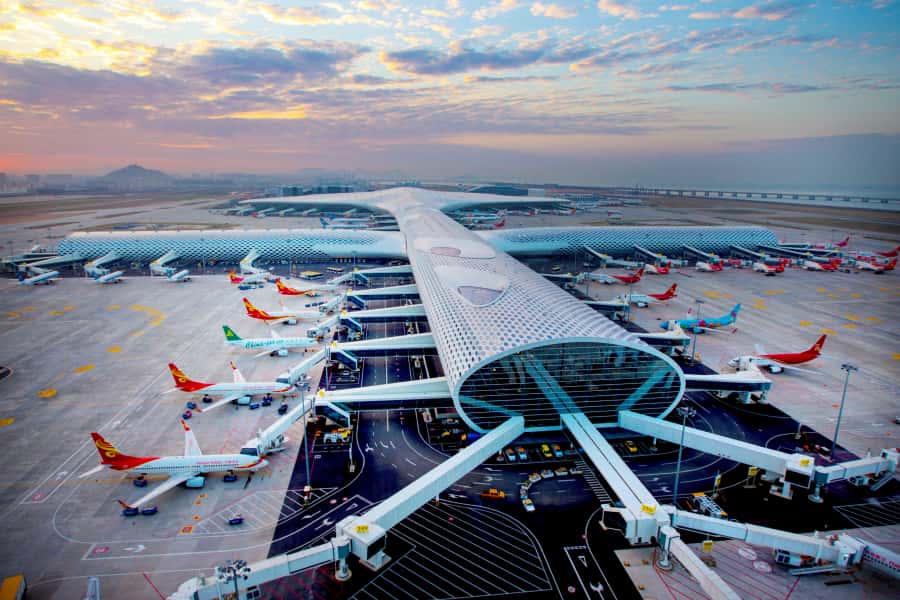
A world-class airport cluster has arrived.
01
A super urban cluster is racing ahead with airport construction.
Shenzhen Bao’an International Airport has officially entered the “three-runway era” with the commissioning of its third runway. Together with the T2 terminal area now under construction, the airport’s future capacity is set to reach 80 million passengers annually.
Just over a month earlier, Guangzhou Baiyun International Airport put its T3 terminal and fifth runway into operation. This made it China’s first airport with five commercial runways and the world’s largest single-terminal airport, designed to handle up to 120 million passengers per year.
Aligned with Shanghai’s “Eastern Hub,” Guangdong’s 15th Five-Year Plan proposal calls for the development of an international business cooperation zone at Baiyun Airport, positioning it as a “Southern Gateway” connecting ASEAN to the world.
Looking further back, Hong Kong International Airport officially opened its third runway last November, boosting its annual capacity to 100 million passengers and 10 million tonnes of cargo.
Together, Guangzhou, Shenzhen, and Hong Kong alone will soon be capable of handling a combined 300 million passengers and over 18 million tonnes of cargo annually—creating one of the strongest airport clusters not only in China, but globally.
And the Greater Bay Area’s airport boom does not stop with these three hubs. Foshan, Huizhou, Macau, and Zhuhai are also pushing full steam ahead.
In Foshan, the Pearl River Delta Hub (Guangzhou New) Airport—often dubbed “Guangzhou’s Second Airport”—is expected to break ground soon with a planned annual capacity of 30 million passengers.
Zhuhai Airport’s T2 terminal is about to open. Macau International Airport’s land reclamation expansion and apron construction are scheduled for completion by 2030. Huizhou Airport is being positioned to serve as Shenzhen’s second airport.
Among the 11 cities of the Greater Bay Area, only Dongguan, Zhongshan, Jiangmen, and Zhaoqing currently have no airports. Yet there is no visible anxiety over this absence. Dongguan benefits from its location between Guangzhou, Shenzhen, and Hong Kong, while Zhongshan and Jiangmen are well covered by the aviation networks of Guangzhou, Shenzhen, Zhuhai, and Macau.
As for Zhaoqing, the site chosen for Guangzhou’s second airport lies on the border between Foshan and Zhaoqing and was originally part of Zhaoqing’s territory. For unified construction, several villages were ultimately reassigned to Foshan.
The Greater Bay Area has formed a coordinated, multi-tier structure of “international hubs, regional gateways, and branch airports,” laying a solid foundation for its rise as a world-class urban cluster.
02
Why does the Greater Bay Area continue to build airports?
With infrastructure already highly developed and population growth approaching its peak, there has been growing debate over whether it is still necessary to keep constructing high-speed railways and airports.
Clearly, not every region needs more large-scale infrastructure.
But for places with massive inflows of population, high passenger volumes, and constant business travel, more infrastructure is always better.
The Greater Bay Area fits this profile perfectly.
Spread across just 56,000 square kilometers, it is home to more than 87 million people and generates GDP of 14.8 trillion yuan—comparable to the economic scale of countries such as Canada and Russia.
It is one of the world’s largest centers for technological innovation and a top-tier international financial hub. The flows of people, goods, capital, information, and data all converge here at extraordinary intensity.
Across the 11 cities of the Greater Bay Area, there are now seven large civil transport airports with a total of 15 runways, giving the region the highest airport density in the country.
In 2024, airport passenger throughput in the Greater Bay Area reached 214 million. This year, it is expected to surpass 230 million.
Guangzhou, Shenzhen, and Hong Kong each surpassed the 50-million-passenger mark last year. Across China, only six cities have reached this level—half of them are in the Greater Bay Area.
Combined, the three major airports handled 191 million passengers last year—three times the total of Jiangsu Province and more than the combined total of the six central Chinese provinces.
Before the latest expansion, both Guangzhou and Shenzhen airports were operating at persistently high utilization levels, with saturated flight slots and still-surging passenger demand.
According to forecasts by Airports Council International, the Greater Bay Area’s air passenger demand will reach 387 million by 2030 and climb further to 420 million by 2035.
And it is not just aviation. Demand for high-speed rail, intercity rail, and metro systems—both within and beyond the region—continues to grow rapidly.
This means the Greater Bay Area must keep building airports, high-speed rail lines, and metro networks, while also accelerating the development of second airports, second high-speed rail corridors, and cross-city metro connections.
03
Why are Guangzhou’s and Shenzhen’s second airports located outside their city boundaries?
When explosive passenger growth collides with airport saturation, the most direct solution is to build a second—or even a third—airport.
This is already the norm for China’s mega-cities. Shanghai, Beijing, and Chengdu have become dual-airport cities, while Chongqing and Nanjing are close behind.
Guangzhou and Shenzhen also face clear demand for second airports. Yet instead of placing them within their own city limits, both chose to locate them within their broader metropolitan areas.
Guangzhou’s second airport—the Pearl River Delta Hub (Guangzhou New) Airport—is positioned as one of the three major international aviation hubs in Guangdong’s “3+4+8” airport system and ultimately selected a site on the border between Foshan and Zhaoqing.
Shenzhen’s planning blueprint supports the development of Huizhou Pingtan Airport into a regional hub capable of handling tens of millions of passengers annually, effectively positioning it as Shenzhen’s second airport.
Why did both Guangzhou and Shenzhen choose to place their second airports in neighboring cities?
Airspace constraints and land shortages certainly played a role. But more importantly, this reflects a strategic shift toward urban integration and regional coordination.
Any city, if driven purely by self-expansion, could concentrate resources within its own borders and maximize the siphoning effect. But modern urban development is no longer a solo game.
National strategy has repeatedly emphasized “coordinated regional development,” advancing metropolitan areas and city clusters for collective growth rather than isolated competition.
By placing Guangzhou’s second airport in Foshan, it helps rebalance Guangdong’s airport layout while filling aviation gaps in Zhaoqing, Yangjiang, Maoming, Yunfu, and even parts of Guangxi.
By positioning Shenzhen’s second airport in Huizhou, it not only fills aviation gaps for Huizhou and Shanwei, but also absorbs overflow passenger and cargo demand from Shenzhen itself—achieving a true win-win.
This is the essence of Greater Bay Area coordination—and the defining feature of a world-class airport cluster.