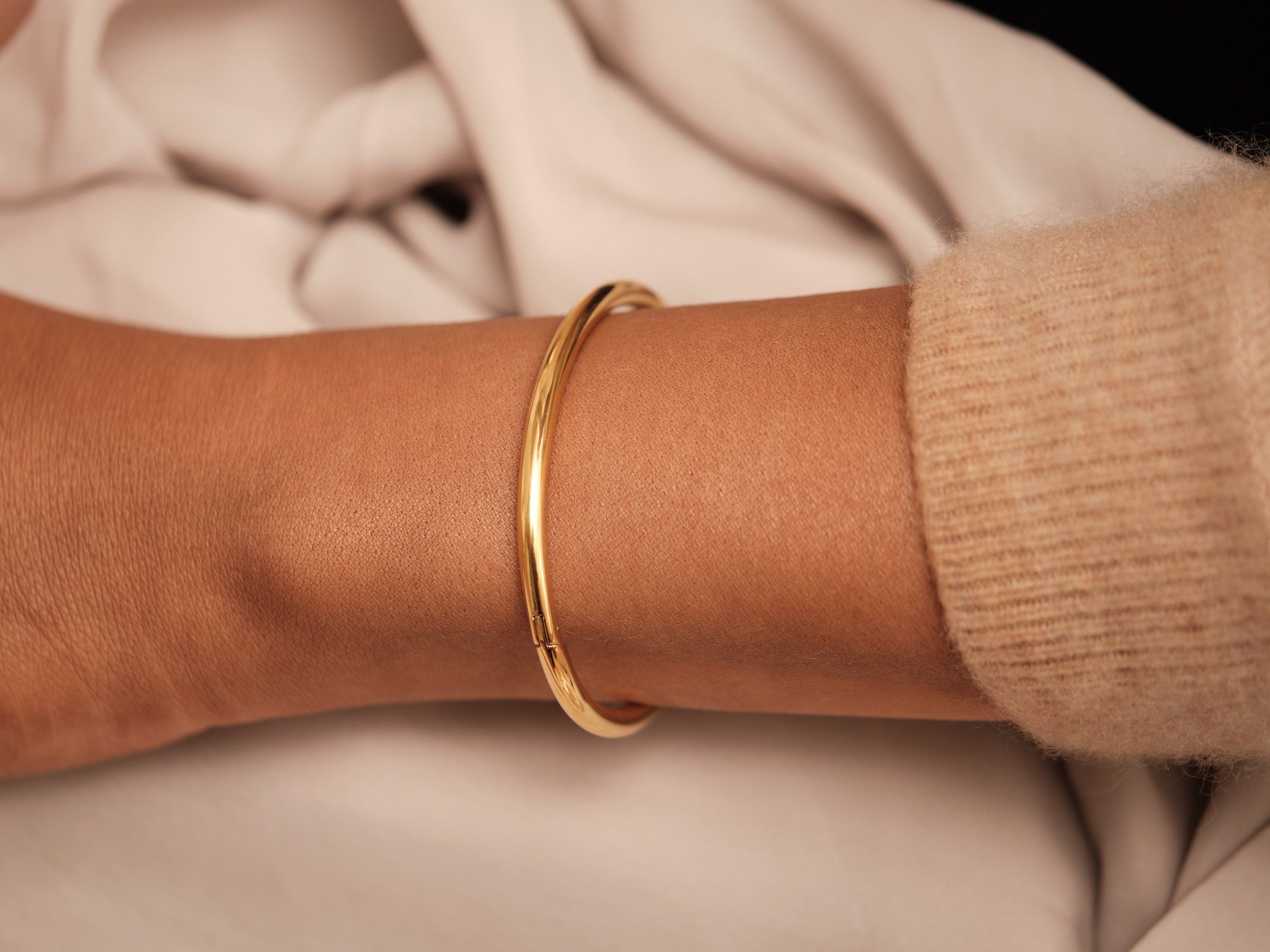
A bracelet that looks solid and heavy—yet inside, it’s thick silver.
“Be honest: are you buying gold jewelry because it’s beautiful, or because gold prices keep climbing?”
Behind that question is a market reality that’s been hard to ignore. Since 2025 began, gold has surged almost nonstop, pushing past US$4,500 per ounce (about RMB 31,600) before year-end—an all-time high, up more than 70% for the year. In China, retail jewelry gold followed, with quotes climbing to around RMB 1,400 per gram.
As of December 28, 2025, multiple major jewelry brands were already listing jewelry gold above RMB 1,400/g.
Some say this renewed love for gold jewelry is “in the blood.” Others argue there’s no awakening at all—gold just keeps edging closer to luxury pricing, while still feeling more value-preserving than typical luxury goods. So more people wear gold, and more people buy it.
From ancient times to today, gold has remained a universal hard currency. And now, wearing gold has become more than a habit—it’s undeniably a trend. You could also say gold isn’t just getting more expensive; it’s become a way for ordinary people to hold onto a last sliver of certainty.
When prices rise, confidence rises with them—until the price climbs too high. Every fashion wave, once it becomes too costly, eventually meets its “affordable alternative.” Right now, gold’s “top-tier dupe” has quietly taken over young shoppers’ carts: gold-filled silver.
01 A New Kind of “Heartbreaker Purchase”?
Xiaomeng first heard about gold-filled silver through a friend-group rant.
Back in April, a close friend broke up with her boyfriend. He asked for some expensive gifts back—one of them a bracelet that looked like nearly 10 grams of gold. She planned to return it outright, but he dismissed that: “What would I do with it?” He demanded cash instead, calculated at the current gold price.
A careful friend sensed something was off and urged her to verify the metal. Only then did they discover the truth: it was gold-filled silver, worth about one-tenth of what a same-weight gold bracelet would cost.
That’s when Xiaomeng realized how it works: the bracelet looks thick and substantial, but the core is silver.
Gold-plated jewelry typically uses a very thin surface layer of gold sprayed or coated onto another metal—cheap to make, but prone to fading or peeling. Gold-filled silver is different. It uses more gold, not paint. Makers rely on gold’s excellent ductility: they press a small amount of gold into a thin sheet, then wrap it over a silver base.
The result is powerful: with the cost of 1 gram of gold, you can get a bracelet that looks like 20 grams—especially in popular “eel-back” style designs that are meant to appear heavy and traditional.
In adult life, “social distance” is the best filter. As long as people don’t examine it up close, anyone’s life—and jewelry—can look as radiant as pure gold.
That’s why many gold-filled silver sellers focus on pieces that look “high weight”: thick bracelets, chunky rings, statement pendants. A former shop owner in Shandong told New Weekly that small items like lightweight rings often aren’t worth producing in gold-filled form—“the profit won’t even cover the labor.”
In fact, the technique isn’t new. Variations of gold-wrapping existed in ancient China as early as the Warring States period, and evolved over centuries. In modern manufacturing, as the outer gold layer becomes thicker and more refined, it can be nearly impossible to distinguish from solid gold at a glance.
Industry insiders used to be able to tell, because gold and silver have different densities—experienced hands could feel it. But now, gold-filled techniques have upgraded, and gold jewelry techniques have also advanced. With 3D hard-gold methods, even traditional heavy-looking styles can be made hollow.
As one seller put it bluntly: “At normal social distance? You absolutely can’t tell.”
02 “Real Substance” vs. “Saving Face”
“Honestly, I’m broke—but gold is just too beautiful.” That’s the simplest reason most people choose gold-filled silver.
Over the National Day holiday, Xiaomeng bought herself a gold-filled silver bracelet for RMB 1,500. Growing up, she envied kids who wore silver bracelets—many classmates had them, and the soft clinking sound felt like a symbol: the kind of thing you wore if your family truly doted on you.
After she started working, she originally wanted to get a silver bracelet for herself. But her skin tone is warm and slightly darker, and she felt silver made her look “tired” and “unlucky.” Later she learned the color logic: cool-toned metals often clash with yellow undertones, while warm gold complements them.
The problem was price. The classic adjustable traditional bracelet she’d dreamed of for years would cost tens of thousands of RMB in solid gold—enough to erase two months of wages.
So she made a promise to herself: buy the gold-filled version first, as a way to treat the teenage version of her that waited so long.
And she didn’t regret it. On exhausting workdays, or when family pressure hit hard, she would touch the bracelet and feel something steady: “Life still has something to look forward to. At least I’m still treating myself like I matter.” She laughed, calling it her own version of “self-care literature.”
For Xujun, gold-filled silver wasn’t about self-reward—it was about a wedding.
She and her husband planned to hold their banquet in March next year. Preparations started early, but one thing kept getting delayed: the traditional “three gold pieces” (typically gold jewelry given at marriage). Looking back, her biggest regret was not buying earlier when prices were lower. “We kept waiting for a dip,” she said. “But the longer we watched, the higher it went.”
With the wedding date fixed, waiting wasn’t an option anymore. In the end, she bought a gold-filled silver set as a substitute.
They’re both migrant workers from ordinary rural families—no financial backing, just mutual support. Together they scraped enough for a down payment on a small apartment in their hometown city.
They first visited well-known gold brand stores in malls, only to learn they’d have to pay RMB 40–80 per gram in additional workmanship fees on top of gold prices.
They tried local gold markets too. Even when the benchmark price once dipped to around RMB 960, jewelry prices stayed stubbornly high. A decent “three gold” set could easily cost tens of thousands, far beyond their original budget.
Her husband nearly decided to push through anyway, telling her: gold keeps rising—consider it an investment. But Xujun stopped him. Their apartment had already fallen about 30% from its purchase price, and after watching gold prices swing downward after October, she didn’t have the nerve to “speculate” with a wedding set.
Still, her husband insisted they should have respectable jewelry at the banquet—so she and her parents wouldn’t lose face among relatives.
That’s when the shop owner offered what he called a “practical workaround”: many cash-strapped young couples choose gold-filled silver for their “three gold,” and some shops even claim they can repurchase it later based on the day’s gold and silver prices.
After weighing everything, the couple spent RMB 5,000 on a gold-filled silver “three gold” set. Her husband even transferred the rest of the original jewelry budget to her as personal savings, promising that one day he’d buy her a real gold bracelet.
Xujun nervously posted online: “Is it embarrassing to replace wedding gold with gold-filled silver?” She expected criticism. Instead, once people learned their story—and saw her husband’s attitude—comments flooded in with blessings.
One reply stayed with her: “There are a thousand ways to live online. Don’t live for other people’s opinions. If you both understand what’s substance and what’s just saving face, and you’re truly building together without calculating against each other, your life will only get better.”
03 Trying to Save Money—Then Getting “Gold-Stolen”
But there’s a harsh twist: people buying gold-filled silver to be careful with money are also the most likely to run into “gold-stealing” traps.
That same former shop owner told New Weekly that in the market, “about 95% of gold-filled silver sellers shave the gold content.” The reason is simple: pricing and margins are transparent. Most shops are basically earning labor fees—and some choose to cheat to boost profit.
Unlike major gold brands, the gold-filled silver market has no dominant giant. Many sellers are small workshops or local goldsmiths branching into a fast-growing category. The result is a messy landscape where quality varies widely.
In his own business, about 60% of orders came from customers buying in-store, and 40% were custom work where customers brought their own gold and silver. Many choose custom work specifically because they want to “watch the process” and avoid being shorted.
But even then, customers often learn too late that building the silver base and wrapping it takes two to three days. That time gap creates room for substitution and skimming. In his words: “It’s all down to the seller’s conscience.”
Online, some buyers reported the same pattern: sellers promised exchanges or buybacks, but when customers returned later, the shop had already shut down. Others took pieces to be tested elsewhere and found the gold content didn’t match what was advertised.
The shop owner explained why this happens so often. First, because profits are thin, many shops can’t survive long and close within a year or two. Second, the nature of gold-filled silver makes it hard to verify like pure gold or pure silver—customers can’t simply re-weigh the piece and confirm.
So the worst discoveries often happen only when it’s time to trade in or exchange—when buyers finally realize their piece was “gold-stolen.”
Xujun worried about this at first. For a while, her social feed was full of “tips” for spotting whether a piece had been shorted. Some people warned that gold-filled silver turns reddish after long storage, so she opened her jewelry box every day to check.
Then, after a month of obsessing, she suddenly felt… calm.
“Whether I lost a little or a lot, whether I bought more or less—this was a purchase,” she said. “Saving face is something you do once. After that, you move forward with your life.”