Tesla’s Robotaxi has been on public roads for less than a year, and the safety driver is already gone—true to “Musk speed.”
Elon Musk personally announced this milestone: Tesla Robotaxi has officially begun fully driverless service, with no safety supervisor inside the vehicle.
The news was met with widespread excitement. Tesla’s stock jumped immediately, rising more than 4% on the day, and some users in Austin wasted no time hailing a ride to experience it for themselves.
But as ride videos began circulating online, doubts quickly surfaced.
Is this really fully driverless—or does it look more like a sleight of hand?
Tesla officially removes the safety driver
Musk took to X to share the update, writing that Tesla Robotaxi had just launched fully driverless service in Austin, with no safety monitor inside the vehicle, and congratulating the Tesla AI team on the achievement.
Riding the momentum, and amid an aggressive push to recruit top AI talent, Musk also turned the announcement into a recruitment pitch, inviting engineers interested in “solving real-world AI problems” to join Tesla.
For anyone following autonomous driving closely, removing the safety driver in public Robotaxi operations is a major milestone. What stands out with Tesla, however, is the pace.
Tesla first launched its Robotaxi service in Austin in June last year, initially limited to a small group of riders. It then gradually expanded to the public and extended operations into the San Francisco Bay Area. By December, Tesla began testing rides without safety drivers—and now, just eight months after the initial launch, fully driverless service is officially live.
Even more notably, Tesla is currently the only company offering publicly accessible driverless service using cameras alone, without lidar or radar.
That said, not all Tesla Robotaxis are driverless yet.
According to Tesla’s head of AI, Ashok Elluswamy, only a small number of driverless vehicles are currently deployed in Austin, operating alongside Robotaxis that still have safety drivers. The proportion of fully driverless vehicles will increase gradually over time.
Most Tesla Robotaxis are still operating in the Bay Area with in-car supervision. Even so, for those tracking Tesla’s progress in autonomy, this limited rollout is already a significant step forward.
Investors certainly agreed. On the day of the announcement, Tesla shares rose 4.15%, adding roughly USD 59.6 billion to its market capitalization—about RMB 415 billion.
Naturally, Austin-based users rushed out to try the service for themselves.
Fully driverless—or just an illusion?
The first publicly known rider to complete a paid Tesla Robotaxi trip with no in-car supervision appears to be a former Tesla AI engineer.
He shared multiple videos on social media, barely able to hide his excitement.
In fact, Musk announced the removal of safety drivers directly in the comments under his video.
The rider tested both the front passenger seat and the rear seat and even attempted to take control of the steering wheel—one of the most common questions surrounding driverless rides.
The result: the steering wheel was locked, could not be turned freely, and a warning appeared on the screen.
Another notable detail is that Tesla’s fully driverless Robotaxi service is paid from day one. By contrast, competitors like Waymo and Zoox did not initially charge passengers during early deployments.
One user’s experience generated even more discussion when the app appeared to summon a Cybercab.
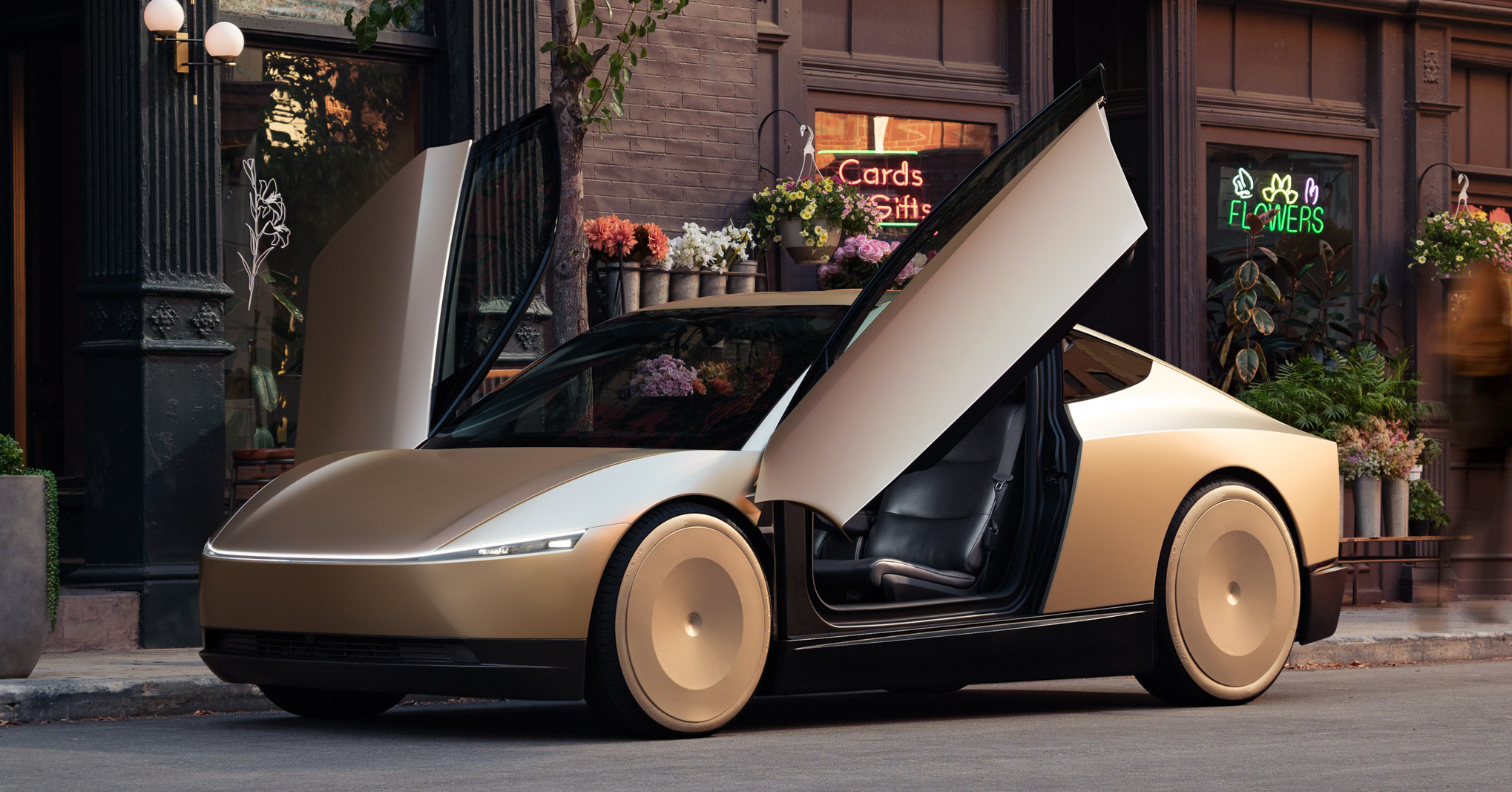
The Cybercab represents Tesla’s ultimate Robotaxi vision—no steering wheel, no pedals, no mirrors—and is still several months away from mass production. Road test sightings have been rare, and no passenger rides had been publicly documented.
Expectations soared—until the vehicle arrived.
Instead of a Cybercab, a black Model Y showed up, complete with a safety driver and mismatched license plate numbers. A classic bait-and-switch moment.
Still, some took this as a hint that Cybercab trial operations may already be in the works.
Other riders did manage to hail Robotaxis with no one inside the cabin at all.
However, sharp-eyed viewers noticed something else. In videos showing two red driverless Robotaxis, each vehicle was closely followed by a black Tesla with occupants inside.
One rider confirmed that a trailing vehicle followed throughout the trip, likely collecting data and ensuring safety.
This sparked skepticism. Critics argued that Tesla hadn’t truly achieved fully driverless operation, but had simply moved the safety driver from inside the Robotaxi to a separate “chase car.”
True driverless operation, they argue, should require no human oversight at all.
Even Electrek noted in its coverage that Tesla’s “removal of safety drivers” appeared, at least in part, to be a visual illusion.
That said, from a strictly technical standpoint, Tesla has indeed achieved a key milestone: there is no safety driver inside the Robotaxi anymore.
Two hundred Tesla Robotaxis are already on the road
Although 2026 has only just begun, Tesla’s Robotaxi efforts are clearly accelerating—both in deployment and in cost structure.
On the scale front, Robotaxi Tracker recently confirmed that Tesla now has around 200 Robotaxis operating across the United States. Of these, 158 are deployed in the San Francisco Bay Area, with the remaining 42 in Austin.
Cost, however, may be the real game changer—and that’s where Cybercab comes in.
Musk has repeatedly emphasized that Cybercab will be extremely low-cost, both to build and to operate.
Cybercab will use Tesla’s “Unboxed” manufacturing process, reducing part counts and assembling vehicles in a Lego-like modular fashion. This approach lowers tooling and labor costs, with Musk estimating production costs below USD 30,000 per vehicle. Once production ramps up, output speed is expected to be exceptionally high.
Operating costs are where Cybercab could truly stand apart. Musk has suggested that on a per-mile basis, Cybercab could become one of the lowest-cost vehicles in operation anywhere.
Accounting for energy, maintenance, cleaning, depreciation, and insurance, Musk estimates operating costs could fall to around USD 0.20 per mile—roughly RMB 0.87 per kilometer.
For context, data from the American Automobile Association shows that the average cost of owning a new car in the U.S. is about USD 0.77 per mile.
Meanwhile, ride-hailing services like Uber and Lyft typically charge between USD 1 and USD 4 per mile. Estimates suggest Waymo’s costs currently range from USD 0.6 to USD 1 per mile, or even higher.
Independent assessments support Tesla’s claims. ARK Invest recently published a report projecting that by 2030, Cybercab’s total cost per mile could be about half that of Waymo’s sixth-generation Robotaxi, at approximately USD 0.40 per mile.
Lower costs make large-scale deployment far easier—and leave more room to pass savings on to passengers.
Some users are already feeling that impact.
One rider took a Tesla Robotaxi to school for a 1.36-mile trip and paid just USD 2.71—cheaper than the breakfast taco he was carrying.
Two more developments worth noting
On the same day Tesla announced the removal of safety drivers, two other major developments emerged.
First, Google-owned Waymo—Tesla’s largest L4 competitor in the U.S.—announced the official launch of its Robotaxi service in Miami. This marks Waymo’s first new market entry this year, with initial coverage planned for 60 square miles.
Including Austin, Atlanta, Los Angeles, Phoenix, and the San Francisco Bay Area, Waymo is now operating in six major U.S. cities.
The second update came directly from Tesla. Speaking at the World Economic Forum in Davos, Musk revealed that supervised FSD could receive regulatory approval in China as early as next month, paving the way for a full market rollout.
True to form, Musk also fielded a familiar question at the forum: “Are there aliens among us?”
His answer was characteristically unconventional.
“I am an alien.”
No wonder Mars remains firmly in his sights.