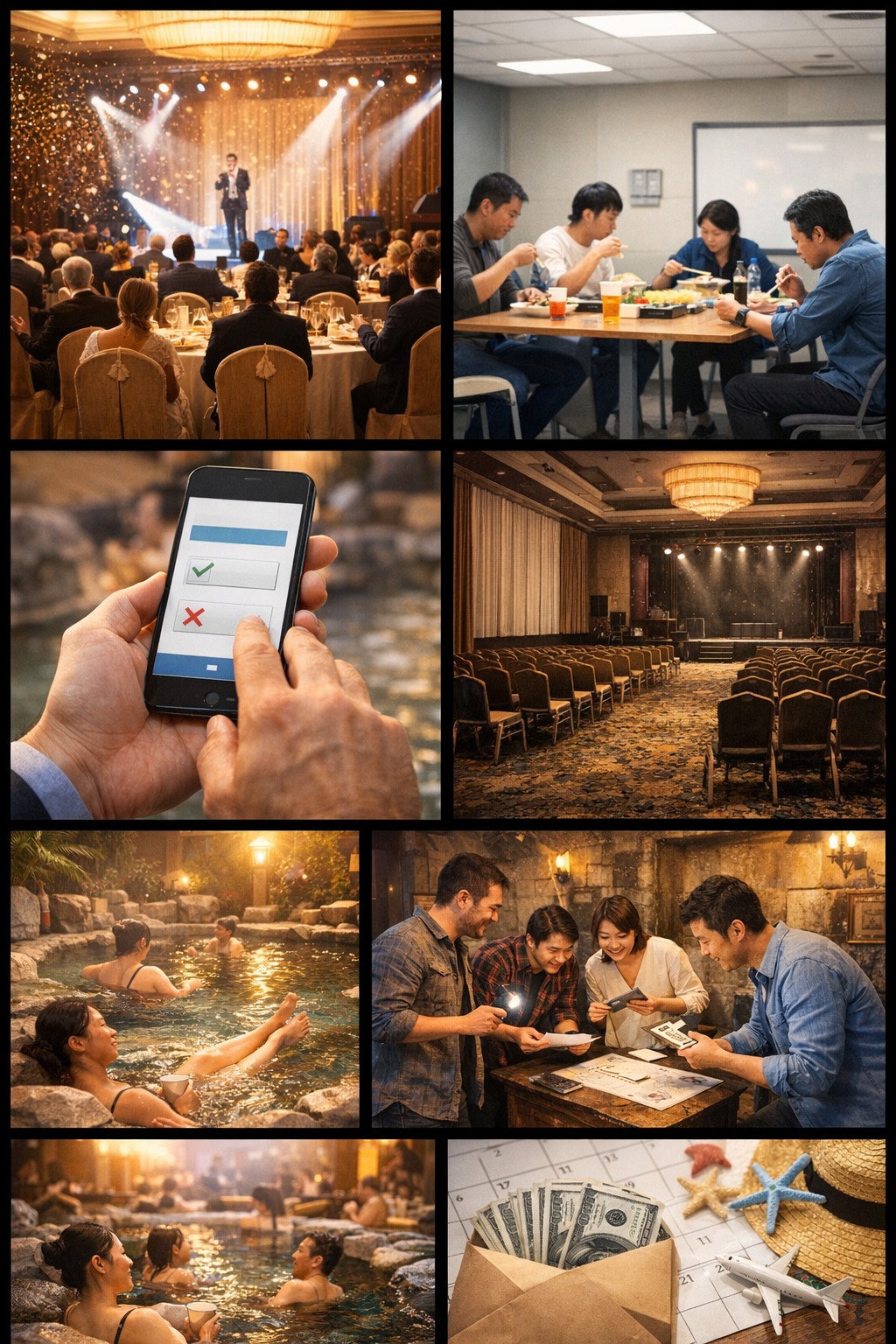
“This year, the number of corporate annual meetings booked at our hotel has been nothing short of disastrous.”
A, who works in sales for a high-end hotel in a northern Chinese city, couldn’t help venting to Jinglv Jun over the past few days. In previous years, this time of year meant the entire team was overwhelmed with corporate annual meeting orders. This year, the scene has flipped completely.
Not only has the number of annual meeting bookings plunged, prices have also continued to slide.
In the past, the banquet standard for a corporate annual meeting was at least RMB 1,500 per table. This year, even RMB 1,000 per table feels like a stretch.
In more extreme cases, some small companies simply bring a dozen or so employees to the hotel for a meal and call it their “annual meeting.” There is no work summary, no awards, no lucky draw. Everyone eats quietly, gets up, and leaves. There’s no sense of celebration at all.
On social media, posts asking “Have annual meetings disappeared this year?” are everywhere. People are privately asking around, trying to find out whether other companies are still holding theirs.
In a poll titled “Does your company still have an annual meeting this year?”, more than 5,000 people participated, and 75% chose “No annual meeting.”
Even more respondents commented under various posts, saying their company’s annual meeting had been canceled—or hadn’t been held for several years already.
A tongue-in-cheek joke about the evolution of corporate annual meetings has also been circulating online: high-end hotels → company meeting rooms → online Tencent meetings → outright cancellation.
Data from research institutions quietly confirms this trend.
According to the China Tourism Hotel Association’s Q3 2025 industry sentiment survey, affected by policy and the broader market environment, demand for corporate meetings and events is declining, with especially clear downward expectations for catering performance.
Other statistics show that the proportion of companies hosting large-scale annual meetings dropped sharply from 78% in 2019 to 42% in 2023, fell further to 31% in 2024, and by the end of 2025, fewer than 20% of companies are expected to retain the traditional large-format annual meeting.
This means that by 2026, nearly 80% of corporate hotel-based annual meetings may have quietly disappeared.
From 2010 to 2019, corporate annual meetings enjoyed a true golden decade.
Starting in 2010, when Jinglv Jun first entered the workforce, the company he joined not only held an annual meeting every year, but upgraded its scale year after year. At its peak, the company booked an entire luxury resort on the outskirts of Beijing and brought hundreds of employees there for three full days of food, fun, and festivities. The lucky draw was electrifying. I won my first-ever “luxury prize” in life—a Sony DSLR camera. When the winners were announced, I was half-drunk and jolted awake by my colleagues’ cheers. I hugged that prize and didn’t sleep a wink all night. It remains one of my most unforgettable workplace memories.
Around 2015, the internet startup boom pushed corporate annual meetings into a new level of competition. Jinglv Jun once attended an annual meeting hosted by a major internet startup at a top-tier resort. Upon entering the venue, I was stunned by a wall-like stack of brand-new iPhones and iPads—these were merely entry-level prizes. The grand prizes included “seven-day European trips for two” and “custom zodiac gold bars.” The extravagance was jaw-dropping.
Around 2018, “destination-style annual meetings” took off. Small and medium-sized companies chose nearby vacation spots, combining group travel with an annual meeting. Large companies brought massive teams to seaside cities like Sanya, booking luxury resorts and mixing meetings with holidays. Industry leaders even took employees overseas—budget-conscious trips went to Thailand or Singapore, higher budgets went to Japan or Korea, and companies with deep pockets headed straight to Europe or the US. At the time, Jinglv Jun’s social feed was flooded with check-in photos from employees traveling across China and around the world. How far the trip was, how expensive the hotel was, and how well-designed the itinerary felt like an unspoken measure of a company’s overall strength.
Soaring demand allowed hotels to make a fortune. Popular hotels needed to be booked six months in advance, and some could achieve a large portion of their annual KPIs solely through annual meeting orders—earning money with ease.
“That was a golden decade we will always miss,” many hotel professionals say with emotion.
After 2020, the boom in hotel-based corporate annual meetings quickly faded.
Even in 2023, which was touted as the peak of “revenge travel spending,” the number of annual meeting orders hotels received was still far below pre-pandemic levels.
Over the past two years, annual meetings have not rebounded—instead, they’ve grown even more subdued.
Why?
“The volatile domestic and global economic environment is the fundamental backdrop,” one hotel industry insider explained to Jinglv Jun. The real pressures facing large, medium, and small companies have forced widespread cuts to annual meeting budgets.
For state-owned enterprises and centrally administered companies, increasingly strict requirements around “compliance and transparency” have created a high review threshold. Under this framework, lavish annual meetings naturally become a target. Some companies have even eliminated lucky draws entirely, as prize procurement sits in a gray area. As regulations have become more detailed and tightly enforced, budgets have been cut, dining and accommodation standards lowered, and reimbursement processes strictly controlled. After navigating all this, many feel that holding an annual meeting is not only troublesome but also risky—so canceling it feels safer.
As a result, some annual meetings have turned into simple year-end reporting sessions. What used to be a celebratory banquet is now just a few extra dishes in the staff cafeteria—quick and perfunctory.
Private companies face a different but equally harsh reality.
Sluggish revenues across companies of all sizes have forced business owners into survival mode. “Cost reduction and efficiency improvement” often starts with travel and meeting expenses. Over the past year, many major internet companies have cut travel budgets and reduced meeting activities. Annual meetings, unsurprisingly, did not escape the knife.
For small and medium-sized companies, saving wherever possible is the norm. One business owner who canceled his company’s annual meeting sighed to Jinglv Jun that with over a hundred employees, hosting a respectable annual meeting could easily cost hundreds of thousands—or even over a million—yuan. When business was good, the expense was acceptable. Now, with performance under pressure, the original annual meeting budget is split: most goes into maintaining cash flow, and a smaller portion is distributed directly to employees as year-end benefits, effectively replacing the annual meeting.
There is also a more subtle reason that has complicated bosses’ attitudes toward annual meetings.
In the eyes of many employers, post-95s and post-00s employees no longer see annual meetings as an emotional bond between company and staff. Instead, they view them as a form of emotional burden or empty formalism.
Especially after the popularity of the film “Annual Meeting Can’t Stop,” more young employees openly oppose company annual meetings. They argue that these outdated rituals only make an already exhausting day worse—forcing them to perform, flatter bosses, and socialize with colleagues they barely know. To them, it feels less like celebration and more like psychological torture.
Bosses worry about spending money without appreciation. Employees worry about pointless hassle. The decline of the annual meeting is the result of a two-way choice.
So, do corporate annual meetings really no longer serve a purpose?
Not necessarily.
Jinglv Jun has observed that while traditional annual meetings are fading, new formats are quietly emerging.
Recently, many people on social media have shared that their companies moved annual meetings to hot spring and bathhouse complexes. The reasoning is simple: lower costs and less formalism. In this setting, everyone sheds their “work identities.” There are no titles, no performances, no forced activities—just bathing, relaxing, eating, and unwinding at year-end. This kind of low-pressure annual gathering resonates far more with younger employees.
Some companies have also “broken up” the annual meeting, replacing one large event with smaller team-based gatherings. A told Jinglv Jun that demand for small-scale team events has surged this year. Departments host their own “mini annual meetings”—sometimes just booking a few tables at a hotel, enjoying food and drinks in a relaxed setting, and even handing out bonuses at the department level. More creative teams opt for escape rooms, private party venues, or similar experiences. The core principle is simple: give departments their share of the budget and let them decide—as long as employees are happy.
Others take an even more direct approach, converting the “annual meeting” entirely into tangible benefits—cash bonuses, paid leave, additional rest days, or flexible schedules—distributed in the name of the annual meeting. This approach is especially popular among post-00s employees.
From this perspective, annual meetings haven’t truly disappeared. They’ve simply shifted from hotel-based formalism to a more practical, people-centered approach.
After all, the original purpose of an annual meeting was never about “where it’s held” or “how luxurious it looks,” but about making employees feel valued at year-end and giving leaders a sense of organizational cohesion.
If that’s the goal, then the format should serve the purpose—whatever works best.
This transformation also presents both opportunities and challenges for the hotel industry.
Whether hotels can break free from traditional path dependence and develop new offerings that better match today’s corporate needs has become a critical question. Those who adapt first will be the ones to seize the next wave of opportunity.