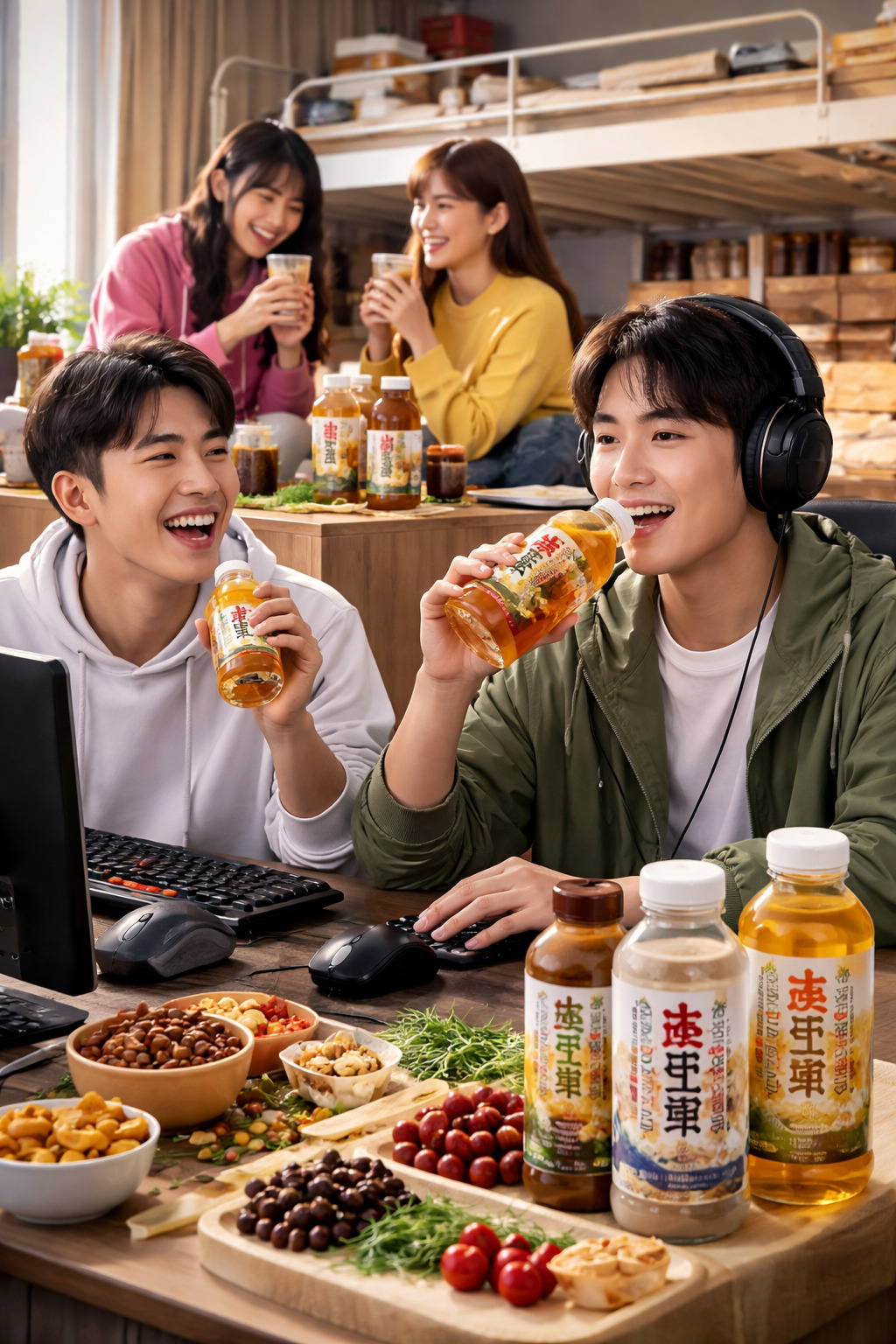
That mysterious wave of “unorthodox wellness” has struck again—and this time, it has its sights firmly set on classic middle-aged tonics.
After tonic liquor had its moment, Liuwei Dihuang Pills—long regarded as a traditional remedy for middle-aged consumers—have been unexpectedly propelled into the youth trend cycle. First rebranded as the tongue-in-cheek “Breakthrough Pill” in college esports circles, the formula has since evolved into a bottled drink: Liuwei Dihuang Tea. Upon launch, it quickly ignited the market, with projected sales expected to surpass RMB 100 million within just five months.
Are young people redefining what wellness drinks mean?
A New Wave of Gen Z Wellness: From Ancient Remedy to Social “Power-Up”
Recently, the phrase “Breakthrough Pill” has gone viral across social platforms. In college dorms and gaming communities, a new piece of slang has taken hold:
“Before ranking up, take the Breakthrough Pill first.”
“Pop the esports elixir—aim accuracy up 20%, item control up 20%.”
The so-called “elixir” behind the hype is none other than Liuwei Dihuang Pills, a thousand-year-old traditional formula. Once a symbol of middle-aged health management, it has now entered Gen Z’s daily life in a completely unexpected form.
Forward-thinking brands were quick to spot the shift.
In August 2025, San Nuo Therapeutic Foods launched Liuwei Dihuang Tea, priced at RMB 6 per bottle. It rapidly became a standout in the “medicine-food homology” beverage category. According to industry sources, the product drew strong distributor interest immediately after launch and prompted dozens of beverage companies to follow suit.
Some forecasts suggest the product could generate over RMB 100 million in sales within five months, with a three-year target of RMB 500 million. Soon after, spin-off products such as Liuwei Dihuang Sesame Paste also hit the market. Phrases like “If you stay up late, drink Liuwei Dihuang sesame paste” began flooding social platforms, turning it into a viral “late-night survival drink” on Xiaohongshu.
The popularity of the Liuwei Dihuang product line reflects a clear consumer trend: young people’s wellness priorities are shifting from vague notions of “health” toward tangible, functional outcomes—unlocking new market space and business models in the process.
Today’s youth are redefining wellness on their own terms. Tradition collides with trend, ancient remedies become social currency, and functional beverages step into the spotlight of modern consumption.
Why Young Consumers Keep Reaching for “Middle-Aged Tonics”: Three Key Trends
- Emotional Resonance Meets Functional Demand—Wellness Becomes a New Social Language
For young consumers, purchasing is no longer just about utility; it’s a way to express identity and connect with like-minded peers. Wellness is no exception.
Sharing a bottle of Liuwei Dihuang Tea during a gaming session signals, “I appreciate traditional wisdom, but I know how to have fun with it.” Recommending drinks like “White Prince Soup” among friends becomes a subtle expression of care. Slang like “Breakthrough Pill” strengthens in-group identity and a sense of belonging.
In high-pressure daily life, young people turn Liuwei Dihuang into a form of self-mocking humor—openly acknowledging their exhaustion in a playful way that feels honest and relatable.
From “period miracle water” to Liuwei Dihuang Tea, these products are no longer just beverages. They function as social media—carriers of humor, empathy, and subcultural meaning.
- The Rise of the “Expert Consumer” in an Age of Information Equality
Gen Z grew up with the internet. They are skilled at searching, comparing, and researching. They are skeptical of traditional advertising but trust academic papers, in-depth reviews, and credible influencer analysis. This has given rise to a new generation of “expert consumers.”
For them, ingredient transparency is non-negotiable. They read labels, understand what compounds like curcumin or prepared rehmannia do, and expect clarity.
The success of Liuwei Dihuang Tea is, in many ways, an expression of “scientific wellness.” Compared with improvised or extreme health hacks, its formula is transparent—containing well-known ingredients such as prepared rehmannia, cornus fruit, and yam—and backed by a thousand-year medical tradition. That combination of historical credibility and modern pharmacological research fits perfectly with the rational mindset of ingredient-focused consumers.
At the same time, authentic user sharing matters. Large volumes of UGC are critical trust signals and play a decisive role in purchasing decisions.
With roots in the ancient medical text Xiao’er Yaozheng Zhijue and support from modern research, Liuwei Dihuang Pills offer what young consumers see as “dual insurance”—both ancient authority and contemporary validation.
- Wellness Needs Become More Precise, Products Integrate Faster into Daily Scenarios
The evolution of health beverages has moved beyond simply reducing sugar or fat. The next phase is additive and targeted: superplants, niche ingredients, and clearly defined functional benefits.
The rise of products like Liuwei Dihuang Tea signals that wellness consumption will become increasingly segmented—much like skincare—and deeply embedded into specific life scenarios.
Positioning is becoming sharper. It’s no longer “boost fiber intake,” but “relieve constipation caused by prolonged sitting.” Not just “support immunity,” but “immune support after late nights.” Fatigue relief becomes “reducing eye and mental strain after extended screen time.” Nutrition is reframed as “liver support during social drinking.”
Whether bottled or freshly made, beverages now need to play a specific role in a user’s daily script—appearing at the right moment, in the right context.
The Rise of Liuwei Dihuang Tea and the Rapid Growth of Functional Beverages
From tonic liquor attracting four million new female consumers to the explosive rise of Liuwei Dihuang Tea, this is not just the story of a viral product. It reflects the broader acceleration of functional beverages.
Across the youth consumption landscape, similar narratives are unfolding simultaneously.
In 2025, Douyin’s top-selling coffee was infused with white kidney bean and mulberry leaf extracts, appealing to highly disciplined consumers and generating RMB 60 million in monthly sales.
In Japan, protein water has become a daily essential for office workers, marketed around beauty and protein supplementation. In the US, “mushroom coffee” developed by Harvard graduates—featuring six organic mushrooms—has achieved USD 300 million in annual sales.
Domestically, Hema’s turmeric shots became surprise bestsellers, nicknamed “Western herbal medicine” and praised for menstrual relief. Imported drinks like “White Prince Soup,” made with spirulina and fruit, were also turned into blockbuster products, becoming a symbolic “wish drink” for young women.
Just last week, Nanjing lemon tea brand Yes Lemon launched a freshly made version of White Prince Soup. Using jasmine tea as a base, infused with Guangdong perfumed lemon and spirulina that turns the drink a mysterious blue, it sparked enthusiastic reactions online—described as “sweet and sour straight to the soul.”
All of these examples point to the same shift: young consumers’ health needs are becoming outcome-driven and scenario-specific. Tonic liquor thrives by addressing warmth during menstrual cycles, while Liuwei Dihuang Tea offers instant support for late nights, workouts, and outdoor activities.
Wellness for young people is no longer an abstract idea of “conditioning the body.” It is a highly contextual, problem-solving, on-demand solution.
For freshly made tea brands—and consumer brands more broadly—the key takeaway is clear: authenticity and transparency matter more than marketing theatrics. Functional claims must be evidence-based, and ingredient information must be clear and credible.
In this new arena, trust is the foundation of consumption. Once broken, it is extraordinarily difficult to rebuild.