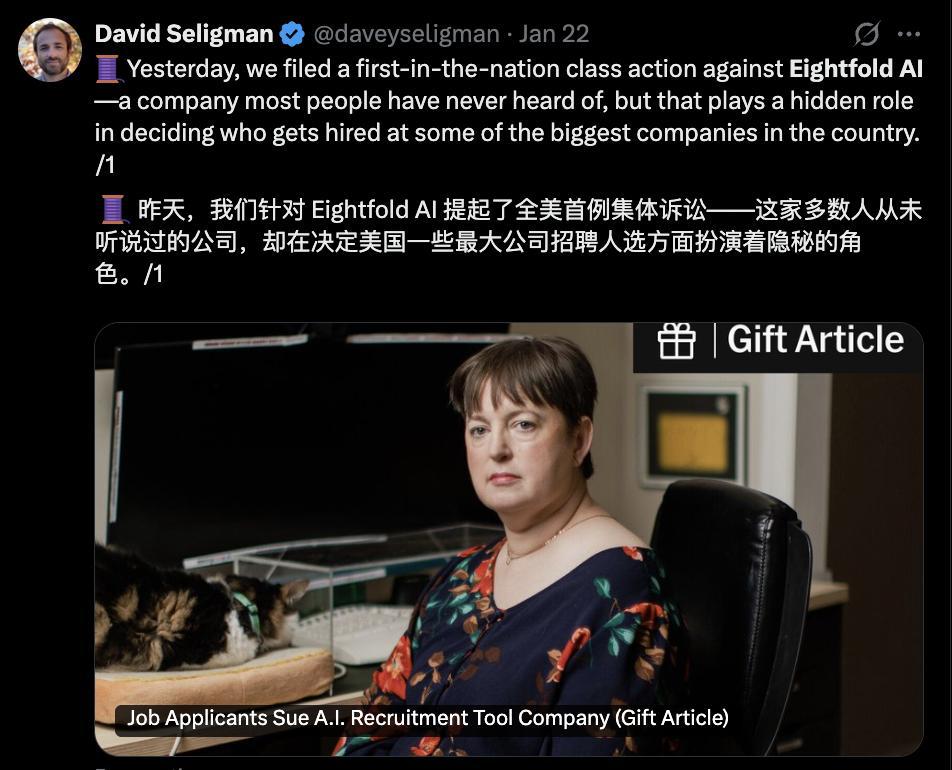
AI hiring tools—once treated as a standard efficiency upgrade in Silicon Valley—are increasingly triggering backlash.
Eightfold AI, a recruiting platform reportedly used by major companies such as Microsoft, Bayer, and PayPal, has been sued by two job applicants. The plaintiffs allege the system’s algorithms produced discriminatory outcomes in real-world hiring. Beyond financial damages, they are asking the court to step in and address “black-box” decision-making by pushing for greater transparency and accountability in automated screening.
As the lawsuit fuels public debate, a separate—and even more unsettling—research topic has resurfaced: AI models that can infer personality traits from a single face photo, then statistically link those traits to career outcomes. It sounds like “digital fortune-telling,” but the study was conducted by researchers affiliated with top U.S. universities and is based on a large dataset and structured methodology.
The team compiled data on nearly 100,000 MBA graduates from the top 110 U.S. business schools, including education, full career trajectories, LinkedIn profile photos, and images from school albums. They first trained a model on 12,000+ individuals who provided selfies and personality surveys, enabling the AI to convert facial features into numerical signals and predict the “Big Five” traits: extraversion, conscientiousness, openness, agreeableness, and neuroticism. Those AI-predicted traits were then compared with real-world outcomes such as school ranking, starting salary, salary growth, management entry, and job stability.
The findings suggested measurable correlations. For example:
- In salary patterns, higher conscientiousness and extraversion were associated with higher starting pay for men, and conscientiousness linked to faster growth; for women, extraversion also correlated positively, while conscientiousness showed a more complex or even negative relationship with growth.
- In job mobility, higher agreeableness and conscientiousness aligned with greater stability; higher extraversion and neuroticism aligned with more frequent job changes—though neurotic individuals tended to switch within narrower industry ranges, while conscientious individuals were more likely to move across industries successfully.
The controversy isn’t just whether the model is “accurate.” The deeper issue is bias and fairness. If training data encodes historical inequality, the model can reproduce—and amplify—it. Worse, algorithmic screening is opaque: candidates often don’t know why they were rejected, when they were filtered out, or how to challenge the system’s decision.
That’s why the Eightfold AI case resonates: it’s not only about efficiency, but also about transparency, explainability, and accountability.
Similar concerns are appearing in education, where some universities have begun using AI to review applications—saving thousands of staff hours and speeding up decisions. Critics warn that over-reliance on models can reward “algorithm-friendly” formats and embed hidden preferences, turning high-stakes evaluation into a fragile black box.
AI can improve workflows, but when decisions shape life opportunities, handing judgment to an opaque system comes with real risks.