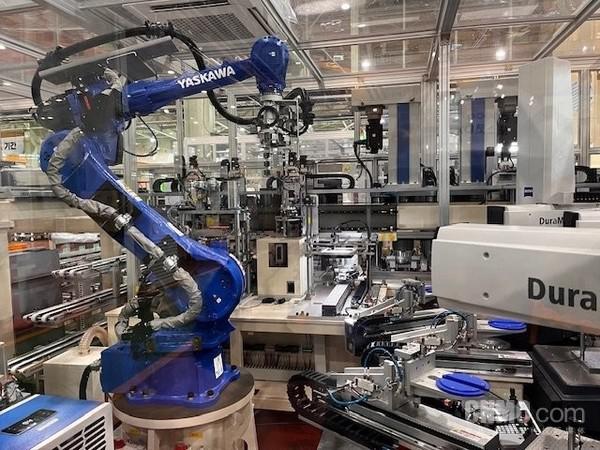
On January 25, a report released by the Korea International Trade Association’s Institute for International Trade stated that South Korea ranks fourth globally in the number of industrial robot installations, while recording the world’s highest robot density—highlighting its strong adoption of automation in manufacturing.
The report also noted that South Korea’s robot market is heavily domestic-oriented: about 71.2% of total shipments are sold at home, with exports making up a relatively small share. In contrast, Japan—ranked second globally in installations—exports more than 70% of its robot shipments. The report argued that the key reason behind this gap lies in structural differences in the two countries’ supply chains.
South Korea remains highly dependent on overseas suppliers for upstream materials and critical components. About 88.8% of permanent magnets essential for robot drives are imported from China, and major parts such as precision reducers and controllers also rely heavily on China and Japan. With domestic self-sufficiency for core materials and components hovering around 40%, expanding production can actually increase import dependence.
Japan, by comparison, cushions upstream risk through technologies that recover rare elements from scrapped motors, as well as advanced capabilities in specialty steel and precision magnets. In the midstream component layer, Japan has built a more stable, vertically integrated supply chain supported by globally competitive players in areas such as reducers and motors.
A senior researcher at KITA concluded that while South Korea is strong in robot deployment and application, excessive reliance on foreign suppliers for key materials and components is a structural constraint. The country needs to shift from an “application-and-manufacturing-driven” strategy toward supply-chain stabilization to strengthen long-term competitiveness in robotics.