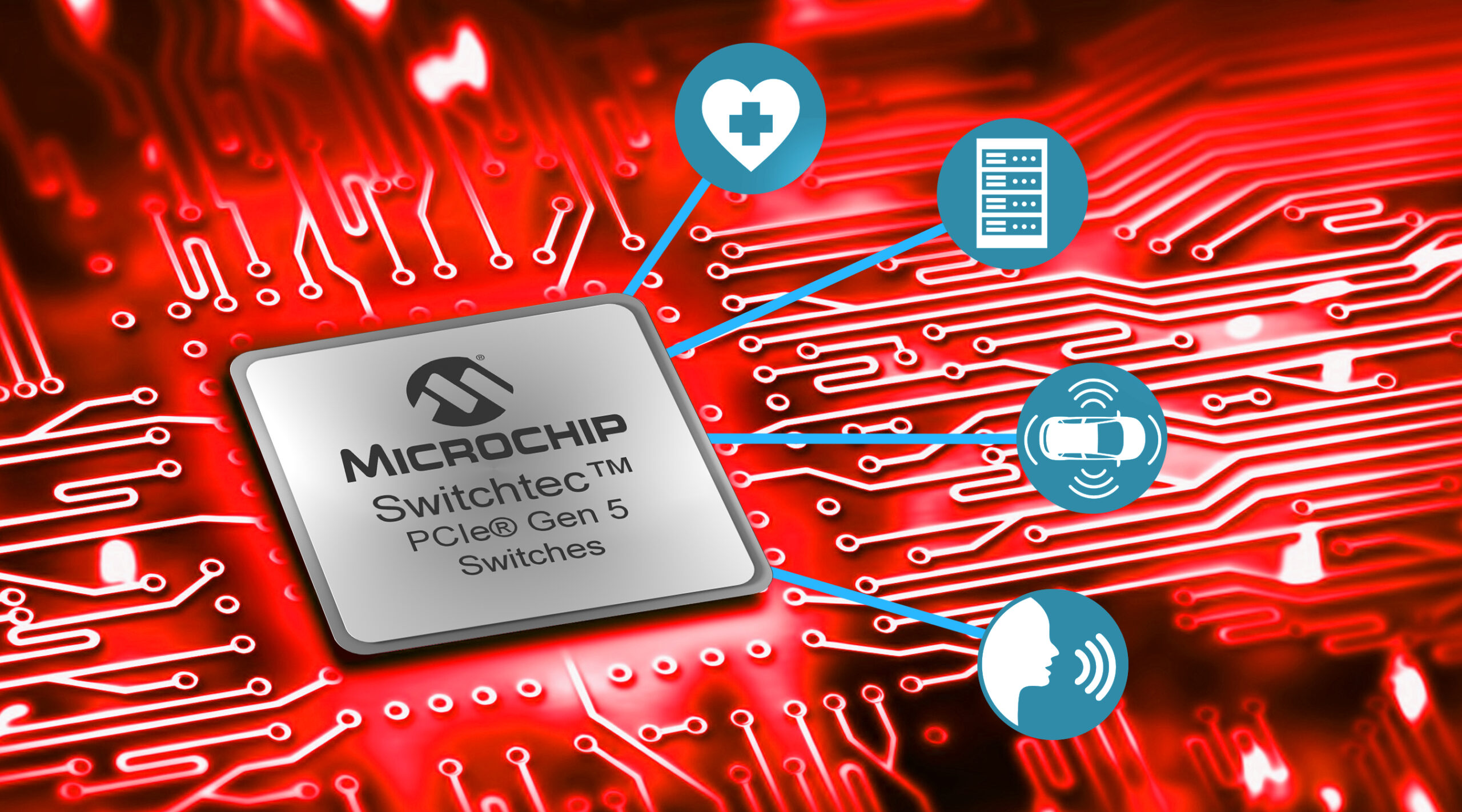
Fast Technology reported on January 31 that InnoSilicon has officially launched the world’s first 120-lane PCIe Gen5 switch chip (codename: GX9104/GX9120). The release represents end-to-end independent innovation—from foundational IP to full architecture design—marking a major breakthrough against long-standing overseas dominance in this critical technology.
The debut of this product signals a pivotal step forward: high-end, domestically developed PCIe switch chips are moving from R&D into real-world market deployment. It also helps close a key gap in the high-performance interconnect chip segment, with performance indicators reaching advanced industry benchmarks.
As the “neural hub” of AI infrastructure, PCIe Gen5 switch chips enable ultra-high-speed data transfer and switching between devices such as CPUs, GPUs, NICs, and SSDs—playing a central role in easing bottlenecks often described as the “memory wall” and “interconnect wall.”
InnoSilicon’s new chip is built on fully self-developed underlying IP and an innovative architecture designed to address industry pain points head-on. The design benchmarks itself against leading global players, adopting a full crossbar, non-blocking switching architecture. It integrates 120 lanes and 30 flexibly configurable ports, delivering a per-lane speed of up to 32 GT/s.
It also supports multi-host, end-to-end, and non-transparent bridging (NTB) modes, enabling seamless deployment across a wide range of scenarios—including data centers, ultra-low-latency AI servers, high-performance computing platforms, and enterprise storage systems.
Backed by the company’s deep IP expertise, the chip’s SerDes integrates multi-stage FFE, one-click adaptive CTLE, and 14-tap DFE signal processing. It is designed to maintain stable, reliable transmission under up to 36 dB of insertion loss, and supports operation across a broad temperature range from -40°C to 105°C.
Key highlights
- 120 lanes to enable efficient 16-GPU interconnects, supporting stronger scale-up and scale-out designs
- Ultra-low 115 ns latency, helping fully unlock GPU compute and meet real-time large-model processing needs
- High-throughput performance, with intelligent switching and scheduling algorithms that improve bandwidth utilization
- End-to-end redundancy and error-correction mechanisms to strengthen system reliability
- Hot-plug support via NTB, enabling plug-and-play flexibility for faster configuration and maintenance
- Low power consumption to support greener, more energy-efficient compute infrastructure
- Three-layer security stack combining a security engine, physically unclonable keys (PUK/PUF-style capability), and a software firewall for comprehensive protection
According to the report, InnoSilicon is among the first domestic vendors to achieve mass production of PCIe switch chips. Its PCIe Gen4/Gen3 product lines have already been deployed at scale across more than 40 leading partners—including ZTE, Hengwei Technology, and Leyan Technology—with broad shipment volumes across servers, communications platforms, network security, industrial control, edge computing, storage expansion, and embedded systems.