In the information-heavy year of 2025, we face countless web pages and data. Although traditional browsers have become more advanced, browsing still heavily relies on users’ own “searching, reading, filtering, and summarizing” processes. Many so-called “AI browsers” on the market mostly just integrate chatbots or plugins in a simple way. Very few truly redefine the browsing experience from the ground up.
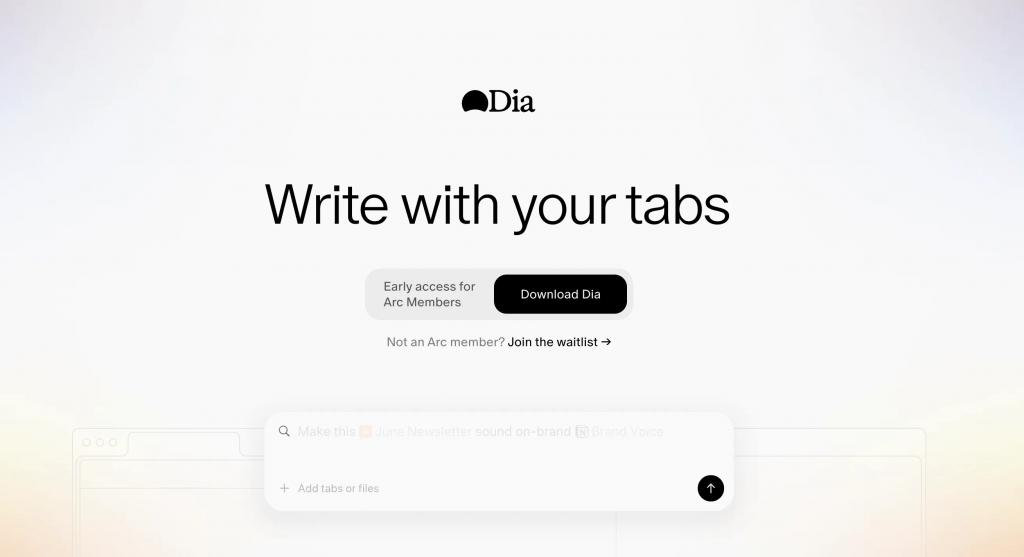
Dia is an AI tool that fundamentally redefines the browser. It’s not an ordinary web browser or a simple AI plugin; it fully embodies the concept that “AI is the browser.” When you open Dia, you’ll find a minimalist interface with no traditional tabs, bookmarks, or plugin areas—just a dialog box and three function cards: “Chat,” “Writing,” and “Coding.” You ask your questions directly in the dialog box, and Dia automatically searches, reads web content, and provides structured summaries and recommendations, realizing a seamless “search — filter — output” process within one platform.
Dia’s content understanding is impressive: it not only reads text but also comprehends tables, charts, videos, and even text in images. For example, if you receive a lengthy email, simply say “Summarize the key points,” and Dia extracts the crucial information without needing you to copy-paste or switch apps. Even more impressively, Dia can analyze multiple videos simultaneously and create personalized plans based on your needs, saving you time and effort.
Moreover, Dia supports customization of language style and tone, even mimicking famous personalities, making it “AI tailored to your preferences.” It transforms the web from a passive object into an active “conversation partner,” significantly boosting user focus and efficiency.
However, Dia also brings concerns. Currently, it only supports login from US IPs and often experiences network stability issues, limiting user experience. More importantly, as information processing becomes highly simplified, users’ need for “full reading” and “patient exploration” decreases, potentially weakening attention to detail and depth.
Dia’s emergence undoubtedly drives browser innovation, making internet use smarter and more efficient. Yet it also reminds us to be cautious of cognitive laziness and superficial understanding that technological advances may foster. A true AI browser is not just a tool upgrade but a transformation in user habits and thinking.