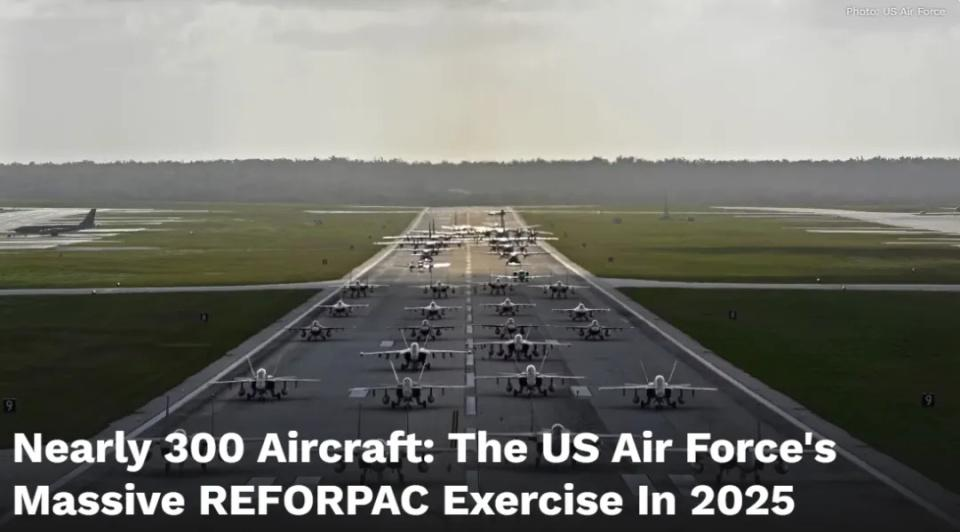
In recent years, the Pentagon’s view of China as its biggest hypothetical adversary has become an “open secret.” What is even more alarming is that the various exercises the US military conducts in the Western Pacific are increasingly detailed in preparing for a large-scale conflict between China and the US. In short, the US military is genuinely preparing for a “major China-US war.”
Agile Combat Employment: The US Military’s Innovative Tactic Against Long-Range Firepower Threats
Starting July 10, the US Air Force launched a two-week-long, unprecedentedly large-scale “Force Back to the Pacific” exercise, involving nearly 300 aircraft and thousands of personnel focused on the concept of “Agile Combat Employment” across multiple theaters. This tactic is specially designed to address the survival challenges of US bases in the First and Second Island Chains under the threat of China’s long-range precision fires.
The US military aims to break away from the traditional concentrated deployment by dispersing aircraft and essential supplies to remote islands to avoid being wiped out in a single strike. These dispersed small units strive for rapid mobility and efficient coordination, capable of quickly regrouping into a “powerful punch” to face complex battlefield environments.
Complex Drills Testing Battlefield Adaptability and Logistics Support
According to Air & Space Forces Magazine, the exercise emphasizes flexible tactical movement, requiring units to adapt quickly to changing scenarios. US and allied fifth-generation fighter squadrons will face complex threats in contested airspace; transport units will operate under harsh conditions to move supplies and redeploy assets; command and control teams will efficiently manage broad synchronized operations.
“Bamboo Eagle” Exercises and Aerial Refueling: Extending Fighter Range
Considering the vast geography of the Western Pacific, especially that fighters operating from the Second Island Chain require aerial refueling to approach China’s vicinity, the US has revived the “Bamboo Eagle” series, focusing on large-scale aerial refueling coordination. The participation of dozens of tankers underscores the high importance of long-range air combat capabilities.
Multinational “Shield Sword” Exercise: Testing Comprehensive Combat Ability in High-Contested Environments
From July 13 to August 4, the US and Australia will lead the “Shield Sword” exercise, involving 35,000 troops from 19 countries—six more than last year. This year’s focus is testing logistics and sustainment capabilities in high-threat environments. US Pacific Army Commander General Ronald Clark noted plans to establish “Joint Theater Distribution Centers” near the First Island Chain to overcome challenges in deploying strategic airpower, equipped with ports and airfields for rapid supply movement.
Western Pacific: The US Military’s Strategic Focus and Future Warfare Testing Ground
While Middle East conflicts still occupy some Pentagon attention, the Western Pacific is clearly the US military’s strategic priority. Unlike previous asymmetric conflicts, the US expects a “peer adversary” here, where traditional tactics are insufficient. Large-scale exercises aim to explore new operational concepts suited for a potential China-US war.
Issues Exposed in Exercises: Maintenance Challenges of Dispersed Deployment
However, US preparations are not flawless. In previous Agile Combat Employment drills, dispersing aircraft increased survival odds but also led to higher rates of aircraft grounded due to small maintenance issues—problems quickly resolved at well-equipped large bases.
Conclusion
The series of exercises and preparations in the Western Pacific shows the US military is seriously preparing for a potential conflict with China. Observers and policymakers should recognize both the strategic intentions and existing shortcomings, maintaining vigilance and calm amid an uncertain future for China-US relations.