The U.S. government has once again put blockchain under the spotlight.
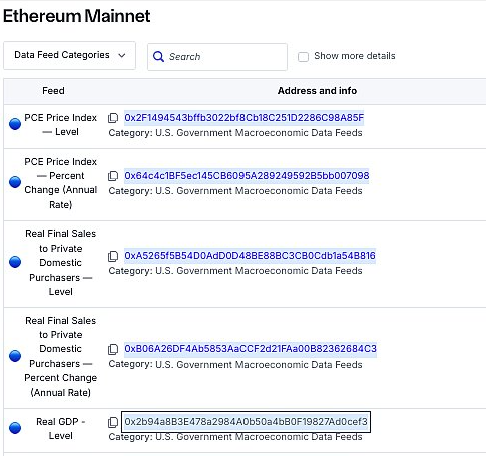
On August 28, the Department of Commerce announced that starting from July 2025, GDP data will be published on multiple blockchains. At the same time, Chainlink revealed its cooperation with the Department of Commerce to push six key economic indicators as blockchain-based data feeds.
This move marks the first large-scale attempt by the U.S. government to integrate macroeconomic data with blockchain technology, sparking heated discussions across the crypto industry: Why blockchain? How is it done? And what does it mean for the market?
Department of Commerce: GDP PDF Hashes Stored on 9 Blockchains
On August 28, the Bureau of Economic Analysis (BEA) revised U.S. Q2 2025 GDP growth to 3.3% annualized.
Unlike before, the GDP report was not only published on its website, but also hashed (via SHA256) and stored on nine blockchains: Bitcoin, Ethereum, Solana, TRON, Stellar, Avalanche, Arbitrum One, Polygon PoS, and Optimism.
- For instance, on Ethereum, the contract address
0x36ccdF11044f60F196e981970d592a7DE567ed7brecords the hash of the official GDP PDF. - This ensures that anyone can download the PDF, calculate its hash, and verify the data against what was written on-chain.
In short, the Department of Commerce is using blockchain as a notary system for data authenticity, not as a data source itself.
Chainlink: Six Key Economic Data Feeds on 10 Blockchains
Chainlink takes a different approach. Instead of just storing a hash, it is pushing six macroeconomic indicators as live data feeds to ten blockchains (Ethereum, Arbitrum, Avalanche, Optimism, ZKsync, and others).
The six indicators are:
- Real GDP
- Real GDP annualized growth rate
- PCE Price Index
- PCE Price Index annualized growth rate
- Final sales to domestic purchasers (real)
- Its annualized growth rate
By integrating Chainlink’s “U.S. Government Macroeconomic Data Feeds,” developers and dApps can directly access official U.S. economic indicators on-chain.
Why It Matters: From “Proof of Data” to “Price Feeds”
- Department of Commerce → focuses on immutability and data verification.
- Chainlink → focuses on real-time accessibility and usability in DeFi and beyond.
This opens new possibilities:
- Prediction markets can reference GDP data for outcomes.
- Crypto assets can be designed around official economic benchmarks.
- Inflation-linked tokens or decentralized bonds could emerge.
But Caution Remains: On-Chain ≠ Truth
While this is a milestone, blockchain cannot solve the credibility of the source. It only guarantees immutability once data is uploaded.
U.S. GDP itself is often revised multiple times: the BEA’s Q2 figure released this time is only the Second Estimate, with a Final Estimate still to come. Market skeptics, including Trump himself, have long questioned the reliability of government economic statistics.
Thus, this step should be seen as a symbolic move toward government adoption of blockchain, but the ultimate trust still depends on the credibility of the issuing institutions.
Conclusion
The Department of Commerce and Chainlink are bridging official macroeconomic data with blockchain in different ways: document notarization vs. real-time oracle feeds.
This signals growing government acceptance of blockchain, while also opening the door to new financial applications. But one fact remains: blockchain is a tool—the real question