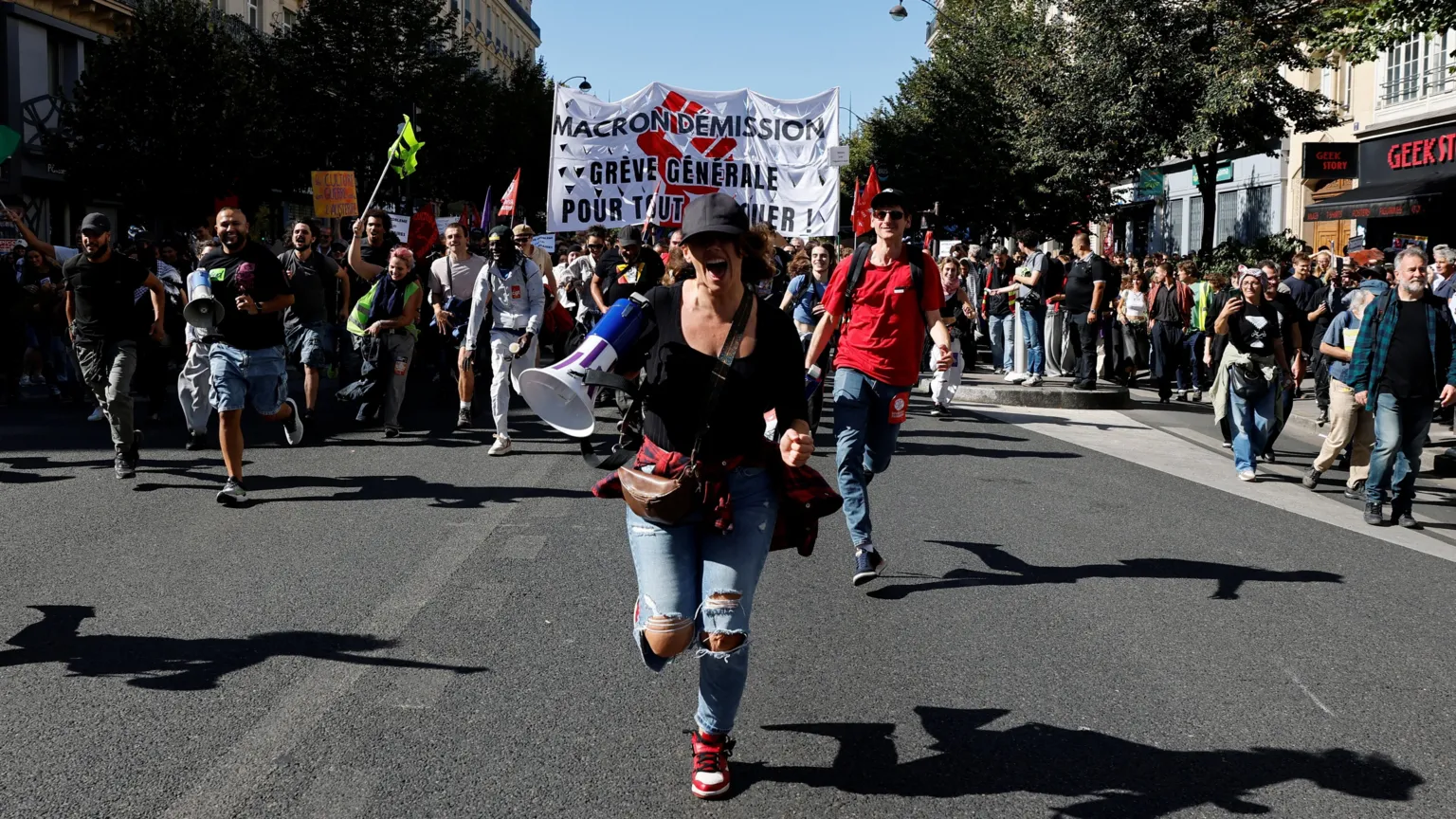
France witnessed a massive wave of unrest on Thursday as hundreds of thousands of workers, students, and professionals poured into the streets to protest against government budget cuts. What began as a call from trade unions has escalated into one of the country’s most significant demonstrations in recent years.
According to the Interior Ministry, between 600,000 and 900,000 people were expected to join the protests nationwide. To maintain order, the government deployed a staggering 80,000 police officers. Yet despite the heavy presence, clashes broke out in Lyon and Nantes, where police resorted to teargas to disperse demonstrators.
A Nation at a Standstill
The strike has disrupted everyday life across the country. In Paris, metro lines ground to a halt, major roads were blocked, and city streets were filled with protestors waving banners and chanting slogans. Students locked the gates of schools and universities, while nearly one-third of teachers refused to work. Even pharmacies joined the movement, with 98% expected to remain closed.
By mid-afternoon, French media reported that more than 110 people had been detained across the country.
Voices of the People
The protest is fueled by frustration over the controversial budget plan of the ousted Prime Minister François Bayrou, which sought to slash €44 billion from public spending. Though Bayrou has been toppled, his successor, Sébastien Lecornu—an ally of President Emmanuel Macron—has yet to fully distance himself from the cuts.
“Macron’s economic and social policies don’t suit me, and neither did Bayrou’s budget,” said Cyrielle, a 36-year-old IT worker marching in Paris. “We need more investment in public services and culture. Perhaps the wealthiest could contribute a little more. A government leaning to the left would be a start to the solution.”
Union leaders echoed this demand. Sophie Binet, head of the influential CGT trade union, declared:
“We must come out in force—that’s how we build strength. Only then can we pressure the government and employers to end policies that favor the richest.”
Political Tensions Rising
Outgoing Interior Minister Bruno Retailleau promised a tough stance, warning police would make arrests “at the slightest slip-up.” Meanwhile, left-wing firebrand Jean-Luc Mélenchon, leader of France Unbowed, called on protestors to remain disciplined:
“Any violent actions would only serve one man—Mr. Retailleau.”
The scale of unrest comes just a week after 200,000 people joined a separate protest organized by the grassroots movement Bloquons Tout (“Let’s Block Everything”), underscoring growing public anger at austerity-driven policies.
A Government Under Pressure
New Prime Minister Lecornu faces an uphill battle. Like his predecessors Bayrou and Michel Barnier, he inherits a hung parliament split into three rival blocs, making it nearly impossible to build consensus. At the same time, France faces a ballooning public debt—equivalent to nearly €50,000 for every citizen—adding urgency to the budget debate.
Trade unionist Alexandre Dubois summed up the mood:
“Of course, we want stability. But whoever leads, whether Lecornu or another, workers must be taken seriously. France must move away from this obsession with short-term economic performance.”
As France roils with unrest, one thing is clear: workers across the nation are determined to make their voices heard, and the battle over the country’s economic future has only just begun.