For years, Chinese companies have chased their own “Disney dream”—to build a magical kingdom that rivals Mickey Mouse’s empire. Yet, one by one, those dreams have shattered under the weight of reality.
The latest chapter? Huayi Brothers’ Film World in Suzhou has been fully acquired by South Korean private equity giant MBK Partners, and rebranded as Suzhou Yangcheng Peninsula Park.
MBK’s tourism subsidiary officially took over the 690-acre park, once valued at ¥3.5 billion, injecting only ¥100 million to revive it. The result was astonishing: during the 2025 summer trial run, the park welcomed 350,000 visitors, with revenue up 68% year-on-year.
MBK isn’t new to this game. Back in 2021, it purchased multiple Haichang Ocean Parks across China for ¥6.53 billion. Now, investors from Singapore and the UK are joining the wave—quietly buying into China’s tourism market while local giants retreat.
Why? Because they see value where others see failure.
The Fall of Huayi Brothers’ Dream
When Huayi Brothers went public in 2009, co-founder Wang Zhongjun envisioned building “China’s Walt Disney.”
The Suzhou park, launched in 2018 with beloved film IPs like If You Are the One and Detective Dee, was meant to be the crown jewel.
Instead, it became a costly burden—losing hundreds of millions of yuan annually.
Unlike Disney, Huayi’s film IPs lacked long-term cultural resonance. Once the movie hype faded, so did the crowds.
Why Foreign Capital Sees Potential
MBK excels at distressed asset investment—buying undervalued projects and reviving them through smart operations.
They did it before: Osaka Universal Studios, once struggling, became the world’s fourth-largest theme park under MBK’s stewardship.
In Suzhou, MBK’s formula is simple but effective:
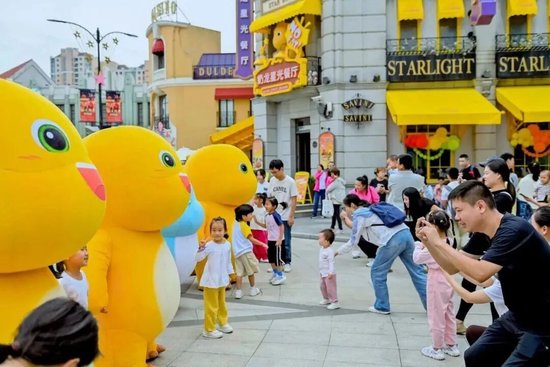
- Add family-friendly IPs like “Nailong”
- Incorporate local culture with live shows such as The Scholar’s Return
- Develop night tourism and seasonal activities
The park’s quick turnaround has proven that management and vision matter more than scale.
A New Era of Foreign Investment
Since China relaxed regulations on entertainment and tourism investment in 2021, global investors have been flocking to the Yangtze River Delta.
Their confidence signals renewed faith in China’s tourism economy—and a belief that, with the right strategy, even “failed” parks can thrive again.
Perhaps the dream of a “Chinese Disneyland” isn’t dead—it’s just changing hands.