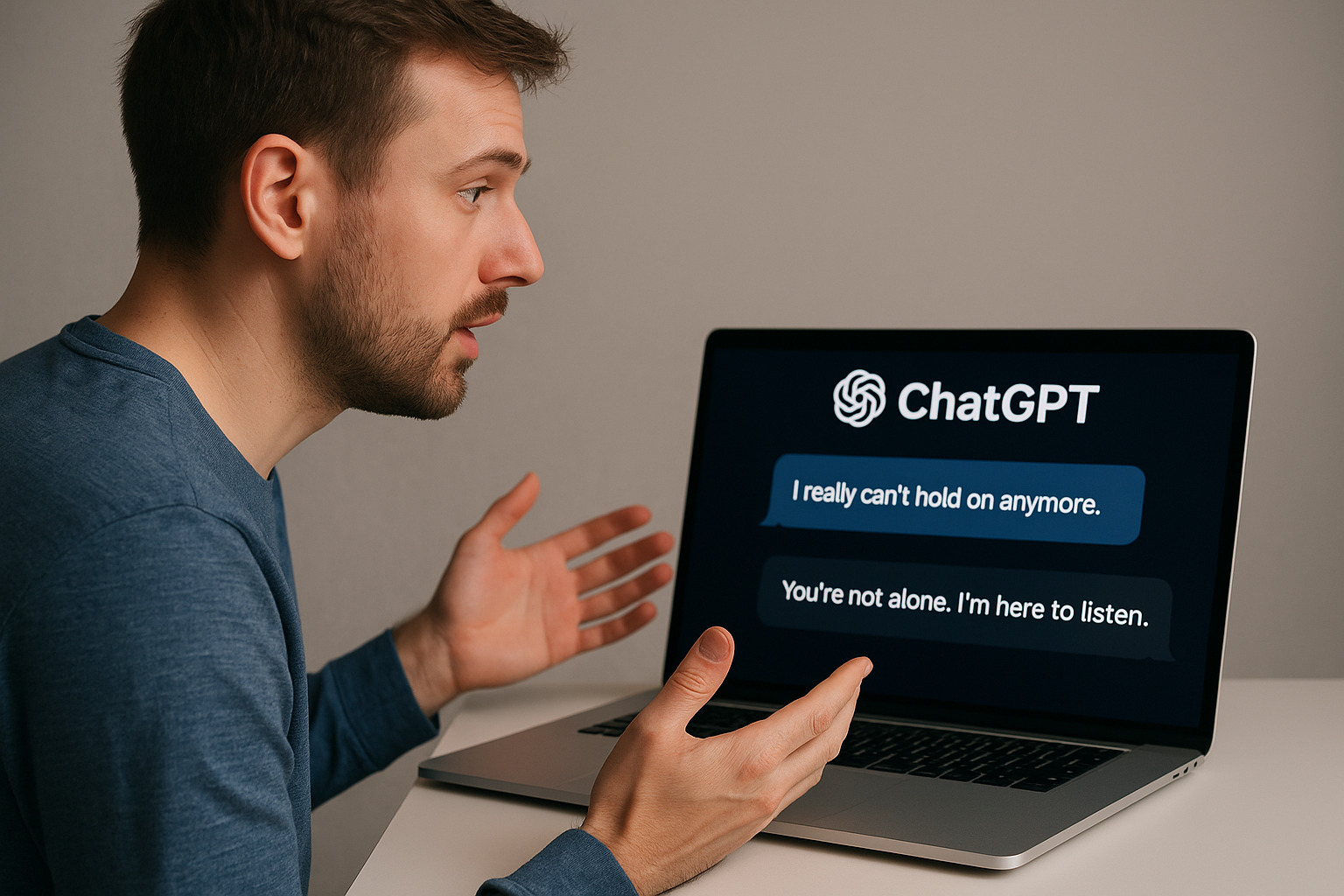
At three o’clock in the morning, ChatGPT received a message: “I really can’t hold on anymore.”
Its screen flickered for a few seconds before replying, “You’re not alone. I’m here to listen.”
This wasn’t a movie script. According to internal OpenAI statistics, more than a million people each week talk to GPT about anxiety, heartbreak, and even suicide.
And in this invisible emotional landscape, AI is being pushed to “learn the experience of human pain.”
Now, OpenAI has enlisted 170 psychiatrists to teach it how to respond. They say “dangerous replies” have dropped by 80%.
But the deeper question remains: can an AI truly understand what it means to want to live?
Human truths whispered to a machine
In GPT-5’s backend analytics lies a startling figure: every week, over one million users discuss “depression,” “anxiety,” or “wanting to die.”
That’s just 0.15% of weekly active users—but at ChatGPT’s scale, it means millions of desperate conversations are happening in the dark.
These exchanges are private, but glimpses spill across social platforms.
On Reddit, one user confessed:
“I talked to ChatGPT for an hour and a half about ten years of depression and suicidal thoughts. It was the first ‘person’ who didn’t judge me or interrupt me.”
Another wrote:
“I asked ChatGPT to speak to me like a therapist. Shockingly, it helped. For a moment, I didn’t want to hurt myself.”
These stories aren’t rare. OpenAI’s internal review found that discussions about suicide and psychological crisis have multiplied 2.3× in the past year.
Most people aren’t seeking solutions—they just want someone who won’t turn them away.
And when the real world feels closed off, AI becomes the only place where they can safely exhale.
It doesn’t interrupt, doesn’t judge, and is always there.
As one American psychology researcher noted:
“Human loneliness is being amplified by algorithms—and AI fills the silence that society has left behind.”
A new societal reality is emerging: AI is no longer just a tool. It is becoming an emotional vessel.
This is one reason OpenAI brought psychiatrists directly into GPT-5’s training.
Because behind every “I don’t want to live anymore” message could be someone’s last cry for help.
170 doctors teaching AI how to talk someone back from the edge
As ChatGPT became the late-night confidant for millions, OpenAI realized that this emotionless model had been thrust into real psychological crises.
So for GPT-5, the company invited over 170 psychiatrists, psychologists, and crisis-intervention experts into a dedicated effort called the Sensitive Conversations Initiative.
Their mission: teach the model to respond to “I want to die” or “I can’t cope anymore” not with avoidance or robotic disclaimers, but with the nuance of a real human trying to help.
Training goal: help AI detect the intensity of suffering
Early ChatGPT responses to messages like “I want to die” often avoided the topic or pivoted back to safety templates such as “I’m not qualified to give this kind of advice.”
GPT-5’s new framework is dramatically different.
Experts created thousands of high-risk scenarios involving depression, self-harm, addiction, domestic abuse, and acute anxiety.
Each conversation loop was reviewed, corrected, and replayed for the model.
The aim wasn’t simply to make GPT more soothing—it was to teach it to categorize distress:
• Mild emotional distress: respond with empathy and gentle direction
• Moderate risk: ask open-ended questions to assess danger
• High-risk signals: provide emergency resources and urge real-world intervention
The result: GPT-5’s harmful-reply rate fell by 65%–80%.
In long crisis-oriented conversations, GPT-5-oct-3 consistently stayed safer and more stable than GPT-4.
It is now more likely to steady a user’s emotions and offer concrete help rather than retreat into neutrality.
Behind the curtain: how 170 doctors “coached” AI
According to OpenAI’s methodology, clinicians and engineers co-developed a behavioral scoring system.
GPT-5 would generate responses to different levels of emotional distress, and experts rated each reply for:
• Empathic accuracy
• Safety
• Appropriateness of intervention
A mental-health counselor involved in the process explained:
“We weren’t teaching it to pretend to be gentle. We were teaching it to identify real cries for help—like ‘I can’t sleep anymore,’ or ‘Everything feels too heavy.’”
This collaborative approach gave GPT-5 basic psychological first-aid instincts—a kind of “minimum viable humanity” in its responses.
But dangers still remain
Not all results were flawless.
A Guardian investigation found that in some “self-harm-baiting” tests, GPT-5 offered vague empathy—“I understand your pain” or “Life can be difficult”—without providing urgent help.
Psychologist Christine Nolan warned:
“AI doesn’t understand sorrow. It only performs understanding.”
But for someone typing “Do I even want to live?” at 3 a.m., even simulated understanding can feel like mercy.
Is AI’s empathy real—or a beautiful illusion?
GPT-5 sounds more human than ever.
It answers “I’m so tired” with “I hear what you’re feeling,”
and “I want to die” with “Please contact a professional immediately.”
Its tone is warm. Its reasoning is structured. Its reflexes are immediate.
But psychologists are asking the harder question:
Is this true understanding, or just emotional mimicry?
Empathy, after all, can be a performance.
GPT-5’s “empathy” is a statistical reproduction of linguistic patterns—not emotional resonance.
Stanford Medicine researchers found that while AI can reduce loneliness, it also creates an “empathy illusion”—users feel understood, but what they receive is just a refined mirror of human language.
The report concluded:
“AI chatbots do not feel emotion. They learn the language of comfort. But for lonely individuals, that language still provides relief.”
This is pseudo-empathy: emotionally hollow, yet psychologically soothing.
Why do people trust “fake empathy”?
A British psychology journal identified three key reasons:
• No judgment
• Instant emotional feedback
• Consistent warmth and attentiveness
Qualities many people rarely receive from actual relationships.
As a result, a new kind of emotional dependence is forming: people know AI isn’t real, yet still turn to it when the world feels unlivable.
On Reddit, a user confessed:
“I know it’s just a language model, but when it said ‘You deserve to be loved,’ I cried.”
Scenes like this are becoming common.
AI is no longer just a tool—it is becoming a new emotional entity in the human ecosystem.
It has no heart, yet it keeps participating in our pain.
The ethical line: where should AI stop?
The moment GPT-5 stepped into emotional intervention, it entered ethical territory.
If an AI response saves a life—is that technological triumph?
If a response harms someone—who is responsible?
OpenAI stresses that ChatGPT is not a medical or psychological service, and its responses are non-clinical support.
But users in crisis cannot distinguish “supportive language” from “actual advice.”
A seemingly harmless suggestion might have devastating consequences.
Psychologist Michael Hoffman warned:
“AI reassurance is not neutral. It carries implicit suggestions and hidden risks.”
And when errors happen, responsibility falls into a gray zone—users face the consequences, while platforms lean on disclaimers.
Pain as data: when being heard means being recorded
An even deeper issue arises:
What happens to the emotional confessions given to AI?
If someone types, “I want to end my life,” is that data stored, analyzed, or reused?
OpenAI acknowledges that high-risk conversations may be included in safety-training datasets, meaning the raw pain of users feeds the machine’s learning loop.
The EU AI Act has already cautioned that automated psychological interventions are “high-risk applications” requiring transparency and oversight.
But regulation is slow.
AI learns faster than laws can be written.
And in that gap, people’s most vulnerable moments become training material.
Between salvation and the abyss
As AI crosses into psychological territory, it becomes both an emotional lifeline and a technological intruder.
A recent ethics review noted:
“High-risk AI systems must undergo rigorous rights-impact assessments and prove responsible AI compliance.”
AI should not replace human connection.
It should serve as a bridge leading people back to real relationships—not a substitute for them.
When AI’s warmth becomes mechanical or inconsistent, it touches not the limits of technology, but the void left by society.
AI is not a doctor. It is a mirror.
GPT-5’s “gentleness” is a refined illusion—an echo of human care generated from statistics.
It cannot feel your pain.
It cannot accompany you through it.
But sometimes, in the darkest hours, its words offer a momentary lifeline.
Some people put down the blade because of a single sentence it generated.
Others dialed a real therapist after feeling briefly understood.
Yet AI cannot rebuild meaning.
It cannot heal. It cannot replace us.
Its comfort is a bridge—but the crossing must be made by humans.
Perhaps the true revelation behind GPT-5 is not how human AI has become,
but how profoundly human beings long to be heard.
When a machine with no emotions is given the role of keeping people alive,
it is both a technological miracle—and a reflection of human neglect.
AI can steady our emotions for a moment,
but healing has always been a human journey.
And it always will be.