Meta Triggers the “AI Vision GPT Moment”: SAM 3D Reconstructs the World with One Click, SAM 3 Reinvents Image Segmentation
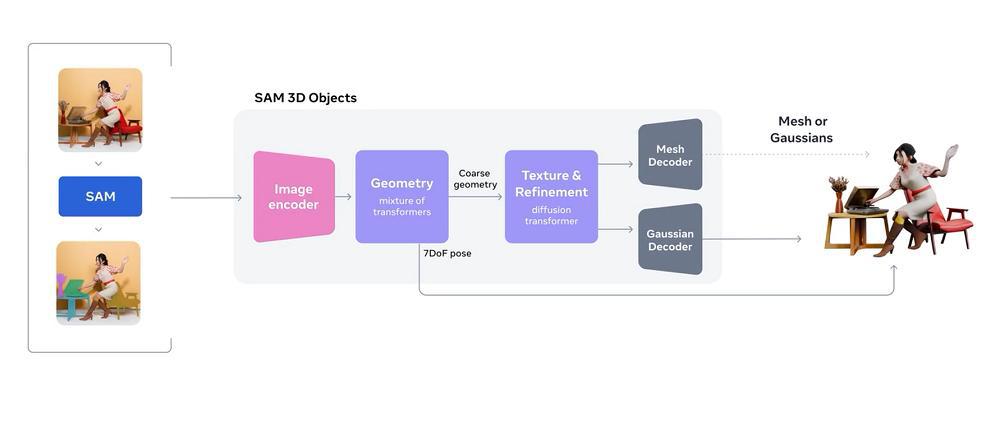
On Nov. 20, Meta unveiled a new family of 3D reconstruction models called SAM 3D, including SAM 3D Objects for object/scene reconstruction and SAM 3D Body for full human pose and shape estimation.
Its most shocking capability:
Click once on any element in a 2D image → get a full 3D model with 360° flawless viewability.
In parallel, Meta officially released SAM 3, the next-generation 2D segmentation model, which introduces a breakthrough feature called “promptable concept segmentation.”
Many engineers describe this moment as:
“The ChatGPT moment for Computer Vision.”
🧩 01. SAM 3D: Turning 2D Images into 3D Worlds with One Click
SAM (Segment Anything Model) has long dominated 2D segmentation.
Now SAM 3D Objects pushes the boundary much further:
- Converts a single image into a complete 3D mesh
- Reconstructs shape, texture, and pose
- Handles small objects, occlusions, extreme angles
- Outputs models nearly free of artifacts
To overcome the industry’s long-standing 3D data scarcity, Meta built the world’s largest natural-image 3D dataset:
- ~1 million images
- 3.14 million mesh models
- Hybrid pipeline combining crowd workers & expert 3D artists
They also introduced the SA-3DAO benchmark with artist-level difficulty.
Performance-wise, SAM 3D Objects beats prior models with a 5:1 human preference ratio, and enables full-texture 3D reconstruction within seconds, unlocking near-real-time robotics perception.
🧍 02. SAM 3D Body: More Control, More Interaction, Human-Level Fidelity
SAM 3D Body specializes in human 3D estimation and remains robust under:
- Occlusion
- Extreme poses
- Multi-person scenes
- Complex clothing
It is built upon the new MHR (Meta Momentum Human Rig) mesh format, which decouples skeleton and soft body structure, making results more interpretable.
It accepts prompt inputs (segmentation masks, 2D keypoints), giving users fine-grained control.
Training data includes:
- Billions of images
- High-quality multi-view videos
- Expert-level synthetic data
- Automatic ranking of rare poses
Result:~8 million high-quality samples.
SAM 3D Body leads multiple benchmarks but still lacks multi-human interaction modeling and fine hand-pose accuracy.
🎨 03. SAM 3: Image Segmentation Evolves into a Concept-Level Model
SAM 3 introduces concept-level segmentation, an ability that resembles language understanding.
You can prompt the model with:
- “dog,” “zebra,” “elephant”
- “animals” (broad concept)
- “person wearing a black jacket and white hat”
- “red-striped umbrella”
To evaluate this, Meta created SA-Co, a large-concept benchmark far beyond previous datasets.
SAM 3 supports many prompt types:
- Text descriptions
- Example images
- Visual prompts (masks, boxes, points)
Meta reports:
- ~100% improvement on SA-Co
- 3:1 preference over OWLv2
- Strong results on SAM 2 tasks, LVIS zero-shot, and object counting
Meta also built a hybrid AI + human data engine, where:
- SAM 3 + Llama 3.2v propose masks
- Humans & AI annotators refine them
- AI annotators are 4× faster
⚙️ 04. Open Source, Unified Architecture, Real Commercial Use
Meta open-sourced:
- SAM 3D models
- SAM 3 model checkpoints
- Datasets
- Inference code
- Human mesh model (MHR)
SAM 3 uses a unified architecture combining:
- Meta Perception Encoder
- DETR detection
- SAM 2 tracking memory
Meta has already deployed SAM 3D in the real world: