Have you built your app today?
Social media feeds used to be full of gym check-ins, makeup tutorials, and travel vlogs.
But recently, something strange is happening: everyone is suddenly… building apps.
A mom proudly shows the first software of her life — a “reading points tracker” for her child.
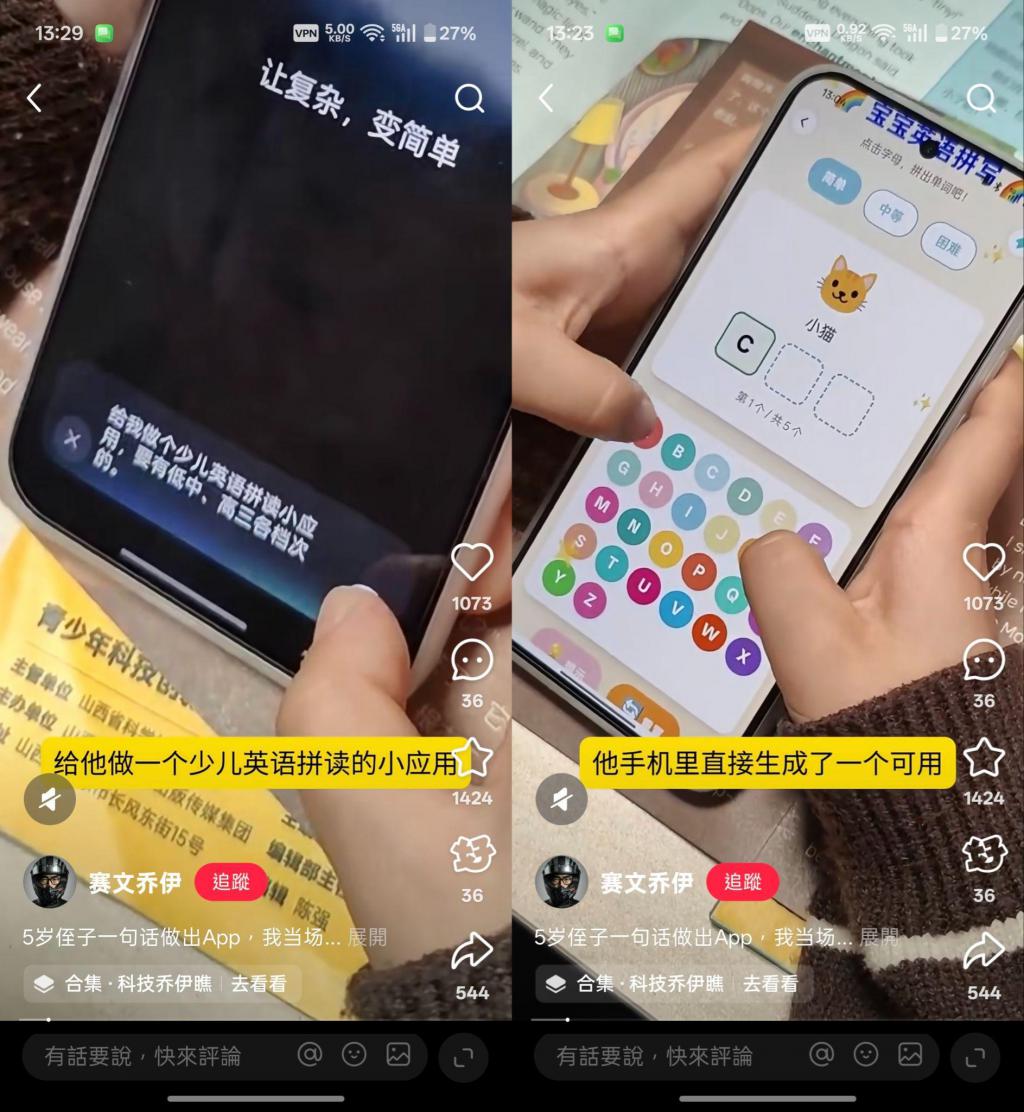
A 5-year-old creates a phonics learning app and starts practicing right away.
A college student uploads a full tutorial on making a “seat-map finder,” and the comments explode with:
“This looks fun! I want to try too!”
Scroll a little longer, and you start to wonder:
Is the whole country developing little apps now?
The source of this nationwide creative wave is Lingguang, Ant Group’s new multimodal AI assistant.
It went viral instantly:
1 million downloads in 4 days, 2 million in 6 days.
Its killer feature? Flash Apps — a function that turns a spoken idea into a fully interactive mini-application.
No coding. No logic design. No flowcharts.
Just say what you want, and the app appears.
It’s fun, useful, and deeply satisfying — so Flash Apps quickly became a new social language.
Instead of sharing dinner photos, people now share:
“Here’s the app I built today!”
Riding this momentum, Lingguang announced its first “National Flash-App-Building Contest.”
The Age of “Everyone Builds Apps”
Lingguang transforms software development from something serious and specialized
into a form of public entertainment.
People no longer gather to play mahjong —
they gather to make apps.
Creators jumped in first.
Comedian Li Dan even made a “self-service reply bot” that answers fan messages in his signature tone.
Fans loved it — not only because it’s funny, but because it proved that AI tools can carry personality.
A 5-year-old used Flash Apps to create an English phonics game with adjustable difficulty.
Parents used it to make custom learning tools, meal planners, math trainers, and even local kid-friendly maps.
Students? They went wild.
A teacher used it to build a real-time “light refraction simulator” for class.
The Magic Is in Solving Tiny Problems
Flash Apps shine brightest in everyday life.
People make:
- cooling-off calculators
- household task spinners
- mood tuners
- office firework launchers
These needs were always too small for traditional apps —
too trivial to develop, too annoying to DIY.
Now one sentence solves them.
Professionals turned Flash Apps into workflow weapons:
- employees built industry-specific news trackers
- lawyers built case-management helpers
- accountants built tax-date calculators
- workers built health-tracking dashboards
For the first time, software is personalized down to a single user.
That’s the true meaning of Flash Apps:
the power to define tools shifts from developers to everyday people.
When Technology Crosses Layers, We Witness a “National Moment”
Lingguang triggered a massive creative surge:
tools shaped by daily life,
needs defined by casual sentences.
Its contest is not about coding ability —
it celebrates small ideas that improve life in simple, delightful ways.
Anything can be built:
travel plans, health logs, baby recipes, budget calculators, study aides, work tools…
The only real requirement:
Do you have an idea worth realizing?
Lingguang handles the rest.