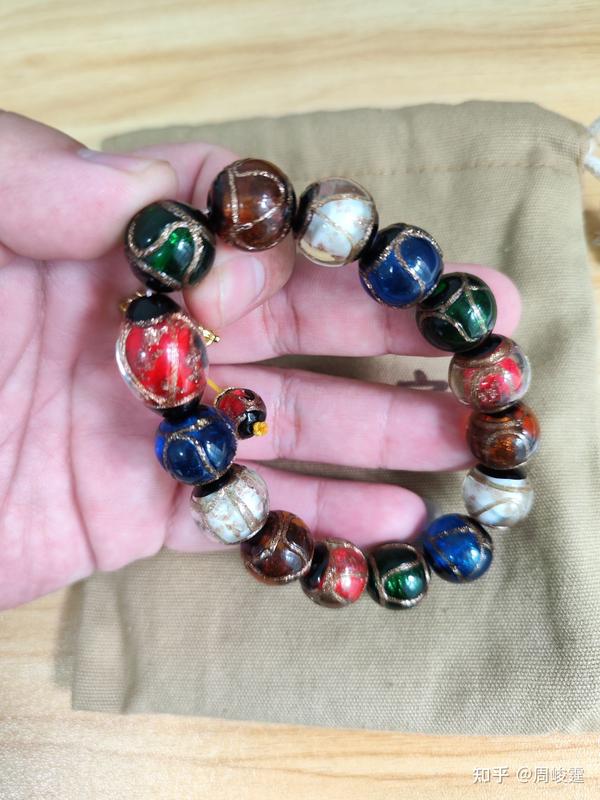
Do you remember the once impossible-to-find Yonghegong incense-ash bracelets?
A bracelet that cost barely a few yuan wholesale instantly jumped to 398 RMB just by printing “Yonghegong” on it — and still couldn’t meet demand. At the peak of its popularity, people hired resellers, and devout buyers lined up an hour and a half early just to secure a bracelet they believed would bring them blessings.
Four years later, every major temple and monastery has joined the “cultural IP” business. Incense bracelets are no longer a rare commodity, but turning to spiritual forces for reassurance — especially among the younger generation — remains the go-to emotional solution. Compared to the wave in 2021, today’s metaphysical consumption has become more personalized, segmented, and custom-oriented, while monks and Taoist priests increasingly develop personal brands, transforming into “metaphysical curators.”
How far has this metaphysical economy evolved? Are new monetization paths emerging? When ancient superstition meets modern AI, can it spark new business models and marketing strategies? To find answers, we must shift perspectives — and step into this new-era metaphysical consumption world alongside the young believers themselves.
This story includes interviews with four individuals — recorded as the 574th to 577th interviewees of “Entertainment Capital Theory” in 2025.
Seeking peace of mind: crowds flood the temples
Beginning in 2023, A-Li became obsessed with flying to Hong Kong. Although flights from Beijing aren’t cheap, she still goes at least once a year.
Not for concerts.
Not for Disneyland.
But for the legendary power of “Wong Tai Sin.”
Wong Tai Sin Temple, officially known as Sik Sik Yuen, is a Taoist site primarily dedicated to the Eastern Jin immortal Wong Cho Ping, with auxiliary altars for the God of Wealth, the Matchmaker deity, and more. Each time, A-Li heads straight to the God of Wealth hall dedicated to Zhao Gongming.
Entering Wong Tai Sin Temple is free — but entering the God of Wealth hall requires a paid ritual service. A-Li explains: there are two packages, 100 HKD and 500 HKD. After payment, participants enter the small treasury hall, where a spiritual master guides them to apply gold leaf to the statue of Zhao Gongming. The package also includes a glass ingot to take home and place at one’s wealth altar. The 500 HKD package includes five ingots instead of one, and during special holidays, the ingots may be substituted with glass talismans shaped like auspicious ruyi scepters.
“500 HKD works — I’ve seen it happen for multiple friends.”
Because every time A-Li visits Wong Tai Sin, her income coincidentally rises, she subconsciously associates the temple with prosperity, turning what began as an occasional ritual into an annual routine.
As external pressures intensify, more young people share similar anxieties, fueling a nationwide boom in spiritual destinations. At Wong Tai Sin alone, according to official statistics, total visitors in 2024 and 2025 approached 1 million, prompting the temple to open 24 hours — from New Year’s Eve morning through New Year’s Day night.
Financial reports further illustrate the trend. Among listed tourism and scenic enterprises in 2024, only a few achieved growth in both revenue and net profit — one being Jiuhua Tourism, whose major income comes from operating cableways connecting ten popular temple locations, all flourishing with worshippers year-round.
Emeishan A, another spiritual hotspot and sacred site of Samantabhadra Bodhisattva, has also shown healthy profit growth even when revenue slightly dipped — signaling resilient demand for spiritual destinations.
Notably, due to a 2012 regulation disallowing religious institutions from being listed as assets, many temples’ financials aren’t publicly disclosed. But visitor counts and social media discussions still reveal the booming reality.
Famous temples like Lingyin and Yonghegong need no introduction, but smaller, previously quiet temples have also been lifted by this tide.
For example, Beijing’s Fire God Temple, barely known for years, suddenly exploded in popularity for its “miraculously effective Matchmaking Hall,” becoming so crowded on major festival days that movement becomes impossible.
Or the tiny Huangwa God of Wealth Temple in Beijing’s Gulou East Street — so small you could walk past it without noticing. Yet it sells plush charms, “God of Wealth Coffee,” and “Prosperity Water.” While many won’t spend 188 RMB on a plush prosperity charm, almost everyone will pay 9.8 RMB for a “blessing-infused bottle of water,” making the temple a viral check-in spot.
A friend who works in marketing explains: “Most of this visibility comes from strategic PR on Xiaohongshu.” Temples collaborate with micro-influencers, preferring everyday users over large KOLs because they appear more authentic — and more believable.
Those seeking answers meet those seeking opportunity
Selling coffee, accessories, talismans — these all follow the same logic that drove incense-ash bracelet mania.
But profits from cultural merchandise go to operations, production, and temple maintenance — not directly into the hands of monks or priests. So some agile minds sought revenue through personalized ritual services.
Happiness may be universal, but anxiety is deeply individualized. Young people carry unique burdens. Just as worshippers must provide real-name details during prayers, in today’s hyper-personalized world, spiritual seekers increasingly expect tailored metaphysical diagnostics.
That’s where real human intermediaries step in.
MOMO met her “master” during a visit to a Taoist site in 2024. Watching him perform purification rituals for a group — chanting, bowing, burning offerings — she waited outside for 40 minutes and finally struck up a conversation.
She learned this was a ritual to “dispel curses and negative forces.” Immediately, she added the master on WeChat.
After sending her birthdate, the master informed her she carried “child-spirit misfortune” according to her Eight-Character profile, and a special ceremonial day was approaching in two months.
Soon afterward, MOMO paid several thousand yuan for ritual documentation and participation in the ceremony. She felt her luck improved afterward, reinforcing her loyalty to the master. Eventually, she was added to a group chat full of others like her — “beneficiaries.” The master rarely spoke; instructions were delivered by “senior disciples.”
These “senior disciples” were not ordained clergy — just ordinary people who started as clients and later were taken in as “secular disciples,” becoming intermediaries of messaging and influence.
When MOMO was asked privately to help promote talismans in exchange for commission, she felt conflicted. “It started feeling like MLM,” she admitted.
Yet she remains in the group. And she still pays for occasional rituals priced between hundreds and thousands, “because not doing it makes me anxious, so I treat it as paying for peace of mind.”
AI empowerment meets the rise of personal metaphysical brands
According to industry observers, today’s metaphysical practitioners fall into two camps:
- Legitimate religious personnel registered with the state
- Self-made “folk masters” with no formal religious background
The former are restricted from publicly building influencer personas due to past scandals involving viral monks and Taoists. Many therefore operate through private networks — by recruiting followers and building personal communities.
The latter category — the “wild path mystics” — are often opportunists drawn to the profit potential.
One interviewee recalled a high-school classmate known as “the ghost-story guy” — a jokester with a flair for spooky tales. He studied e-commerce in college, worked a few years as a low-level office employee, and then in 2024 unexpectedly reinvented himself online as “Master So-and-So,” offering feng shui consultations, divination, ritual services, and personalized spiritual objects.
Initially, he struggled to gain traction as a paranormal storyteller.
But AI changed his fate.
He fed historical cases and folklore into AI models, tweaked the generated narratives, and posted them as “true supernatural incidents.”
At the conclusion of each story, he appeared as the expert “who resolved the spiritual aftermath.”
He then used small alternate accounts to comment:
“Master, could you also help me?”
Soon enough, people started messaging him privately with real questions.
Modern metaphysics doesn’t even require expertise. With someone’s birthdate, AI-powered tools — from horoscope apps to numerology engines — generate highly coherent readings. Tests we conducted using DeepSeek, Qianwen, or Doubao delivered analyses nearly identical to those given by traditional masters — sometimes even more detailed.
But the “ghost-story classmate” possessed an invaluable skill: he was exceptionally good at talking to people. He could make individuals feel heard, validated, understood — and gently guided them toward spiritual dependency.
When asked how he performed rituals without being detected as a fraud, insiders pointed to a convenient explanation: “family-passed secret technique,” which conveniently elevates him as a uniquely gifted practitioner.
A new spiritual economy shaped by culture, marketing, psychology, and AI
From thronging temple lines to booming private chat groups…
From mass-produced bracelets to digitally-generated spiritual insight…
Metaphysical consumption has broken free from old “superstition” frameworks and evolved into a psychological service — a commodified ritual of reassurance, affirmation, and emotional care.
And once someone steps into this world, it rarely ends.
As official clergy cultivate private spiritual networks…
And civilian metaphysical entrepreneurs leverage AI to scale personal brands…
This fusion of tradition and technology is reshaping both the pathways of monetization and the emotional fabric of modern society.
The key question ahead is:
How can this industry mature without losing ethical boundaries — ensuring spiritual comfort doesn’t decay into psychological exploitation?