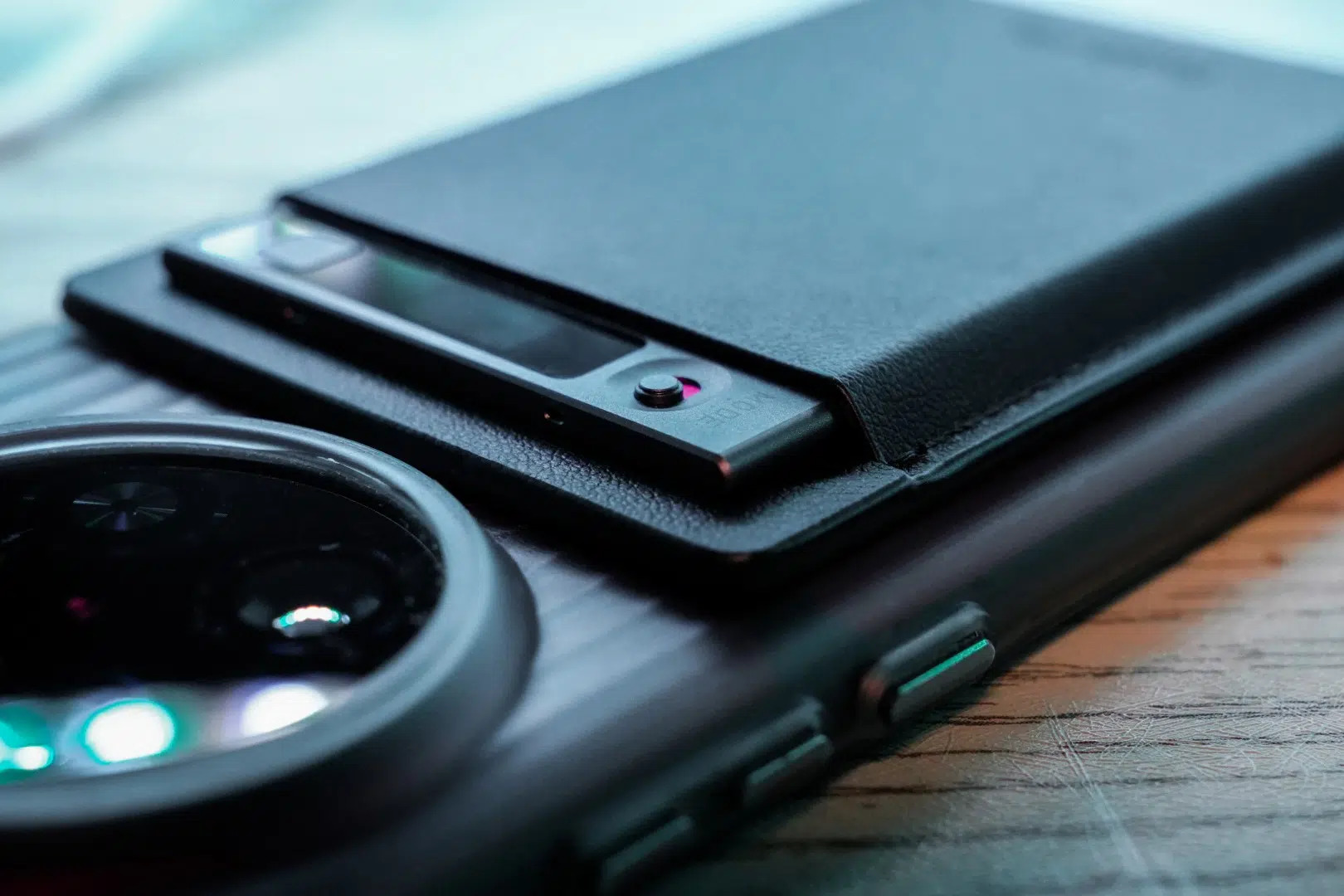
By 2025, smart AI hardware has entered an exciting new phase with the rise of a brand-new product category: AI recording cards. These compact devices—about the size of a business card—attach magnetically to the back of a smartphone and assist users with recording, transcription, summarization, and more.
Driven by curiosity, we selected the three most popular models currently on the market to see how they might reshape everyday work and productivity.
First Impressions
The three standout products in our comparison are Mobvoi TicNote, the highly anticipated Plaud Note Pro, and DingTalk A1. From a design perspective, all three appear to be made specifically for iPhones, as each adopts Apple’s MagSafe-style magnetic attachment.
This design choice makes perfect sense. Most Android phones already support built-in call recording, AI transcription, and automatic summaries. In contrast, iPhone users—still waiting on full Apple Intelligence capabilities—have a far greater need for dedicated external hardware.
Although they all fall under the category of “recording cards,” each product reflects a different design philosophy. Plaud and TicNote prioritize slim profiles by using magnetic charging, which is somewhat unconventional in today’s standardized charging ecosystem. While their batteries can comfortably last an entire day, users must still rely on a separate proprietary magnetic cable at home or in the office.
In fact, when I borrowed a friend’s TicNote, he casually mentioned that he had already lost the original charging cable—so he had to buy a replacement online.
DingTalk A1 takes a more practical approach by using a standard USB-C port. While this makes the device slightly thicker than the others, it also allows for a much larger battery. DingTalk A1 supports up to 45 hours of continuous recording, compared with 30 hours on Plaud Note Pro (up to 50 hours in long-battery mode within 5 meters) and just 20 hours on TicNote.
It’s worth noting that TicNote’s shorter battery life comes with a trade-off: it offers the longest pickup distance, reaching up to 10 meters, while both DingTalk A1 and Plaud Note Pro operate optimally within a 5-meter range.
Design and Controls
In terms of aesthetics, Plaud Note Pro delivers a truly refined design. Its body blends wave-textured metal with a glass back, and the entire device is controlled through just one physical button. Whether attached to a phone for call recording or placed on a desk for meetings, it intelligently switches between audio pickup modes automatically—minimalist, elegant, and high-end.
TicNote, on the other hand, adds an extra microphone mode toggle alongside the power/record button. Users must manually switch between omnidirectional meeting mode and directional call mode. While functional, it introduces the risk of forgetting to switch modes, which can lead to subpar audio capture and less accurate transcription.
DingTalk A1 stands out most visually among the three. Beyond the standard power and record button, it includes a unique “Note” button. This button allows users to mark important moments during recording or press and hold to speak directly to the device. The recorded voice memo can then be sent to oneself or to the AI assistant within DingTalk.
This feature strongly resembles the iconic “flash idea capsule” button on classic Smartisan phones—perfect for capturing spontaneous thoughts and creative ideas. It also gives DingTalk A1 a broader identity beyond meetings, positioning it as both an AI input tool and a voice-based productivity gateway.
Real-World Testing
To put their meeting transcription capabilities to the test, we used scenes from the film Twelve Angry Men as our audio source. The movie is packed with intense debates, overlapping dialogue, emotional outbursts, and constant interruptions—an ideal stress test for AI speech recognition.
In the selected clip, eight different voices were present, frequently talking over one another. This created extremely challenging conditions for speaker recognition.
The results were revealing. TicNote identified only three speakers, while Plaud detected just two. In contrast, DingTalk A1 delivered a near-flawless performance, accurately distinguishing five different speakers with impressive precision. This significantly improves the efficiency of post-editing, review, and content organization.
When using DingTalk’s “AI Visual Recording” mode during live recording, the system even maps out where each speaker is positioned in the room, offering an advanced layer of spatial intelligence. This highlights a major differentiation in how DingTalk integrates hardware and AI together.
AI Analysis and Summarization
All three devices performed well in identifying the core disputes, witness information, testimonies, and physical evidence from the movie.
Interestingly, the TicNote unit we tested was the overseas version, yet its analytical performance showed no obvious difference from domestic models.
DingTalk benefits from its deep integration with Alibaba’s Qwen AI model, meaning the product is co-optimized with proprietary AI technology. To a certain extent, it’s the only device in this comparison backed by a truly in-house large model ecosystem.
TicNote and Plaud both generate mind maps alongside written AI analysis. Compared with dense blocks of text, these visual frameworks make complex information far easier to digest.
DingTalk takes a different route. Leveraging its deep integration with a multifunction productivity platform, it automatically generates rich, image-and-text combined summaries directly inside the transcript. The AI determines content type and presents matching visual infographics with varying levels of detail across different sections—far more dynamic and automated.
After summaries are generated, all three apps allow users to ask follow-up questions using the AI assistant. TicNote’s responses tended to be overly verbose, filled with unnecessary embellishment. Plaud and DingTalk delivered much more concise, well-structured answers, complete with timestamps pointing to the original source material.
Unique Features
TicNote also includes several distinctive features beyond basic summarization. One of them, called “Insight”, attempts to deliver AI-generated philosophical interpretations. While creative, it often feels more like a gimmick than a truly useful tool.
By contrast, TicNote’s “Deep Research” feature is genuinely powerful. It can generate a complete, professional-grade research paper directly from recorded materials, with all references traceable and verifiable.
Perhaps the most surprising feature is TicNote’s ability to transform recordings into a podcast-style audio discussion. Rather than a dry retelling of facts, the AI presents the case as if two friends are actively discussing it—raising thoughtful questions such as whether joint witness interviews might influence testimonies. This opens up new angles for reflection and content review.
Enterprise Workflow and Sharing
As a piece of DingTalk hardware, DingTalk A1 excels at enterprise collaboration. Recorded content can be seamlessly shared within the DingTalk ecosystem. The version we tested was the enterprise edition, which allows IT departments to centrally manage all devices. Personal versions are also available for individual users.
And let’s not forget that the microphone button on DingTalk A1 enables instant voice-to-self messaging—making it exceptionally effective for capturing inspiration on the go.
Subscription, Usage Limits, and Pricing
All three products include 300 minutes of free usage per month by default (DingTalk offers 1,000 minutes for personal users and 300 minutes for enterprise users). For most people, this is more than sufficient.
For power users, all three brands offer premium subscriptions with longer transcription durations and additional AI services. TicNote allows users to purchase transcription minutes separately, while Plaud and DingTalk only offer upgrades through bundled membership plans.
In terms of hardware pricing:
- TicNote: 999 RMB
- Plaud Note Pro: 1,299 RMB
- DingTalk A1: 799 RMB