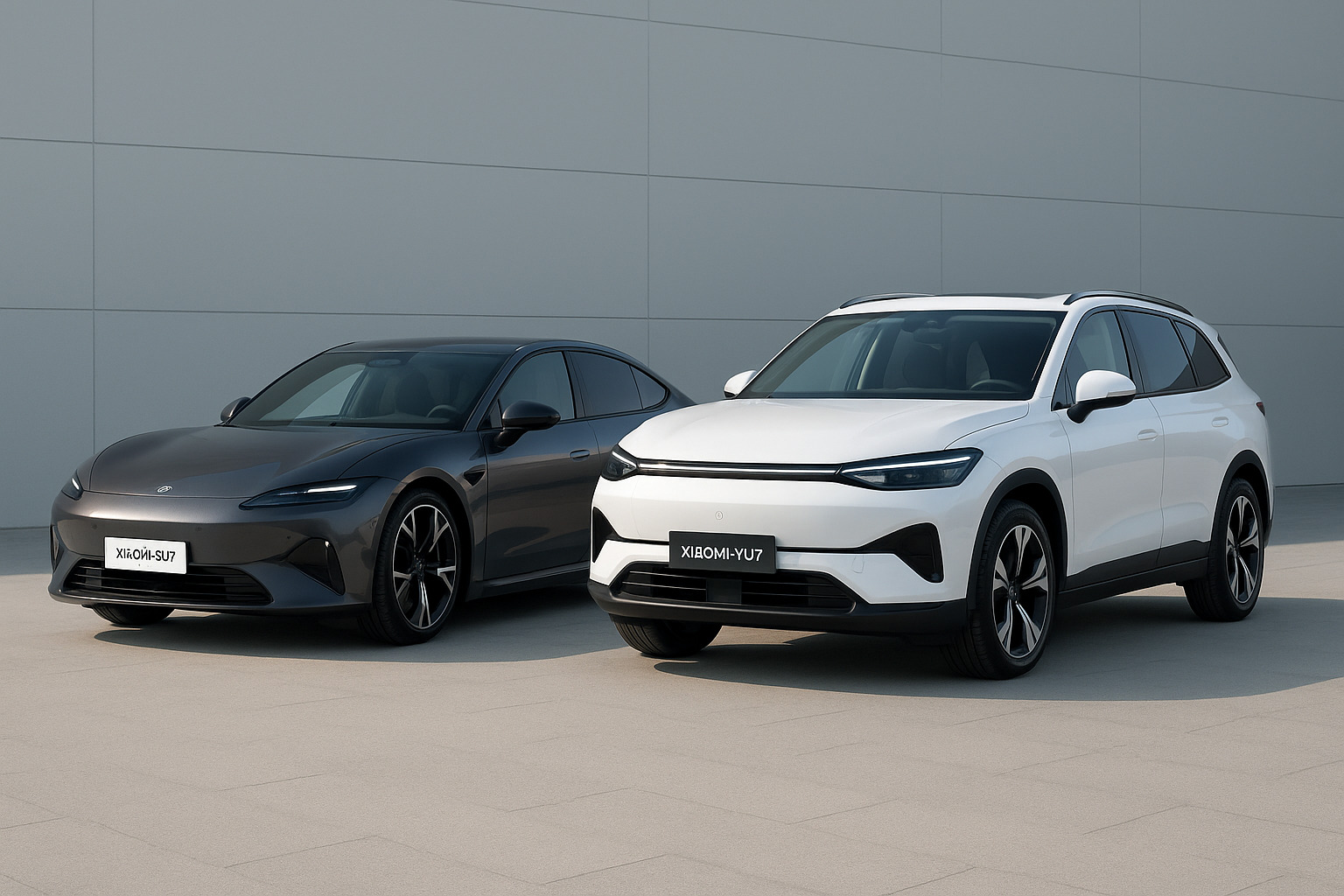
Xiaomi’s car business this year hasn’t just been “steady” — it has blown past expectations.
According to official data from Xiaomi Auto, since April 3, 2024, the company has delivered more than 500,000 vehicles. This achievement has set a new global record for the fastest new energy vehicle maker to reach the 500,000-unit milestone.
Looking back at the Xiaomi SU7 and YU7, it’s clear these models were never designed as safe, middle-of-the-road choices. They lean into a sporty character, coupe-style silhouettes, and a deeply integrated “people–car–home” ecosystem rather than pure mass-market compromise. Yet despite this non-traditional positioning, Xiaomi’s cars are selling extremely well.
And the company is far from showing its full hand.
Based on multiple credible leaks, Xiaomi still has several new models in the pipeline: the high-performance track-focused YU7 variant, Xiaomi YU7 GT; the family-oriented extended-range SUV codenamed “Kunlun,” likely to be launched as Xiaomi YU9; and an updated, facelifted version of the Xiaomi SU7 expected next year.
That’s already a rich product roadmap — and it may still not be the full story.
Recently, new clues have surfaced online suggesting something even more ambitious: Xiaomi is working on its very first motorhome.
Could this be the “first motorhome for young users” under the Xiaomi brand?
In today’s new energy market, every serious player is busy expanding its product matrix. Still, given that the refreshed SU7 and the YU9 have yet to hit the market, talk of a Xiaomi motorhome initially sounded a bit premature — more like fun speculation than reality.
That was the mindset at first: an interesting rumor, nothing more.
But then the story gained weight. The media account “Shanghai Auto News” reposted the leak and added that it had also heard about a Xiaomi project codenamed “Man Island” from a major supplier about half a month earlier. With this cross-verification, the idea of a Xiaomi motorhome with the internal codename “Man Island” started to look increasingly credible.
Following that trail, another key piece of evidence appeared.
In November 2025, Xiaomi published a patent titled “Table Assembly and Vehicle.” The stated purpose: to integrate a practical table into the limited space inside a vehicle, minimizing the space it occupies when not in use.
Studying the patent, the table system appears to work like this: when folded vertically, the tabletop first moves upward, then rotates into a horizontal position where items can be placed on it. When stowed, it occupies virtually no lateral space inside the cabin.
That naturally raises a few questions: what kind of vehicle can accommodate such a substantial table mechanism? And what type of vehicle truly needs a dedicated, deployable table as part of its interior layout?
Xiaomi SU7, Xiaomi YU7, Xiaomi YU9?
Clearly not. A system like this doesn’t fit conventional sedan or SUV layouts.
Now, put that patent next to the “Man Island” leak, which describes a model with a 95 kWh battery and roughly 600 km of range, four motors, active suspension, an interior with a wardrobe and shoe rack, a 30-inch TV, a roof that can lift to allow standing height inside, and a rooftop sleeping area.
It’s hard to imagine this being anything other than a motorhome designed around outdoor living and long-distance travel.
A four-motor setup would enable ultra-responsive torque distribution. Active suspension would simultaneously improve comfort and off-road capability, and could lower the vehicle when parked to make getting in and out easier. A large 95 kWh battery with an extended-range system would directly address long-range energy anxiety — especially important for a motorhome.
But the most exciting part may be what happens inside such a vehicle.
With the SU7 and YU7, Xiaomi’s “people–car–home” concept has so far focused on phone–car connectivity, voice control of vehicle functions, and remote control of smart home devices. A motorhome, however, is essentially a “mobile home” on wheels — the perfect canvas to fully embed the entire Xiaomi smart home ecosystem.
In theory, a Xiaomi motorhome could integrate a wide range of Mi Home smart devices and accessories from day one.
And this isn’t Xiaomi’s first experiment in blending RVs with its smart home ecosystem. Back in 2021, Xiaomi partnered with RV manufacturer Ailvtou to build a smart home motorhome that was unveiled at a launch event. Based on the Maxus V90C chassis, the vehicle’s interior was outfitted with Mi Home devices.
Inside, there was a bathroom, bedroom, and kitchen. The smart features were immediately recognizable: a Xiaomi water dispenser, a Xiao Ai touchscreen speaker Pro 8, a Mi induction cooker, air purifier, and more. When Lei Jun demonstrated it, he simply pulled out his phone and triggered a “Home Mode” scene: the interior lights turned on, the curtains closed automatically, and Xiao Ai reported the room’s temperature and humidity. After a shower, he could lie back and watch shows via a Mi projector.
For a traditional RV, that level of integrated “people–car–home” interaction was a genuine step change.
However, that RV wasn’t a Xiaomi-built vehicle, and with modest specs and relatively high cost, the project never turned into a large-scale product.
Fast-forward a few years, and the situation is very different. Xiaomi now has its own automotive platform, a more mature Mi Home ecosystem, and far more experience bringing devices into vehicles. Launching a motorhome that you can literally move into at any time would no longer be just a tech demo — it would effectively be a “Xiaomi Home on wheels.”
That said, Xiaomi’s current smart speaker or in-car control experience still has limitations. Most interactions are based on strict voice command rules. If you shorten a phrase or speak less precisely, Xiao Ai sometimes struggles to understand what you actually want.
The good news is that Xiaomi is already working on a next-generation solution: the Xiaomi Miloco smart home future exploration system.
In simple terms, Miloco is a large-model-driven smart home brain. It is designed to truly understand natural language. If you simply say, “I want a good night’s sleep,” it can automatically adjust the lights, air-conditioning, and ambient noise of your Mi Home devices — no need to spell out each command step by step.
Miloco also uses Mi Home cameras as its “eyes,” enabling visual understanding of the environment. Ask, “Where’s my cat?” and it can identify the pet via camera feeds and tell you which room it’s in.
Overall, Xiaomi Miloco feels like a “Jarvis for the home”: it can proactively give suggestions and understand conversational instructions instead of just reacting to rigid commands.
Now imagine Xiaomi combining this technology with a full suite of Mi Home devices, all factory-installed in a motorhome.
From a value standpoint, that could rival or even outperform an older, expensive city apartment — and it comes with the freedom to park beside a lake, under the stars, or at the foot of a mountain. In terms of emotional appeal, it’s off the charts. Drive a million-yuan sports car and people might glance over politely. Park a fully loaded Xiaomi motorhome, and most passers-by will probably walk up and ask, “Hey, can I have a look inside?”
At this point, it’s hard not to think back to that wish a netizen once shared during Lei Jun’s livestream: “I want to drive a motorhome with Xiaomi smart home installed and travel around China.”
If the “Man Island” project is real, Xiaomi might be getting ready to turn that dream into reality — and to prove once again that its reputation as a “dream-maker” brand is still very much alive.