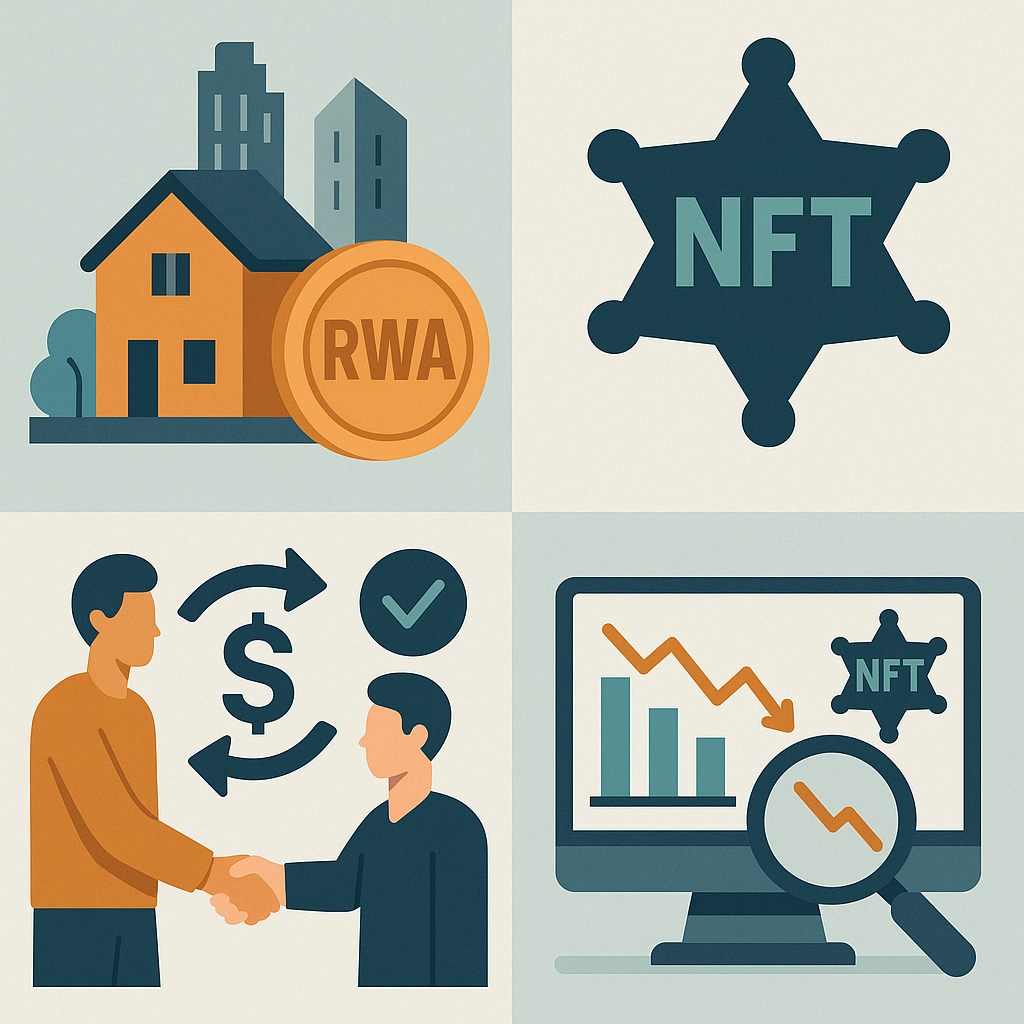
A new report from blockchain analytics platform DappRadar highlights that the NFT lending market has plummeted nearly 97% since its early 2024 peak and is currently facing significant declines in both transaction volume and user activity. However, analyst Sara Gherghelas believes that introducing real-world assets (RWA) as collateral could be the catalyst needed to breathe new life into the struggling NFT lending industry. Additionally, streamlining lending processes and incorporating intelligent risk management solutions are seen as potential drivers of a future recovery.
Summary
The NFT lending market is currently in deep decline, with borrower and lender activity down by 90% and 78%, respectively, and the average loan size dropping by 71% year-on-year. DappRadar analysts suggest that real-world asset NFTs (RWAs) could offer more stable collateral sources, potentially unlocking new demand for lending. Furthermore, innovations such as simplified tools, credit scoring, and AI-powered risk management systems might help revive the market. While the market remains in a holding pattern in the short term, new applications could pave the way for a more sustainable phase in NFT lending.
Full Article
Blockchain analytics platform DappRadar recently released a report indicating that combining real-world assets (RWA) with NFTs could be a key catalyst for reviving the NFT lending market. The sector is currently grappling with sharp declines in transaction volume and user activity.
DappRadar analyst Sara Gherghelas noted that NFT lending volume has plummeted from a peak of around $1 billion in January 2024 to just $50 million in May 2025—a staggering 97% drop. She stressed that for NFT lending to “move beyond survival mode,” it needs more stable and credible collateral sources, such as tokenized real estate, to serve as a foundation for a market revival.
“So far, 2025 hasn’t provided a convincing reason for an NFT lending rebound,” Gherghelas said. “While the infrastructure is still in place and platforms remain active, the overall activity has slowed, with many in the sector waiting for new use cases or a broader market recovery.”
She added that other potential catalysts include tools that simplify the borrowing process, low-collateral lending, credit scoring, and AI-driven risk-matching systems.
The report also showed that since January last year, borrower activity has fallen by 90%, while the number of active lenders has dropped by 78%. The average NFT loan size has shrunk from a peak of $22,000 in 2022 to $4,000 in May 2025—a 71% year-on-year decline.
Gherghelas noted that this shift likely reflects users becoming more cautious with leverage or only using it for lower-value assets.
Additionally, the average loan term has shortened from around 40 days in 2023 to about 31 days in 2024 and early 2025, suggesting that lending activity has become more tactical and short-term.
The broader slump in the NFT market has also directly impacted lending activity. In Q1, NFT market transaction volume fell 61% year-on-year to $1.5 billion.
“As the value of NFT collateral has collapsed, lending demand has naturally decreased,” Gherghelas said. Although a few platforms remain active or have managed to regain momentum, these are exceptions rather than the norm.
The NFT lending ecosystem has also clearly contracted, with only eight protocols holding significant market share.
Gherghelas concluded: “The speculative flipping and high-risk leverage models that thrived during bull markets are no longer viable in today’s cautious environment. But this doesn’t mean the end for NFT lending. Instead, the sector is shifting towards more practical and sustainable models. As platforms diversify, collateral preferences evolve, and new use cases emerge, NFT lending may be on the verge of a ‘second spring’—a phase built on durability and real-world utility.”