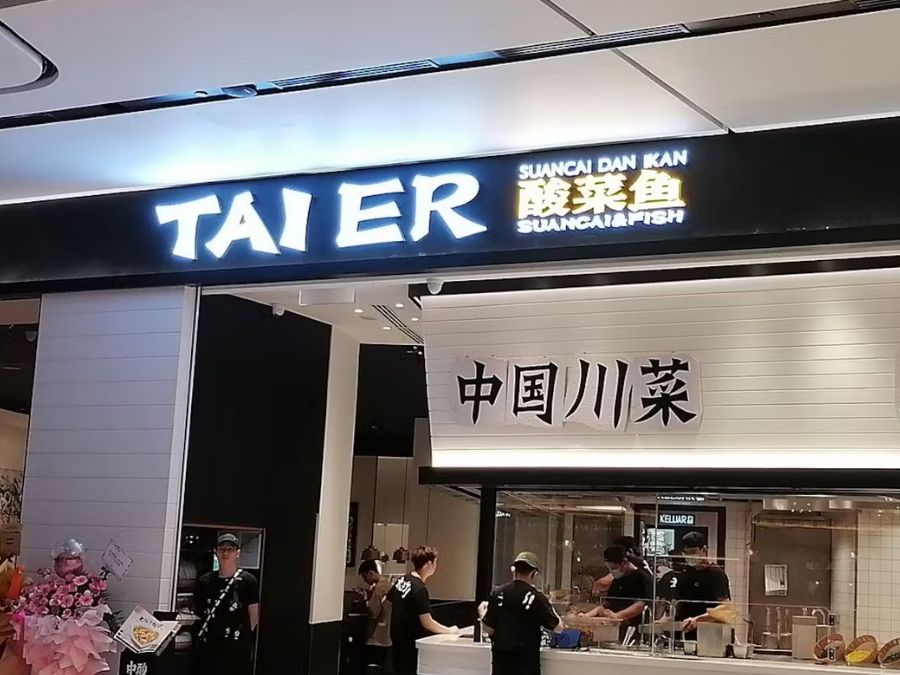
Tai Er is changing again.
In 2025, if you visited Tai Er at the beginning, middle, and end of the year, you might have noticed its storefront signage evolving almost in phases. Some locations first added the words “fresh live,” becoming “Tai Er Fresh Live Sauerkraut Fish.” Now, other stores have shifted further—rebranding as “New Tai Er · Fresh-Ingredient Sichuan Cuisine.”
Even the catchphrases shouted when dishes arrive have kept pace with the makeover. The long-standing “Sauerkraut is tastier than fish” gave way to “Live fish that’s even better than sauerkraut is here,” and the latest version now reads: “Using fresh live ingredients to cook fresh-ingredient Sichuan cuisine.”
So why does Tai Er keep reinventing itself?
From sauerkraut fish to a broader Sichuan menu
In late December, several “New Tai Er · Fresh-Ingredient Sichuan Cuisine” stores (referred to below as “New Tai Er” stores) quietly opened in Guangzhou and Foshan.
At these locations, Tai Er’s once-untouchable signature—sauerkraut fish—still appears on the menu, but both pricing and portion size have changed. According to a staff member at a Guangzhou “New Tai Er” store, the dish is currently priced at 99 RMB for 300g. Compared with the past, the fish portion has been reduced by 50g, and the price lowered by 40 RMB.
The goal of adjusting the sauerkraut fish, the staff explained, is straightforward: to encourage customers to order more dishes beyond the classic.
Those “other dishes” are built around five headline ingredient themes: live fish, live shrimp, fresh beef, fresh chicken, and fresh pork. After the renovation, “New Tai Er” stores added more than 20 new dishes. These aren’t traditional Sichuan “blockbuster” staples, but rather modernized, fusion-style Sichuan offerings—such as cheese spicy shrimp (78 RMB), stir-fried fresh beef (72 RMB), and stir-fried fresh pork (48 RMB).
So far, this shift doesn’t appear to be driven by pricing pressure. On Dianping, “New Tai Er” set menus—152–158 RMB for two people, and 289 RMB for 3–4 people—put per-person spending around 74–80 RMB, roughly in line with classic Tai Er sauerkraut fish stores.
Not long after opening, “New Tai Er” stores climbed onto Dianping’s Guangzhou Sichuan cuisine trending list. The same staff member said that queues typically form within half an hour of opening for both lunch and dinner service.
In reality, brand upgrading has been one of Tai Er’s defining themes throughout 2025.
As early as March, Tai Er confirmed a brand upgrade strategy centered on its “5.0 Fresh Live Model.” Tai Er Sauerkraut Fish told Youyisi Report that the “fresh live” stores rolled out in the first half of the year already emphasized live fish, fresh chicken, and fresh beef, which was essentially a move toward “fresh-ingredient Sichuan cuisine.” The “New Tai Er” stores go a step further—expanding the menu, deepening the positioning, and pushing the “fresh-ingredient Sichuan cuisine” concept into a more complete format.
As for scale, Tai Er says this store model currently includes only five or six locations and remains in a testing phase. The next step is still a nationwide transformation of “fresh live” stores. According to the parent company Jiumaojiu Group’s 2025 Q3 financial report, Tai Er expects the number of renovated stores to reach 200 by year-end.
But why step away from doubling down on sauerkraut fish—and pivot into Sichuan cuisine?
Why the sauerkraut fish formula is no longer enough
One reason is simple: it has become harder for Tai Er to make strong money from sauerkraut fish alone. With ongoing controversy around prepared dishes and the growing impact of cheaper “substitute” sauerkraut fish competitors, Tai Er’s performance has shown fatigue since 2024.
Financial reports show that in the first half of the year, Jiumaojiu Group delivered 27.53 billion RMB in revenue, down 10.14% year-on-year, while net profit attributable to shareholders fell 16.05% to 60.69 million RMB. Within that, Tai Er generated 19.48 billion RMB in revenue, down 13.3%.
Meanwhile, the broader Sichuan cuisine track is thriving. According to Hongcan data, by October 2024, China’s number of Sichuan cuisine restaurants exceeded 150,000, accounting for 11.4% of the Chinese dine-in segment—ranking first among all major cuisine categories.
In many ways, sauerkraut fish was originally a breakout “spin-off” from Sichuan cuisine. Now, with sauerkraut fish momentum weakening, Tai Er seems determined to return to the larger Sichuan “home base.”
At the same time, Tai Er is clearly leaning into the idea of “fresh live”—fresh ingredients, cooked to order, stir-fried on site. After the prepared-dish debate, consumers have become increasingly sensitive to “made fresh” claims. Nearly every restaurant brand is trying to label itself as “wok-fresh,” and Tai Er is not about to be left behind.
The hardest part: escaping the sauerkraut fish label
Still, transforming into a Sichuan cuisine brand comes with real obstacles.
In the view of Lin Yue, chief consultant at Lingyan Management Consulting, Tai Er has chosen a path that looks trend-aligned on the surface—but is far more demanding operationally.
The most obvious challenge is pricing.
Hongcan data shows Sichuan cuisine’s per-person spending typically falls in the 30–80 RMB range, with 30–60 RMB representing the largest share at 43.2%, followed by 60–80 RMB at 27.7%. Only a small portion of premium Sichuan restaurants push beyond 100 RMB per person.
That isn’t great news for Tai Er, whose per-person spend is close to 80 RMB. Zhan Junhao, founder of Fujian Huace Brand Positioning Consulting, argues that Tai Er’s pricing is not necessarily unreasonable—but the “value anchor” is unclear. Compared with mainstream Sichuan restaurants, Tai Er looks expensive and less cost-effective. Compared with premium Sichuan, it lacks the atmosphere, occasion, and emotional value that justify higher prices.
And cutting prices further may be difficult. “New Tai Er” stores emphasize fresh ingredients and on-site cooking. Staff say ingredients are delivered the same day. Lin Yue estimates this kind of shift could raise supply chain costs by around 15%—meaning the redesigned Tai Er is operating with higher costs, not lower.
A bigger challenge lies in people.
Unlike Tai Er’s earlier central-kitchen model, fresh cooking depends on one thing above all: chefs. Training chefs takes time, and scaling a chef-dependent model is rarely fast.
That’s why many fresh-cook Chinese restaurant brands grow steadily but not explosively. Take Fei Da Chu (known for chili stir-fried pork): data from Narrow Door Restaurant Eye shows that after nine years, it still has only 188 stores.
By contrast, Tai Er had 530 stores as of the third quarter this year. As the transformation expands, whether chef capacity can keep up with store demand will become a real test.
Tai Er is accelerating training. According to the same store staff, new dishes are developed by Sichuan chefs hired by headquarters, then rolled out through more than one month of kitchen training before being served to customers.
But a Sichuan cuisine operator with more than 20 years of experience told Youyisi Report that such short-term training is not enough. In his view, a Sichuan chef typically needs three to five years in the industry to truly reach a competent baseline.
Lin Yue shares a similar concern: one month can teach a method, but ensuring consistent flavor across different stores and different chefs is far from easy.
Finally, Tai Er must cross an even harder barrier—rebuilding brand perception.
For years, Tai Er has been synonymous with sauerkraut fish. Now it wants consumers to accept that Tai Er doesn’t just do sauerkraut fish—it can also represent Sichuan cuisine.
Zhan Junhao believes that because Tai Er has been deeply bound to sauerkraut fish for so long, the old impression won’t shift easily. Entering the Sichuan category under the same Tai Er name could even create confusion. “To reshape consumer perception,” he argues, “the marketing, R&D, and education costs are hard to estimate—and the education cycle could easily take years.”
From that perspective, Tai Er isn’t just upgrading its menu.
It’s racing against time.