2 days and 20 hours across the U.S. with zero interventions — has Tesla FSD passed the “physical Turing test”?
Tesla’s Full Self-Driving (FSD) is edging toward a symbolic milestone: driving in the real world in ...
Tesla’s Full Self-Driving (FSD) is edging toward a symbolic milestone: driving in the real world in a way that increasingly “feels human.”
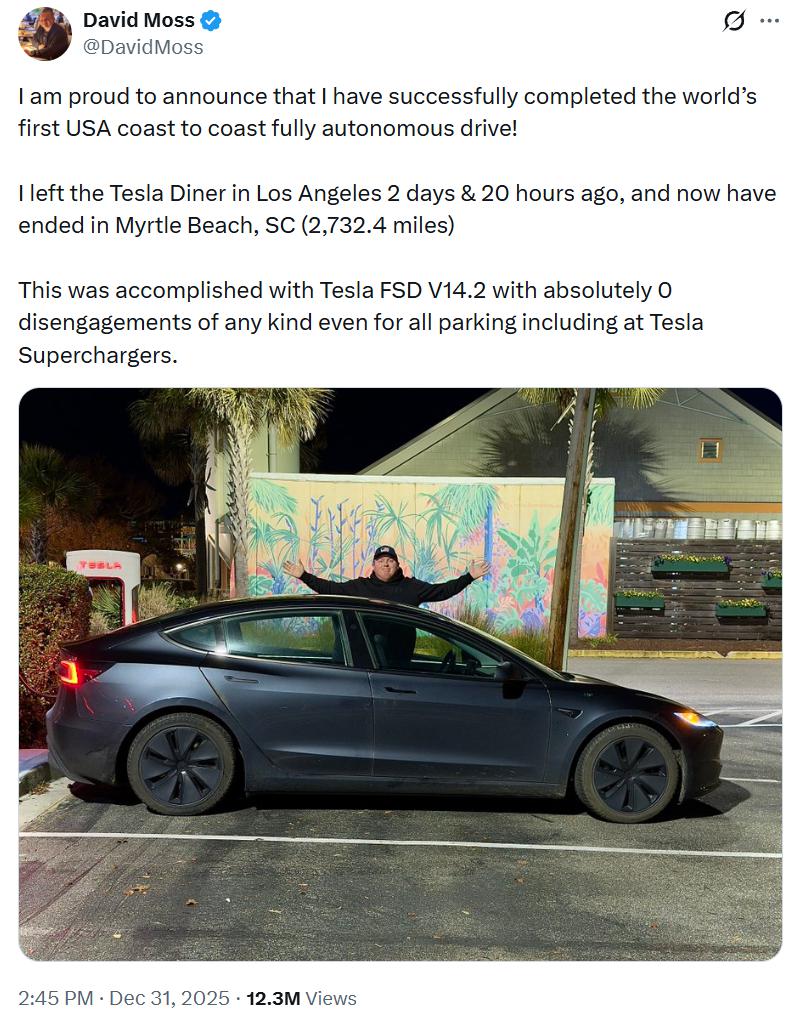
Recently, a Tesla owner documented a coast-to-coast run in a Model 3 equipped with AI4 hardware and FSD v14.2.1.25. The trip started in Los Angeles and ended in Myrtle Beach, South Carolina, taking 2 days and 20 hours over roughly 2,732 miles. The route reportedly included highways, city streets, night driving, multiple Supercharger stops, and parking maneuvers—while the owner claimed zero human interventions throughout.
The significance isn’t just the distance; it makes a long-standing question more concrete: Is FSD now stable enough across real-world conditions to effectively replace a human driver in most situations?
However, it’s important to note that Tesla still positions the system as “FSD Supervised,” meaning the driver must remain attentive and be ready to take over at any moment—this is not legally recognized driverless autonomy.
At the same time, the phrase “physical Turing test” has gained traction. Borrowing from the classic Turing test, it shifts the focus from language to physical behavior: if observers can’t easily tell whether a task was performed by a human or a machine, the machine is said to be approaching that threshold. Supporters argue FSD v14 shows more humanlike driving cues—cautious creeping at intersections, smoother braking, natural lane changes, and responsive handling of subtle real-world signals.
Still, a “physical Turing test” is more of a perception-based claim than a formal safety certification. Even a high-profile “zero-intervention” run needs broader, repeatable validation across edge cases before it can translate into a definitive conclusion about real-world autonomy.

Long Island MRI Room Horror: 61-Year-Old Companion Fatally Sucked into Scanner by Metal Necklace
On July 20, a rare and tragic accident occurred at an MRI center on Long Island, New York: a 61-year-old man accompanying a family member for an MRI scan was fatally injured when his metal necklace was violently drawn into the scanner’s powerful magnetic field. He succumbed to his injuries the following day.
Trump Proposes $100,000 H-1B Visa Fee Hike, Sending Shockwaves Through the Tech Industry
U.S. President Donald Trump has unveiled plans to impose a staggering $100,000 fee on H-1B visa appl...
Legendary Atlético Madrid captain Enrique Collar has passed away at the age of 91. Known as the “First Golden Boy,”
Collar was the club’s longest-serving captain, leading the team from 1960 to 1969. On December 30, A...
Wang Junjie says he’s “jealous”: the coach’s constant push and real opportunities unlock Lin Wei at his best—23 points showcasing his value as a combo guard.
Oregon lost 85–88 to Rutgers in overtime, but the game still delivered something important: the best...
Not just A1 soup packs—Hee’s Group will also sell New Zealand instant milk powder.
(Kuala Lumpur, Jan 7) A1AKK (A1AKK, 0365, ACE Market) announced that it has been appointed the exclu...
Xibei Won’t Back Down
Recently, the topic “#Xibei waiter payslip#” trended again, and the claim that some Xibei frontline ...
Another wave of layoffs hits the financial sector, with Citi and UBS among the firms affected
New York, Jan 13 — Several major financial institutions have begun the new year with workforce reduc...
Google Confirms: YouTube Background Play Now Exclusive to Premium Members
On January 30, Google confirmed to Android Authority that YouTube has updated its service rules, res...
Miho Nakayama’s son gives up 50 million inheritance: reason revealed
(Tokyo, April 4) Miho Nakayama, widely known as Japan’s iconic beauty and star of the classic film L...