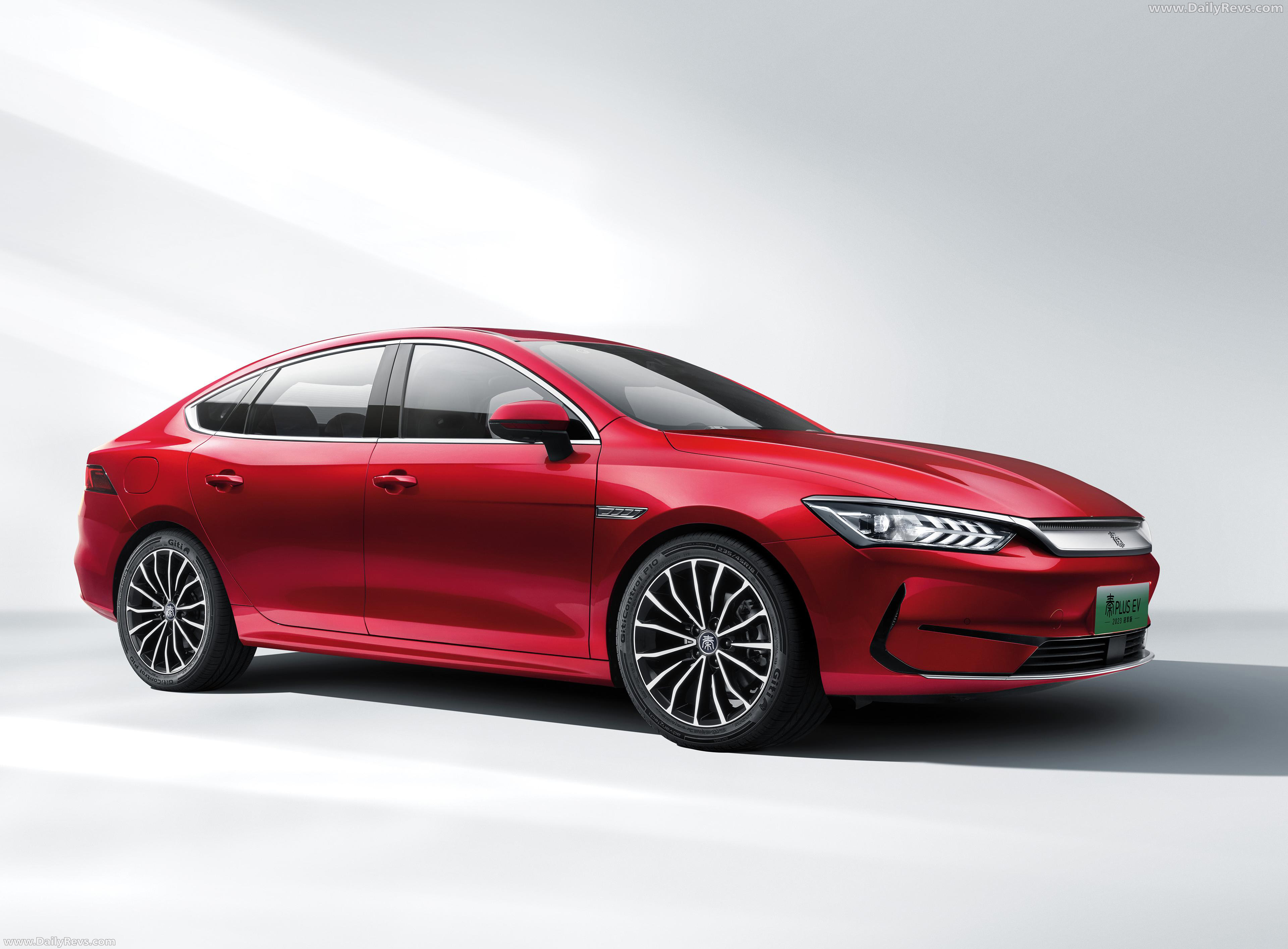
On the evening of January 8, BYD rolled out a major upgrade for its Qin family. Our team at LEI Technology / EV Guide was invited to attend the launch and experienced firsthand a “no fluff” showcase of technology made accessible for everyday drivers.
The message of the event was clear and focused: extend electric-only range and further reduce the cost of ownership. Both the 2026 Qin PLUS DM-i and Qin L DM-i now add a long-range variant, with battery capacity increased to 25.28 kWh and CLTC pure-electric range jumping to 210 km.
In terms of pricing, both models continue the Qin family’s long-standing value proposition, staying true to the “affordable for the masses” positioning that has made the lineup so competitive.
With cumulative sales surpassing 2.7 million units, the Qin family is already the champion of the mainstream family-sedan segment. In our view, introducing a longer-range version is like adding another log to an already roaring fire—strengthening momentum in a market that’s clearly leaning toward more electric miles, even in plug-in hybrids.
As charging infrastructure becomes more complete, many PHEV owners are increasingly hoping for longer EV-only driving. While a hybrid system solves range anxiety, pure-electric driving is simply more cost-effective in cities with convenient charging. With 210 km of EV range, a typical commuter could realistically drop charging frequency to about once a week—an upgrade that translates directly into everyday convenience and savings.
Efficiency remains a headline feature. BYD states that both models achieve an ultra-low depleted-battery fuel consumption of 2.79 L/100 km (NEDC), with total combined range reaching 2,110 km. At the event, Lu Tian, General Manager of BYD Dynasty Network Sales Division, offered a straightforward comparison: a family of four driving a Qin L DM-i round trip between Shenzhen and Wuhan would cost about RMB 400 in total, while a round-trip high-speed rail journey could cost around RMB 4,000.
That kind of contrast makes the Qin family’s advantage for family travel instantly tangible—especially for households that value flexibility, comfort, and cost control.
Beyond range and fuel economy, both new models also receive targeted upgrades in equipment and features.
Starting with the 2026 Qin L DM-i, BYD continues to offer the DiSus-C intelligent damping body control system with a preview function, designed to deliver a more composed and confident driving experience. On the safety front, the vehicle adds a W-HUD head-up display and a class-exclusive front-row far-side airbag. BYD is also providing the TBC high-speed tire blowout stability system as a complimentary feature, reinforcing its emphasis on active safety.
Smart comfort is another standout. BYD has partnered with Goodbaby and Breo, enabling users to control compatible Goodbaby smart child safety seats, Breo neck massagers, and smart eye-mask devices through the central screen and voice assistant—bringing a more integrated “in-car ecosystem” experience to everyday family use.
Meanwhile, the Qin PLUS DM-i—positioned below RMB 100,000—also receives a notable wave of intelligent features previously reserved for higher-priced segments. The “God’s Eye C” driver assistance system (DiPilot 100), which includes high-speed navigation assistance, lane cruising assistance, and full-scenario intelligent parking, is now available on this compact NEV sedan. It also offers the upgraded DiLink 100 smart cockpit with features such as phone-car connectivity, karaoke without a microphone, and a built-in gaming center.
To many people, the Qin family’s popularity may look like a simple story of “it’s cheap.” But that misses the bigger point. The Qin family has succeeded because it keeps solving real-world user pain points with speed and precision.
When consumers wanted lower-cost travel without range anxiety, BYD developed its fifth-generation DM technology and introduced it on the Qin L—helping it become a breakout hit right from launch. When BYD noticed everyday families valued features like a heating-and-cooling storage box, it moved quickly to bring that functionality down to the mainstream.
Now, as more drivers want PHEVs to deliver longer EV-only range, BYD responds with a 210 km pure-electric Qin family—while also steadily expanding comfort-oriented smart ecosystem devices across the lineup. That relentless focus on what users actually need is the real reason the Qin family continues to sell so well.
With 2026 only just beginning, and with the Qin family still serving as one of BYD’s core volume pillars, this evolution clearly isn’t the end of the road. As the industry’s “second half” of intelligent transformation accelerates, the Qin family looks set to keep pushing the idea of technology for everyone—proving that a true national family sedan isn’t only about an accessible price, but also about delivering a level of quality and capability that feels genuinely above its class.