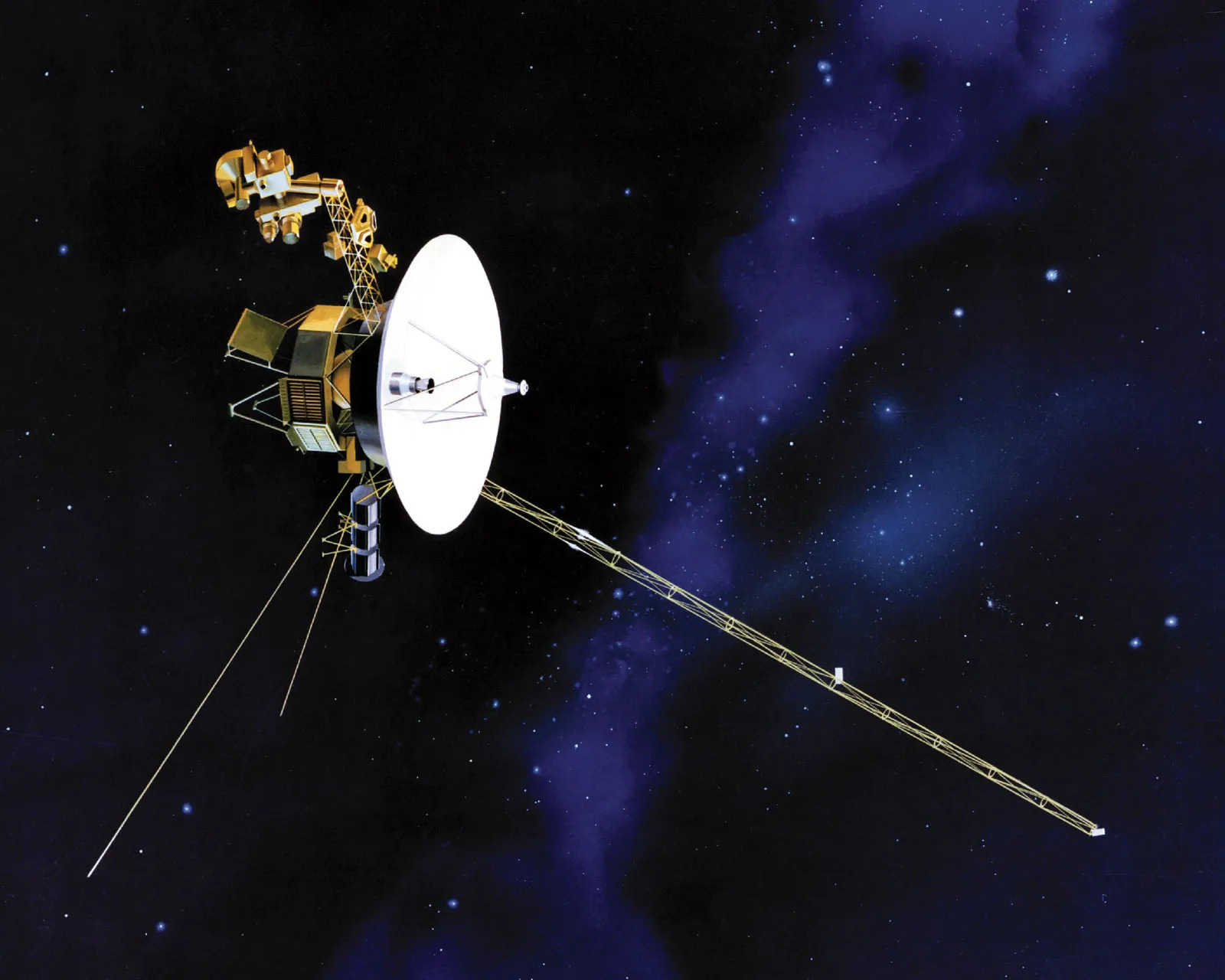
Voyager 1 was once forecast to fall completely silent in 2025. Yet the farthest human-made spacecraft in history has crossed into another new year—still doing what it has always done best: turning improbability into achievement.
Today, it is racing through space at roughly 17 kilometers per second, more than 25.5 billion kilometers from Earth, heading toward the constellation Ophiuchus along the Milky Way. Age has caught up with it: most of its instruments have been shut down, its power output has dropped to well under half of what it once was, and its data rate back to Earth is slower than 1990s dial-up internet. And still, with what remains, Voyager 1 continues to speak—sending precious information home with its last, steady strength.
Recent telemetry suggests that at the edge of the solar system, Voyager 1 encountered an invisible “wall” where temperatures can soar to around 30,000°C—another clue helping scientists understand the boundary where the heliosphere meets interstellar space. Another milestone is also approaching: by November 2026, Voyager 1 is expected to be about one light-day away from Earth.
It is astonishing, especially when you remember that this “old traveler,” now nearing half a century in flight and reshaping humanity’s understanding of the solar system, was originally designed for a mission expected to last only five years.
In 1965, scientists made a fortunate discovery: in the late 1970s, Jupiter, Saturn, Uranus, and Neptune would align in a rare arc relative to Earth. This geometry would allow a spacecraft to “bounce” between planets using gravity assists—like a cosmic billiards shot—cutting the travel time to Neptune from about 30 years to roughly 12.
It was a celestial opportunity that calculations suggested comes around only once every 175 years. The last time it occurred was during the Napoleonic Wars, when “exploration” still meant horses, sails, and canoes—not machines navigating the outer solar system.
NASA originally hoped to launch four spacecraft to visit all the outer planets in one ambitious sweep. Budget cuts forced a more modest plan: a mission focused on Jupiter and Saturn, ultimately named the Voyager Program.
But the engineers never stopped thinking beyond the official boundaries. Over years of design decisions—quietly, almost by unspoken agreement—they kept weaving “secondary objectives” back into the spacecraft. The hope was simple and bold: complete the Saturn mission, and then keep going, onward to Uranus and Neptune.
Voyager 2 launched on August 20, 1977. Voyager 1 followed on September 5.
Thirteen days later, Voyager 1 turned back and captured the first-ever joint image of Earth and the Moon. In the vast darkness, Earth appeared as a luminous blue crescent, suspended against an endless cosmic backdrop.
It felt like a final wave goodbye. After that, Voyager 1 turned away and committed itself to a one-way route—leaving home behind for a journey that could never be reversed.
Before Voyager, our understanding of the outer planets was fragmented and often wrong. Some even assumed those distant worlds might resemble the Moon—cold, cratered, and geologically dead—so much so that no one initially thought the mission needed a geologist.
Then Voyager arrived, and the outer solar system revealed itself in breathtaking detail: Jupiter’s Great Red Spot, Saturn’s rings in all their structure and elegance, and Neptune’s storms with winds exceeding 2,000 kilometers per hour. We learned that moons are not automatically lifeless rocks—they can be worlds of erupting volcanoes, fractured ice shells, oceans larger than Earth’s, and perhaps even places where the signs of life could exist.
Day after day, the Voyager spacecraft delivered surprises. And among the roughly “100,000 encyclopedia volumes” of information they returned, the most famous image may be one that—scientifically speaking—offered almost nothing at all.
By 1989, both Voyagers had completed their grand planetary tour. With their final gravity assists, they were flung above and below the plane of the solar system. There was no next destination—only the unknown dark ahead.
They could have slipped away quietly. But Carl Sagan—one of the most influential astronomers of the 20th century, and an unashamed idealist—wanted Voyager 1 to do one last thing before its camera was permanently shut down: turn around and photograph Earth from about 6 billion kilometers away.
From a strict engineering perspective, it was hard to justify. Earth sat close to the Sun in Voyager’s view, and sunlight could damage the camera’s imaging tube. And from so far away, Earth would occupy only a pixel—maybe even less. Engineers didn’t want to spend limited resources on a seemingly useless observation.
Sagan insisted otherwise. Precisely because the image would show how unremarkable our world appears, he argued, it was worth taking. Seeing Earth as no more than a speck could change how humans think about themselves.
So on February 14, 1990, at 4:48 a.m., just 34 minutes before Voyager 1’s camera was powered down forever, it captured one of the most iconic photographs in the history of space exploration: the “Pale Blue Dot.”
For thousands of years, humans believed the universe existed for us. That image offered a quiet, sobering correction. In the immense starfield, Earth was only a tiny, faint blue point—no more special than any other world in view, as if it could be wiped away with a careless gesture.
Sagan later wrote a caption that became unforgettable: our self-importance and our illusion of cosmic privilege are challenged by that pale point of light. The picture, he argued, reminds us of our responsibility to treat one another more kindly—and to protect and cherish that pale blue dot, the only home we have ever known.
Since 1990, every kilometer Voyager has traveled has been an extra gift. But everyone also knows the time is limited. NASA’s latest plan is that after 2026, Voyager’s instruments will be shut down one by one to conserve power, leaving only the communication system running as long as possible. By around 2036, its remaining energy may be too faint to send even a final greeting—and we will lose contact with this old friend for good.
Even then, its journey will be far from over. In roughly 300 years, Voyager is expected to reach the inner edge of the Oort Cloud—often described as a theoretical boundary of the solar system. Yet it may take another 30,000 years to traverse the cloud’s outer edge and truly leave the Sun’s domain. After that, the spacecraft could drift around the Milky Way’s center for billions of years. If the universe were a photograph, Voyager would still have explored far less than 0.001 of a single pixel.
It is a scale that can unsettle anyone. Stretched across billions of years and expanded across the distances between stars, the civilization we take pride in—our history, our technology—can suddenly feel compressed into a point of light with no special marker. The coordinates we use to define meaning begin to dissolve.
Voyager does not answer what the universe is. Instead, it keeps reminding us that the universe is not built to human scale. And yet, within that almost uncomfortable smallness, humanity still chooses to send a trace of itself outward—not to conquer, and not necessarily to arrive, but simply to prove, in the boundless dark, that we were here.
Six months before Voyager launched, another decision—also led by Sagan—captured that spirit perfectly. The mission added a 12-inch gold-plated copper record: a time capsule of human civilization. It includes 115 images, greetings in 55 languages, 12 minutes of natural sounds from Earth, 27 musical pieces from around the world, and the coordinates of our solar system within the galaxy.
If an extraterrestrial civilization ever decodes it, they may see how 20th-century humans embrace, run, or lick ice cream. They may hear Bach and Beethoven, wind and rain, waves and whale songs, a human heartbeat—and a Chinese greeting that says, warmly: “How are you all? We miss you very much. Please come visit when you have time.”
Some questioned whether this was dangerous—an unnecessary act of revealing ourselves. Sagan’s response was characteristically hopeful: if a civilization found the record, they might assume a species willing to announce itself so openly must be driven by altruism.
From today’s vantage point, that may sound naive. But it was the 1970s—an era when space exploration felt unstoppable. Humans had reached the Moon, launched the first space station, and watched satellite television knit the world closer together. The phrase “global village” entered public imagination. Many scientists believed that if other life existed out there, it would not be an enemy, but a friend.
That belief shaped the record itself. The team intentionally avoided depicting humanity’s darker chapters—war, political conflict, or even folk songs that might be misread as aggressive. The message was designed to be beautiful, hopeful, and open-hearted. A greeting included from the then–UN Secretary-General spoke of seeking peace and friendship beyond our solar system.
This is one reason Voyager continues to captivate people. It represents not only technical progress, but something even rarer: the best of humanity—curiosity, courage, ambition, and resilience.
And among everything preserved on that record—built to last as long as a billion years—one of the most unusual entries may be a set of brainwaves from the project’s creative director, Ann Druyan. She wondered whether a far-future intelligence might one day decode human thought.
During an hour-long meditation, she reflected on Earth’s origins, evolution, human history, suffering, and hope. In the final minutes, her mind drifted—quietly, irresistibly—back to a recent moment: her engagement with Carl Sagan. She thought about love.
That small fluctuation was carried aboard Voyager, traveling alongside humanity’s grandest dream, until it is destroyed—or discovered by another civilization. We may never witness where it ends. But simply knowing it exists is enough to keep imagination alive here, on this modest blue world.