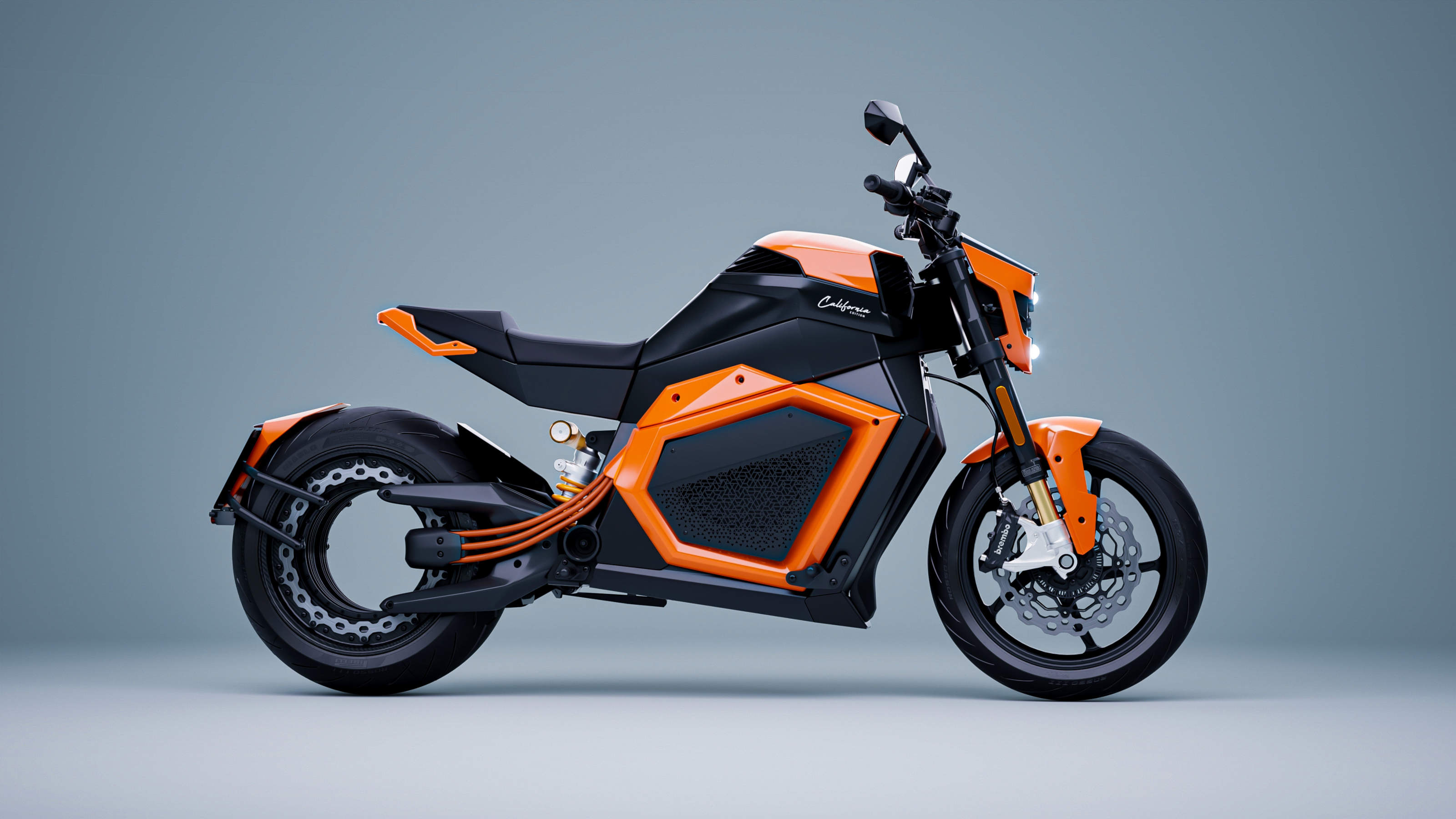
The Verge TS Pro electric motorcycle that just showed up at CES is, frankly, playing a little “no mercy.”
It comes armed with a hubless motor pushing over 100 horsepower, a 0–100 km/h sprint in just 3.5 seconds, and what’s being promoted as the world’s first mass-produced solid-state battery. If the claims hold, it can travel up to 600 km on a charge. On paper, the core hardware reads like a peak-level flex in the e-motorcycle world.
This machine comes from Finland’s Verge—a brand with a longer backstory than its “new” image suggests. The company started in 2018 as RMK, rebranded to Verge in 2020, and launched the first-generation TS Pro in 2022.
The CES version is positioned as the 2026 update, and its headline upgrades are the hubless motor and the solid-state battery. Interestingly, both key components come from the same supplier: a company called Donut Lab.
Putting a hubless motor and a solid-state battery into a production bike was never going to come cheap. In the U.S., the base price starts at USD $29,900. In Finland, after taxes and fees, it jumps to €42,200. This is unapologetically a luxury toy—at that price point in Finland, you’re flirting with Volvo XC40 money.
So does it deserve the price tag? Let’s start with the attention-grabbing hubless motor.
Its patent name is essentially “rim-integrated electric motor.” In plain terms, it’s still a form of hub motor—just shaped like a donut, embedded in the wheel rim, and undeniably futuristic to look at.
Globally, not many companies are making “donut motors” at scale. Donut Lab claims a product line spanning roughly 4.7-inch to 21-inch configurations, making it one of the few players betting big on this architecture.
The working principle is pretty straightforward. The stator is fixed to the motorcycle’s swingarm, while the wheel itself acts as the rotor. In other words, the motor lives in the rim: the stator generates a rotating magnetic field, and the rim—along with the tire—spins as a result.
Compared with traditional motorcycles, this setup eliminates chains, belts, and gears. With fewer drivetrain components, transmission efficiency can improve. But there’s a trade-off: motorcycles get bumped, scraped, and occasionally abused, and when the rear wheel is this highly integrated, repairs are unlikely to be cheap.
For the 2026 TS Pro, Verge is using Donut Lab’s “donut motor 2.0,” which is said to be lighter and better at heat management. The claim is that it can sustain peak output for 30 minutes without power fade—a bold promise in any high-performance EV segment.
Performance figures, at least on spec sheets, are hard to argue with. The Pro version is rated at 136 horsepower and an eye-widening 1,000 Nm of torque, with 0–100 km/h in 3.5 seconds.
Step up to the Ultra version and it reportedly reaches 204 horsepower and 1,200 Nm, dropping the 0–100 km/h time to just 2.5 seconds. That’s the kind of straight-line punch that puts it in the same conversation as high-end performance cruisers—meaning if you have the nerve, most cars won’t keep up in a quick acceleration run.
The other major headline is the battery: what Verge and Donut Lab describe as the world’s first mass-produced solid-state battery, with equally dramatic numbers.
Two battery options are listed. The 20.2 kWh version is said to deliver around 350 km of range. Pay an additional €3,000 (or about USD $5,000) and you can choose the 33.3 kWh version, which is claimed to reach 600 km.
If you roughly translate that into battery cost per kWh, the premium sounds less outrageous than people might assume—around RMB 1,800–2,700 per kWh. Compared with common ternary lithium packs used in many e-motorcycles (often roughly RMB 1,200–1,500 per kWh), the markup is noticeable but not absurd. For well-funded overseas buyers, the larger pack is likely the default choice.
Range alone is one thing, but Donut Lab’s published specifications are what really turn heads.
They claim energy density up to 400 Wh/kg—if that were broadly achievable in mainstream EVs, it could mean similar range with roughly half the battery mass.
They also claim cycle life as high as 100,000 cycles. Even with generous assumptions, that’s far beyond the typical “lifetime of the vehicle” narrative. In a playful sense, it’s less “one car for three generations” and more “one battery for five”—assuming everything else somehow lasts.
Fast charging is also part of the pitch: up to 200 kW, with claims of gaining 300 km of range in 10 minutes. Taken together, the specs read like something built for nonstop use, long-distance riding, and minimal downtime.
Of course, the big question is whether these numbers are real outside a controlled environment.
Across the industry, solid-state batteries are widely expected to reach broader commercialization closer to around 2030. Donut Lab, however, is positioning itself as if that future has already arrived—saying the technology is ready for vehicles now, and ready for production.
Even more provocatively, they suggest the battery does not require rare earths or lithium, while costing roughly the same as today’s lithium batteries.
They also claim they’ve already built a 1 GWh production line and plan to expand. That kind of confidence makes the story sound like a breakout challenger narrative—except there’s a major catch.
At the moment, much of this is still Donut Lab’s own storytelling. From performance claims to capacity claims, there’s no widely cited third-party validation, no transparent technical pathway disclosed, and little in the way of independent testing data. The “solid-state” promise, right now, remains a black box.
If you look deeper into the relationship between Verge and Donut Lab, it gets even more interesting. This isn’t a simple supplier partnership—the founders behind the two companies are reportedly brothers, which naturally raises questions about how the story is structured.
In late 2024, Verge spun off its technology division into an independent company: Donut Lab. The new entity would handle motor and battery R&D, supply Verge, and also sell its technology externally.
From a business perspective, this move makes sense. Technology platform valuations—especially anything tied to batteries—often trade far higher than motorcycle manufacturing valuations.
And sure enough, in July 2025, Donut Lab reportedly raised €25 million in seed funding. To many observers, the spin-off looks like a strategic “technology + capital” combination—where solid-state batteries are the most investor-friendly headline in the deck.
That leads to the uncomfortable but unavoidable question: are we looking at a genuine technical leap, or a polished capital-market narrative built around the hottest keyword in energy storage?
It wouldn’t be the first time Verge leaned on concept-first momentum. Back in 2019, when it was still RMK, the company announced the E2 concept bike with a €24,990 starting price and a €2,000 deposit, reportedly drawing more than 500 orders worldwide.
Mass production, however, didn’t arrive until July 2022—by then the brand had already transitioned from RMK to Verge, and the RMK E2 effectively became the Verge TS, with the higher-performance TS Pro released alongside it.
Now, with the 2026 TS Pro pushing “solid-state battery + hubless motor” as its new headline, it’s understandable that some people feel skeptical. Is this the real breakthrough moment—or another high-gloss promise designed to generate attention and funding?
For now, Verge has already won the visibility game at CES. The hubless motor is at least tangible—if it rides, performs, and holds up, it’s hard evidence.
The battery, though, is the mystery box.
The next real milestone is delivery. If Verge can actually ship in Q1 2026 as suggested, third-party testing and independent teardown-style validation will inevitably follow—and that’s when the industry will finally get a clear answer.