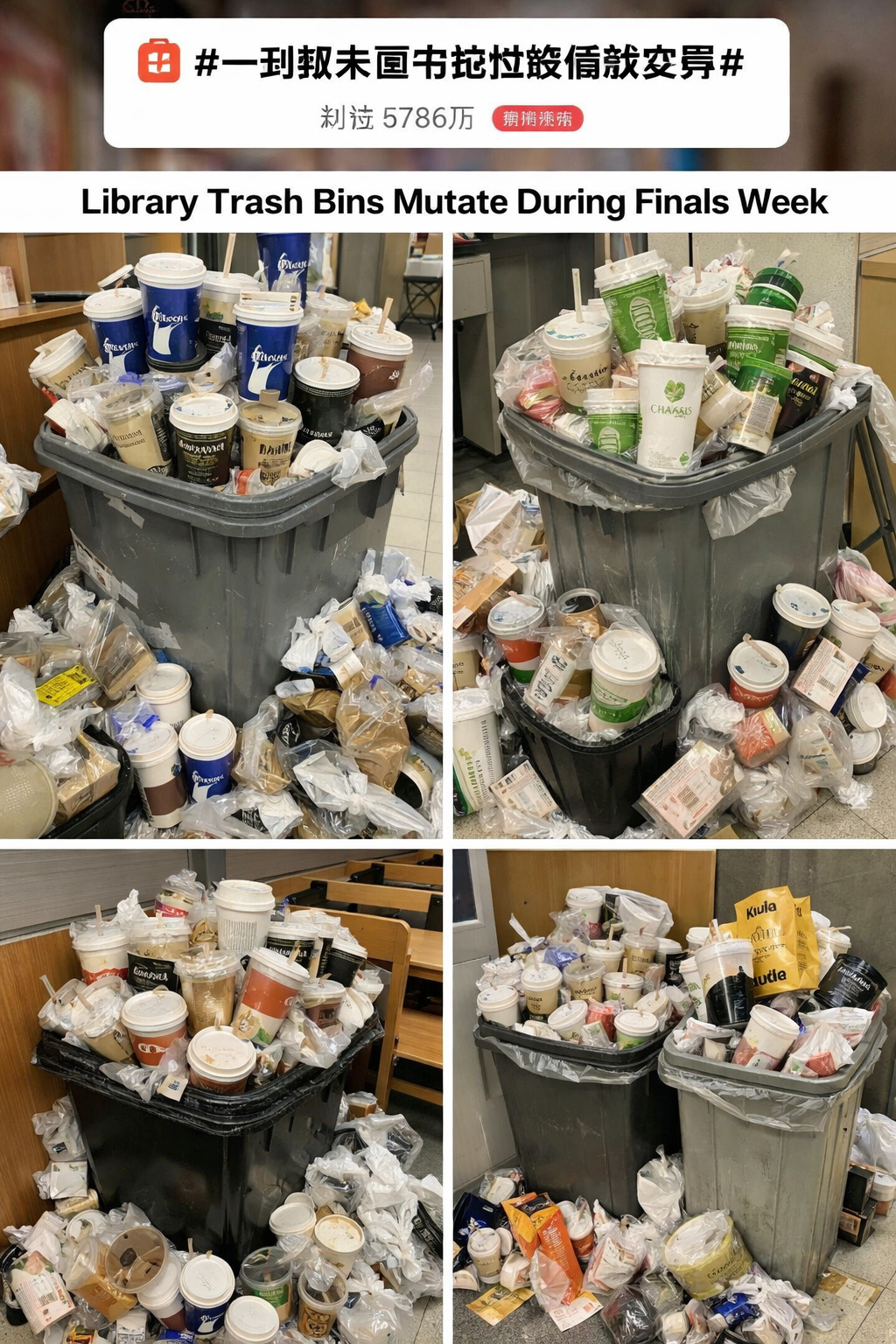
As finals week arrives, something strange happens to campus library trash bins—they “mutate.”
Who would’ve guessed that the fiercest battleground in today’s beverage competition is right here on university campuses?
Recently, the phrase “library trash bins mutate during finals week” trended on Xiaohongshu, with students posting photos of overflowing bins packed with coffee pouches and milk tea cups.
In some schools, “Cotti has the upper hand.” In others, it’s “a Luckin kingdom.” And in a few places, Chagee practically “books the whole venue.”
Put together, these bins look like real-time “heat maps” of the beverage war—while also revealing a shifting campus drink landscape.
During finals season, especially near libraries, empty coffee and milk tea packaging piles up into little mountains, spilling onto the floor.
The volume—and the neatness—can be genuinely shocking. “If you didn’t know better, you’d think this was a delivery pickup station,” one student joked. Another called it “the power of the finals-week ‘study-like-a-buffalo’ method.”
The topic struck a nerve, quickly climbing to No. 2 on Xiaohongshu’s trending list. Comments poured in: “This is literally my school,” “I contributed to that,” “Finals week is impossible without caffeine…”
As one blunt takeaway put it: no “first milk tea of autumn” marketing campaign can compete with the unstoppable demand of finals week.
From the photos students shared, brand dominance varies sharply by campus. Some bins are filled mostly with Cotti bags, others with Luckin, and some are nearly all Chagee—while 1点点 occasionally makes a quiet appearance.
One student described a routine that feels almost universal: wake up, order a coffee, then brush teeth and head straight to the library for battle.
Others said they need at least two drinks a day to “recharge” during long library sessions, while some treat milk tea as a small reward to stay motivated.
There were even playful suggestions online: if coffee and tea brands launched a “Pass Every Exam” series—complete with themed packaging and merch—it would almost certainly sell out.
Behind the humor, those overflowing bins also reflect very real stress and pressure. At the same time, they offer a surprisingly clear snapshot of competition on campus.
For example, photos from Gansu University of Chinese Medicine (Heping campus) show bins dominated by Luckin packaging. At Ningbo University’s Zhencheng Library (East Campus), Cotti bags surround the elevator-area trash bins.
Another noticeable detail: co-branded packaging appears far more frequently—hinting that collaborations may be especially effective with students.
Some photos show bins filled with Luckin x Mo Dao Zu Shi collaboration bags. Others feature Cotti’s “Romantic Debut” packaging tied to a collaboration involving Chanel’s Lesage atelier creative leadership.
There’s no question: finals week creates one of the biggest consumption spikes of the year for campus beverage stores.
Beverage brands have long been fighting hard for university market share. On many campuses, you can find most of the top coffee and tea chains operating side by side.
Luckin, as an early large-scale entrant, has already built a clear advantage. Public data shows that by the end of Q3 2025, Luckin had 29,214 stores in total. According to Narrow Gate Food Eye, stores located in schools account for 6.83%—close to 2,000 locations.
In its 2025 Location Franchise Report, Luckin disclosed that it opened over 600 new targeted locations in 2025, emphasizing deeper penetration into core consumption scenarios such as schools.
Cotti is also accelerating its campus expansion. Public information indicates that by December 2025, Cotti Coffee surpassed 18,000 stores, with school locations accounting for 9.42%. To scale faster, it has also introduced “light-investment” formats with a low entry threshold.
Meanwhile, Nowwa Coffee has expanded through both standalone campus stores and partnerships across on-campus retail scenarios—creating co-operated “store-in-store” models to increase reach with lower upfront investment.
If coffee brands are rushing campuses to capture “young people’s first cup,” milk tea brands—facing intense competition in mature markets—are also pushing deeper into more segmented, high-frequency consumption scenes like universities.
Mixue Ice Cream & Tea, driven by ultra-affordable pricing (often under 10 RMB per item) and massive store coverage, has become a “standard feature” for many campuses. With 42,000+ stores, its campus-store share is 7.73% (Narrow Gate Food Eye), roughly around 3,000 school locations.
For perspective, China’s Ministry of Education reported that as of June 20, 2025, there were 3,167 higher-education institutions nationwide—showing just how deep Mixue’s campus penetration runs.
Chagee, on the other hand, leans into a “premium image + flagship campus store” strategy. By opening stores at top universities, it builds brand benchmarks, attracts quality-focused students, and amplifies visibility through social sharing.
In June 2025, Chagee opened a campus store at Tsinghua University’s Zhaolan Courtyard. On opening day, it reportedly sold more than 2,200 cups and ranked No. 1 nationwide in single-day store GMV.
Another brand with a strong campus footprint is Yihutang, which claims an entry rate of over 70% in university commercial districts. In Wuhan, it has 120+ stores, and about 70% are campus locations.
Each brand is attacking the campus market with a different playbook. As universities become a key channel for new-store growth, the competition for campus dominance has entered a full-on white-hot phase.
But campus stores aren’t just about today’s sales—they’re about locking in tomorrow’s core customers.
Universities are increasingly viewed as a “new blue ocean” for chain beverage brands. Some reports estimate the campus dining market has an annual compound growth rate of 31.6%, with the total market expected to surpass 600 billion RMB in 2025.
At the same time, campus dining remains far less “chain-ified” than off-campus food and beverage—leaving major room for expansion.
For beverage brands, the advantages are obvious: stable foot traffic, thousands of students with high-frequency needs, and a rare opportunity to shape long-term brand preference early.
Student behavior also boosts organic spread. Decisions are often made by dorm groups, sharing is common, and friend-group purchases are frequent—making word-of-mouth and social visibility more powerful. Labor costs can also be more flexible, with the option to hire student part-timers.
So the value of campus goes far beyond a single store’s profitability—or the immediate finals-week rush. It’s one of the best environments to cultivate the next generation of loyal consumers.
After all, today’s “survival drink” on campus is very often tomorrow’s everyday staple in the working world.