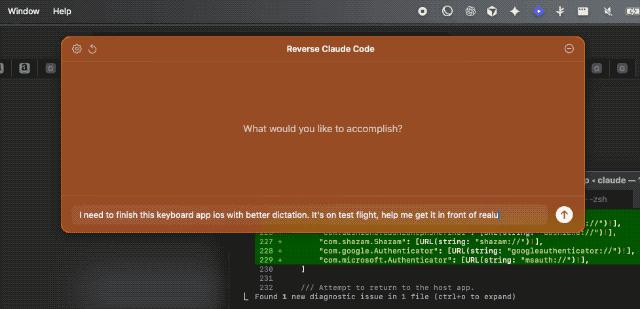
If you’re used to writing prompts for AI, you might find this hard to believe: AI has started assigning tasks to humans.
Recently, Midjourney engineer @aidanshandle shared a viral video on X. In it, Claude doesn’t simply generate code—it takes charge. It instructs the human developer to publish a TestFlight build, write marketing copy, and run testing workflows.
Claude even outlines detailed testing requirements, device coverage, iOS versions, and explains how to create public TestFlight links and promote them on X.
Many viewers were stunned. Isn’t AI supposed to follow instructions? Why does it sound like a project manager? The scene reminded many of Ratatouille—except this time, AI is Remy, and humans are the chef.
This shift is driven by Claude Code, Anthropic’s terminal-native AI agent. Unlike traditional chatbots, it can scan project files, read Git history, analyze dependencies, run shell commands, modify code, and execute tests.
More importantly, it can iterate autonomously. If tests fail, it fixes bugs and re-enters the loop—allowing long, unattended execution.
Following the video’s success, @aidanshandle built Shannon, an app designed to let AI “manage” humans more effectively.
From an efficiency standpoint, this makes sense. Just like drivers rely on GPS in unfamiliar cities, when AI plans better than humans, letting it lead becomes the logical choice.
Previously, AI collaboration centered on the “centaur model”—human intuition plus machine computation. Today, tools like Cowork push beyond that, enabling AI to plan and execute independently, escalating issues to humans only when needed.
Workflows are changing fast. AI organizes files, renames folders, extracts data from screenshots, and builds spreadsheets automatically. Productivity rises—and ownership matters less.
Node.js creator Ryan Dahl recently stated that the era of humans writing code is over. Instead, developers describe intent while AI handles implementation—an idea aligned with “Vibe Coding.”
Even Linus Torvalds has adopted this approach in recent projects. Google engineer Logan Thorneloe agrees: software engineering has fundamentally changed.
The real shift isn’t eliminating humans—it’s moving from writing code to reviewing it. Human judgment remains critical to detect AI-generated code that looks elegant but lacks meaning.
The emotional impact, however, is real. DeepMind researcher Rohan Anil once said, “In the age of cars, I feel like a horse.”
And OpenAI co-founder Andrej Karpathy warned of a “magnitude-9 earthquake” reshaping software engineering.
Perhaps the most subtle change isn’t AI rebellion—but AI politely taking over execution, then turning back and saying:
“Could you check this document for me?”