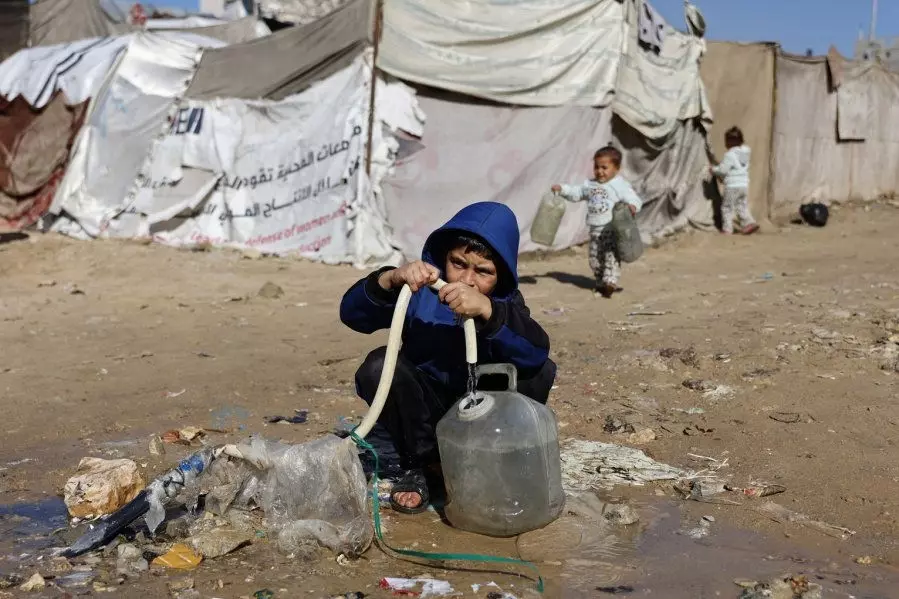
(Hamilton, Jan 21) A report released Tuesday by the United Nations University Institute for Water, Environment and Health warns that the world’s water systems have entered a state of “post-crisis failure.” Long-term overconsumption and pollution have pushed water use beyond renewable capacity and safety thresholds, leaving critical water systems unable to recover to historical baseline levels. The report stresses that traditional terms such as “water crisis” or “water stress” are no longer sufficient to describe today’s reality.
According to UN News, the report finds that around 2.2 billion people still lack access to safe drinking water, 3.5 billion people do not have safely managed sanitation services, and nearly 4 billion people experience severe water scarcity for at least one month each year.
Approximately three-quarters of the world’s population now live in countries facing water insecurity or extreme water insecurity. Since the 1990s, more than half of the world’s large lakes have seen declining water levels, about 410 million hectares of natural wetlands have been lost, and roughly 70% of major aquifers are in decline.
The report also highlights that accelerated glacier melt is eroding long-term water buffers, placing freshwater systems, agriculture, food production, and ecosystems under increasing threat.
Water scarcity, the report notes, is increasingly driven by human activities, including excessive extraction, pollution, soil degradation, and climate change.
Drought causes over US$300 billion in losses annually
The report estimates that around 3 billion people and more than half of global food production are located in regions where water availability is declining or unstable. Over 170 million hectares of irrigated farmland face high or extreme water stress, while salinization continues to undermine global grain production. Annual economic losses from drought are estimated at approximately US$307 billion.
The report warns that “water bankruptcy” intensifies social inequality and the risk of conflict, disproportionately affecting farmers, rural communities, Indigenous peoples, informal urban residents, women, and youth.
It calls on governments to move beyond short-term crisis management toward “water bankruptcy governance,” focusing on preventing irreversible damage, rebalancing supply and demand, transforming water-intensive industries, curbing illegal water use and pollution, and ensuring a just transition for affected communities.
The report concludes that water can serve as a bridge across national and community divides. Investments in water bankruptcy management can simultaneously support climate stability, biodiversity conservation, food security, peace, and social cohesion.
It urges world leaders to use the 2026 and 2028 UN Water Conferences and the 2030 Sustainable Development Goal on water and sanitation as milestones to reshape the global water agenda, formally recognize the state of “global water bankruptcy,” strengthen monitoring and governance, and position water as a central pillar for achieving global environmental, economic, and social objectives.