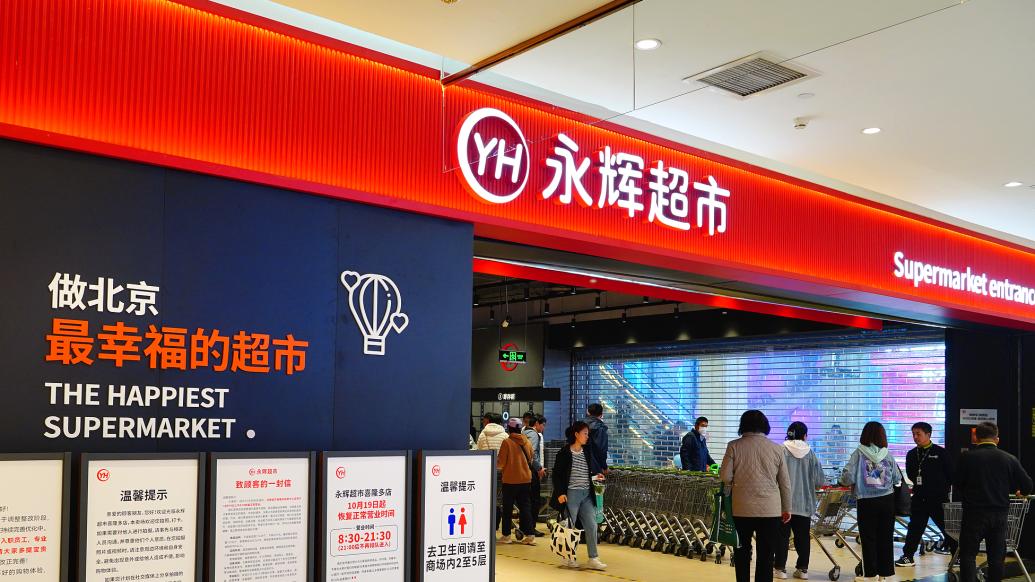
After 18 months of “Pang-Gai” (the “bigger-and-better” makeover inspired by Pang Dong Lai), Yonghui Superstores still hasn’t emerged from the pain of restructuring.
On January 20, Yonghui Superstores (601933.SH) released a 2025 earnings warning, projecting a net loss attributable to shareholders of about RMB 2.14 billion, roughly 45.58% wider year-on-year. Its net loss excluding non-recurring items is expected to reach around RMB 2.94 billion, expanding about 21.99% year-on-year.
At the company’s results briefing last March, Miniso founder Ye Guofu set a clear priority for 2025: narrowing losses. He framed the key levers as “three raises, two cuts”—raising productivity per employee, boosting sales, and improving gross margin, while cutting costs and lowering expense ratios.
Ye also outlined an aggressive operational plan: upgrade 200 stores, close 250–330, and complete the transformation of all existing stores by 2026. At the time, some market observers viewed the pace as ambitious. In practice, Yonghui not only delivered—it exceeded those targets.
By the end of 2024, Yonghui operated 775 stores. By the end of 2025, that figure had fallen sharply to 403. Over the year, the company closed 381 stores and completed upgrades at 315 locations.
However, this large-scale renovation-and-closure campaign is also a major reason why losses widened in 2025. Store upgrades can trigger disposal losses from scrapped assets, revenue disruptions during renovation closures, and one-off opening and refurbishment expenses. Yonghui disclosed that scrapped assets and one-time investments totaled about RMB 910 million, while gross profit lost due to renovation-related downtime was roughly RMB 300 million.
A former flagship of China’s supermarket sector, Yonghui built its reputation on fresh produce and once expanded to more than 1,000 stores at its peak. But since 2021, the company has remained in the red. Seeking a new path, Yonghui began benchmarking Pang Dong Lai in 2024 and launched its first “Pang-Gai” pilot store in June of that year.
In September 2024, Ye Guofu invested RMB 6.3 billion to become Yonghui’s largest shareholder. He later took on the role of head of the company’s reform leadership group, accelerating the pace of upgrades.
Yet the turnaround is still incomplete. Since the second half of 2024, when the remodeling push began in earnest, Yonghui’s cumulative losses have totaled about RMB 3.88 billion. Its share price also trended downward, falling 26.03% over 2025. On January 22, the stock closed at RMB 4.67 per share, implying a market capitalization of roughly RMB 42.4 billion.
How effective has Yonghui’s “Pang-Gai” really been?
Pang Dong Lai is a regional retailer based in Henan, operating 14 stores across Xuchang and Xinxiang as of the end of 2025. Despite its small footprint, it reportedly delivered RMB 23.531 billion in sales in 2025, up nearly 40% year-on-year.
Its reputation is built on strong private-label and self-operated products, as well as high service standards. Pang Dong Lai follows a “big fresh” strategy, with fresh categories contributing more than half of sales. Ready-to-eat, ready-to-heat, and ready-to-cook products are standout categories, and its customer service has become a hallmark.
Yonghui’s “Pang-Gai” focuses on these same strengths. According to a Shanxi Securities research report, Yonghui has been shifting toward “quality retail” since 2024—refreshing a large portion of its product mix, strengthening its bakery and prepared foods assortment (categories with stronger traffic and profitability), and applying a “broad category, narrow SKU” strategy to grow its “Yonghui Youxuan” private-label products.
At the same time, Yonghui has been reshaping its supply chain, moving away from a traditional KA (key account) model toward a cost-plus approach. Service processes have also been upgraded to improve both customer experience and employee satisfaction.
Early signals show tangible progress. Public information indicates the first remodeled store—Zhengzhou Xinwan Plaza—posted RMB 1.88 million in first-day sales in June 2024, nearly 14 times its average pre-upgrade level. In January 2025, Yonghui’s Fuzhou Olympic Sports Center store exceeded RMB 3 million in daily sales, setting a record for a remodeled Yonghui location.
In 2024, Yonghui remodeled 31 stores. Over the first three quarters of 2025, those same 31 stores generated RMB 4.662 billion in sales, up about 71% year-on-year, with cumulative profit of RMB 104 million—an increase of roughly 112%.
Management believes the benefits will become more visible as upgraded stores mature. By the end of 2025, 315 stores had completed renovations, and Yonghui expects these locations to enter steady-state operations in 2026, contributing meaningfully to performance improvement.
Not every store, however, is worth upgrading. Yonghui said it decides on closures based on historical performance and the commercial viability of each trade area. If a store’s profit potential is deemed low, it is more likely to be shut down. The cash required for renovations, alongside scrap losses and impairment charges tied to closures, is a key driver behind the deepened 2025 losses.
Looking ahead, the company expects the pace of disruption to ease. Yonghui forecasts that in 2026 it will close about 25 stores and renovate around 50—far fewer than in 2025—meaning the negative impact from closures and remodeling should materially decline.
A shift into the “post-founder era”
As the transformation progresses, Yonghui is also moving further into what could be described as a “post-founder era.” The company was founded by brothers Zhang Xuansong and Zhang Xuanning. While Ye Guofu has not sought outright control, the founders’ influence has clearly weakened.
Of Yonghui’s six non-independent directors, three now have a Miniso background. Among the other three are the Zhang brothers and newly appointed CEO Wang Shoucheng. Wang joined Yonghui in 2017 as part of the company’s “Rongcai” management trainee program, later became deputy head of the reform leadership group, and played a leading role in the “learning from Pang Dong Lai” remodeling initiative.
At Yonghui’s new product launch event last October, Chairman Zhang Xuansong did not appear; it was CEO Wang Shoucheng who spoke on behalf of the company—another signal of the evolving leadership structure.
RMB 3.1 billion private placement to fill the funding gap
Upgrading 315 stores has meaningfully reduced Yonghui’s cash reserves. At the end of June 2024, the combined balance of cash and trading financial assets stood at about RMB 7.77 billion. By the end of September 2025, that figure had fallen to RMB 5.043 billion.
To secure more funding for its transition, Yonghui announced a private placement plan last July, earmarking proceeds for store upgrades, logistics and warehousing improvements, and working capital support. The initial fundraising target of RMB 3.992 billion was later lowered to RMB 3.114 billion. Of this, RMB 2.405 billion is planned for store upgrades, while RMB 309 million is allocated to logistics and warehousing.
In its filings, Yonghui estimated that from Q4 2025 through 2027, its overall funding gap would total about RMB 3.552 billion—exceeding the amount it plans to raise. The private placement has not yet been completed. Yonghui said it may use internal or self-raised funds to advance projects before proceeds arrive, then replace those funds in accordance with required procedures after fundraising is completed.
The placement plan also reveals the economics behind “Pang-Gai.” Yonghui expects total investment in its store upgrade program to reach about RMB 3.979 billion, covering approximately 216 stores. That implies renovation spending of more than RMB 18 million per store on average.
Supply chain upgrades are part of the same equation. After remodeling, the company expects fresh products and “3R” items (ready-to-eat, ready-to-heat, ready-to-cook) to account for 50% of in-store mix—raising the bar for cold chain and distribution capabilities. Yonghui said its self-built warehouse network currently totals 310,000 square meters, with ambient warehouses making up 74%. Following full remodeling, it estimates cold chain space will need to rise to 40% of the total.
Finally, Yonghui provided profitability projections for the upgraded fleet. The 216 stores slated for renovation generated RMB 1.985 billion in revenue in 2024. With a two-year construction and ramp-up phase, the company estimates that by the third year—once all 216 stores are fully operational—cumulative revenue will reach RMB 3.282 billion, about 65% higher than in 2024. It also forecasts cumulative pre-tax profit of RMB 674 million, nearly 20% higher than the 2024 level.
Taken together, Yonghui’s strategy reflects a classic trade-off: short-term losses driven by restructuring, in exchange for a more focused footprint, a refreshed product model, and stronger store-level economics once the upgraded network reaches maturity.