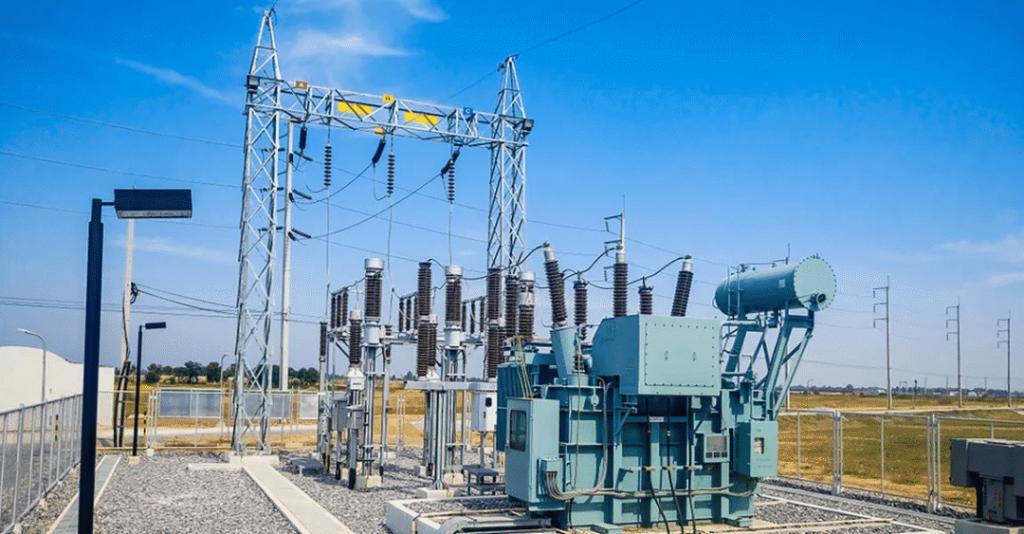
Major tech companies in the U.S. and Europe are scrambling for Chinese transformers, with export orders already booked through 2029. AI data centers built by Google, Microsoft, and Amazon are filled with H100 chips—but one critical transformer could hold everything up. Only Chinese supply can meet the demand.
Why are transformers so critical? A quick calculation: one H100 GPU consumes 700 watts; an AI rack with 50 GPUs exceeds 35 kilowatts; a supercomputing center with thousands of racks consumes over 100 million kWh annually, comparable to a small county. High-performance equipment demands extremely stable voltage—if fluctuation exceeds 1%, chips can be instantly damaged. Ordinary transformers cannot meet these requirements; only high-end, custom, and high-stability transformers can safely step down voltage to power servers reliably.
China is currently the only country capable of mass-producing these high-end transformers. It’s not that Western manufacturers can’t produce them—they simply cannot meet quantity and speed requirements. The reasons:
- Labor Shortage: Transformers may look bulky, but they are highly precise. Coil winding, insulation, and oil-immersed processes rely heavily on skilled technicians. U.S. Department of Labor data shows a shortage of 25,000 skilled workers in the power equipment sector as of 2025.
- Limited Core Materials: The core material for transformers is grain-oriented silicon steel. Only China, Japan, and South Korea can produce ultra-thin, high-magnetic silicon steel at scale. In the West, decarbonization policies over the past decade have shut down much of the high-energy steel capacity, leaving almost no domestic production in the U.S., and Europe has less than 5% of global capacity.
- Long Delivery Cycles: In the U.S., delivering a large transformer takes 127–160 weeks (2–3 years). In contrast, Tebian Electric Power’s Xinjiang factory produces three 220kV main transformers per day, and China XD Electric’s Xi’an smart manufacturing base can deliver orders in just 45 days.
This gap is reflected in the numbers: Chinese transformer exports reached 64.6 billion CNY in 2025, up 36.3% year-on-year, with Saudi Arabia replacing the U.S. as the largest importer. Exports in the first 11 months exceeded 5 billion CNY, doubling year-on-year. Behind this is a fully integrated industrial chain—from raw materials to components, from design to testing—making China the only country in the world capable of one-stop delivery.
Leading companies driving this market include:
- Tebian Electric Power (TBEA): The “Huawei of transformers,” leading in ultra-high voltage transmission, with annual production over 200 million kVA. It controls mining, silicon steel, and assembly in-house. International contract value surged 80% in 2025, winning major overseas projects in Pakistan, Argentina, and India.
- China XD Electric: Specializing in high-altitude, cold, and saline environments; core supplier for the Qinghai-Tibet Railway, West-to-East Power Transmission, and Central Asia projects. European exports meet stringent EMC, seismic, and environmental standards.
- Baobian Electric: Military-grade “gatekeeper,” designated supplier for nuclear, defense, and aerospace projects. Nuclear transformer market share exceeds 60%, passing strict seismic, fire, and explosion tests.
- Other firms: Huapeng, Shunte, Jinpan Technology, and other “specialized and innovative” enterprises dominate niche fields.
Unlike the West, China has not pursued deindustrialization but has steadfastly developed its real economy and strengthened industrial foundations. Decades of this “hard work” now make Chinese transformers indispensable to global power supply.