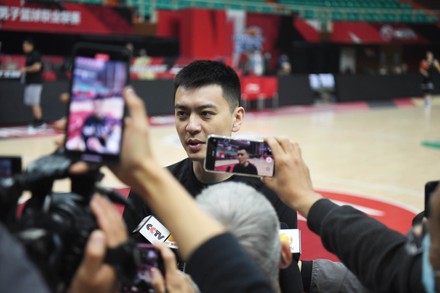
The recent resignation of former Liaoning men’s basketball head coach Yang Ming sent shockwaves through the CBA community. Known for his strong personal image and articulate analysis, Yang quickly transitioned into an NBA commentator on a major platform. While covering NBA games, his insights often extend beyond the league itself, drawing clear parallels to the CBA and offering fans a rare glimpse into the inner workings of professional basketball in China.
During one broadcast, the host raised a pointed question: what should a club do when its core leader demands a transfer? Yang responded with a counter-question—who ultimately has the final say, the club or the player? He explained that in today’s reality, players increasingly name their preferred destinations, sometimes limiting negotiations to one team or a small shortlist. This phenomenon is common in the NBA, and Yang noted that the CBA is no exception. Zhang Zhenlin’s departure from Liaoning last summer was a clear example of a player exercising that kind of agency.
After helping Liaoning secure a historic three-peat, Zhang Zhenlin spent much of the 2024–25 season recovering from injuries. Even after returning, his form never fully recovered. He later applied for a transfer and ultimately joined Shanghai. At the time, reports suggested that his preferred destinations were Shenzhen or Shanghai, driven by family considerations as well as ambitions for a higher competitive ceiling.
Liaoning’s willingness to grant Zhang significant freedom was rooted in history. His original arrival in 2020 required no aggressive bidding war or costly poaching, unlike many other young prospects. He earned his place purely on merit. After a brief adjustment period in his rookie season, Zhang rapidly developed into the backbone of Liaoning’s wing rotation and a central figure in the three championship runs. In the end, both sides parted on good terms: Liaoning secured a substantial transfer fee, while Zhang found himself in a Shanghai squad with strong results and sustained title contention potential in the coming years.
Elite players having a say in their next destination is nothing new. Zhou Qi offers another textbook case. In 2021, he refused to renew his contract with Xinjiang, and while trades were discussed, his personal preference still mattered. Even if a club wanted to send him to a bottom-tier team, few were willing to take the risk—if Zhou chose not to play, the trade would be meaningless.
When Zhou Qi’s contract expired in the summer of 2024, Guangdong no longer held priority renewal rights, leaving his future entirely in his own hands. Beijing Shougang eventually won out by presenting the most sincere offer. A year earlier, Beijing had already explored a potential trade with Xinjiang, proposing Fan Ziming as a centerpiece. However, Fan himself was reluctant to move, and as a max-salary player within Beijing’s system, the club opted not to force the deal after weighing all factors.
Xinjiang’s experience with Zhao Rui, by contrast, proved far more problematic. The club initially believed that moving Zhou Qi could secure them a top-tier guard, but Zhao Rui’s long-term ambition had always been to join a major-market team like Shanghai. After arriving in Xinjiang, recurring injuries kept him sidelined for extended periods, and his lack of full integration into the team became increasingly apparent. Sensing that the situation was unlikely to improve, management moved quickly last year to transfer him to Beijing.
Now, Liaoning faces yet another crossroads. Poor results and the collapse of its established system have cast uncertainty over the future. Zhao Jiwei could soon explore a move of his own, and as a high-caliber guard, he would attract interest from numerous teams across the league. If he were to specify which clubs Liaoning could negotiate with, the team would have little room to resist. After all, it is impossible to keep a player whose heart is already set on leaving. In such a scenario, the only realistic option would be to facilitate the move and extract as much value as possible in return.