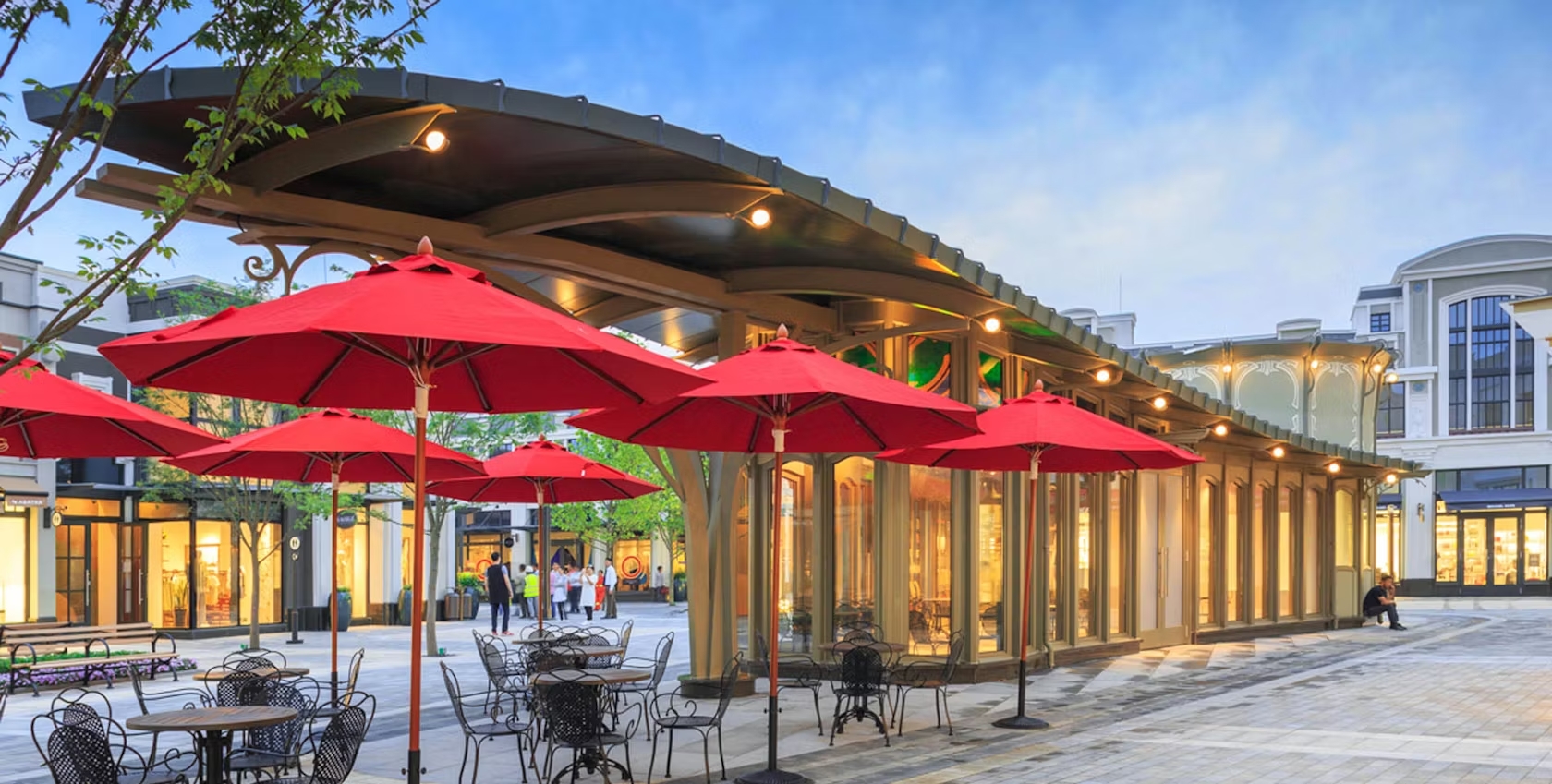
Last week, while visiting Shanghai Bicester Village, I stumbled upon a surprising and telling shift: the designer multi-brand boutique BLOCK had opened a store right inside the outlet—offering discounts starting from 30% off, stacked with additional promotions.
In my past understanding, boutiques of this kind typically anchored themselves in prime urban shopping districts and rarely ventured into the outlet space. Seeing one appear here felt like a quiet but powerful signal that the rules are changing.
Brand movement often mirrors market movement. And over the past two years, the rising popularity of outlet malls has been impossible to miss. Visit any major outlet on a weekend and you’ll likely find queues at the parking entrance. Young shoppers clutch bubble tea while checking in outside streetwear stores, families push strollers between restaurants and children’s play areas—it’s a far cry from the old stereotype of outlet malls being the exclusive hunting ground of bargain-seeking aunties.
The numbers back this up. From 2021 to 2025, total sales in China’s outlet industry climbed from approximately RMB 126 billion to RMB 248 billion—nearly doubling in just five years. Even more striking is the sector’s resilience during periods of broader market volatility, demonstrating strong counter-cyclical performance.
Behind this rapid growth, outlet malls themselves are undergoing a visible transformation. They are becoming more like full-scale shopping centers—and increasingly, like preferred weekend leisure destinations.
Shedding the “clearance” label,
outlets are undergoing a forceful upgrade
Look closely at today’s outlets, and the most immediate change is how blurred their boundaries have become. What was once a retail-dominated format has evolved into a fully integrated, multi-format consumption ecosystem.
Not long ago, the purpose of visiting an outlet was straightforward: buy discounted clothing, shoes, and bags—then leave. There was little reason to linger, and almost no spending beyond retail.
Today, however, “one-stop destination” and “all-format integration” have become the new direction. Non-retail formats are expanding rapidly and reshaping the outlet experience.
Beijing Wanli WellTown now dedicates over 40% of its tenant mix to dining and entertainment, ranging from viral tea brands to full-service restaurants.
China Resources’ Dongguan MixC Coastal Shopping Village positions itself as a boutique outlet, introducing brands like Chaoshan-style beef hotpot and Banu Hotpot for the first time in an outlet setting, while also bringing in Hema Fresh as a key supermarket anchor.
Wuhan Fangyuanhui Outlet goes even further, integrating cinemas, KTV, ice rinks, Suning Electronics, and Hema Fresh—essentially functioning as a shopping center built around an outlet core.
On the retail side, outlets have also moved beyond the single logic of selling off-season inventory.
Alongside multi-brand boutiques like BLOCK, many brands that once dismissed outlets are now actively entering the space. Lululemon and On Running have both opened their first outlet stores at Shanghai Bicester Village, while emerging American vintage brand Amercia Vintage launched its first-ever outlet store nationwide last April.
Even early entrants are adjusting their merchandise strategies. At DESCENTE’s Shanghai Qingpu outlet, products discounted at 50% or more account for only 25% of offerings, while new arrivals and full-price items make up over half of the assortment.
These shifts mean outlets are no longer just an inventory exit for brands—they are now viable destinations for purchasing new products as well.
Beyond formats and brands, experiential upgrades are pushing outlets past traditional shopping centers and turning them into true weekend leisure hubs.
During the planning phase of China Resources’ Coastal Shopping Village, there was reportedly intense internal debate over design standards. One camp argued that since outlets are product-driven, high-end design was unnecessary, suggesting a more cost-efficient benchmark slightly below MixC M1. The other camp believed the future of outlets lay in experience and vacation-style ambiance, insisting that cutting corners on environment would be shortsighted—and that Bicester Village should be the benchmark.
The final naming choice—“Coastal Shopping Village”—made the outcome clear. China Resources commissioned renowned Italian architect Gianni Ranaulo to lead the design, weaving together coastal waterways and sandstone streets inspired by southern France. White seaside architecture and Mediterranean landscaping create a relaxed, immersive urban micro-resort.
Today, watching the sunset at Coastal Shopping Village has become a trending topic on Xiaohongshu.
A similar approach can be seen in Ningbo’s Qianwan · Shengshili, positioned as China’s first cultural tourism IP–themed outlet. Drawing on Eastern aesthetics and Tang dynasty architectural rituals, it offers a distinctly immersive spatial experience.
Behind the evolution,
who is fueling the rise of next-generation outlets?
Why are outlets—already strong performers—continuing to reinvent their formats and tenant mixes?
The answer lies largely in the influence of two key groups.
First is the influx of cross-industry players, bringing new playbooks into the outlet arena.
As consumers become more value-conscious, traditional commercial property operators have entered the outlet space in force. China Resources has launched new outlet product lines, Deji Group has established a subsidiary to target the sector, and Century Golden Resources has experimented with outlet-style transformations of existing assets through light-asset models.
Although these companies often operate outlets through separate teams or business units, strategic decision-makers remain the same. Inevitably, they bring mature shopping-center methodologies—refined over years—into outlet planning, design, and operations.
At the same time, major internet platforms are stepping in. Vipshop, which entered offline discount retail through its acquisition of Shanshan Outlets, has opened its first city outlet in Hefei. JD.com has launched its national debut JD Outlet in Jiangyin, Wuxi.
With strong advantages in brand relationships and capital, these players are scaling quickly and accelerating consolidation.
This cross-border influx has increased pressure on traditional outlet giants such as Wangfujing, Capital Outlets, Bailian, Florence Town, Shanshan, and Sandhill. While their 83 outlet projects still accounted for over 60% of national premium outlet sales between July 2024 and June 2025, standout performances—like Coastal Shopping Village’s average daily footfall of nearly 200,000 during the New Year holiday—are undoubtedly triggering a renewed sense of urgency among incumbents.
The second driving force is the growing rationality of consumers, especially younger shoppers, who are increasingly embracing outlets.
Their arrival has injected fresh vitality into the format. To attract Gen Z, outlets are pulling out all the stops: launching trendy flagship stores, hosting IP exhibitions, organizing street dance shows, and creating highly shareable moments.
Young consumers who once viewed outlets as outdated now visit specifically for pop-up exhibitions or streetwear discounts—and increasingly treat outlets as new social and check-in destinations.
Once young people are willing to show up, expanding naturally into a full-age offering—especially for family groups traditionally dominated by shopping centers—becomes much easier.
At Wuhan Fangyuanhui Outlet, family customers account for 74.51% of visitors, with nearly 60% aged 30–44. To retain this audience, the project has developed large-scale children’s spaces and regularly hosts parent-child workshops and children’s theater performances, positioning the outlet as a family gathering hub.
Coastal Shopping Village has gone even further, incorporating theme-park-style parades and live performances into its regular operations, delivering immersive experiences that go well beyond conventional mall marketing.
Today, at Shanghai Bicester Village, it’s increasingly common to see families spending entire weekends there. This evolving customer mix is, in turn, pushing outlets to compete on dimensions beyond merchandise—such as spatial friendliness, comprehensive amenities, and experiential depth.
As outlets rise,
which malls are feeling the impact?
Once outlets combine discounted brands, comprehensive formats, and leisure experiences, their competition with shopping centers extends far beyond merchandise—and into a full-spectrum contest.
Most notably, they are beginning to erode the weekend family traffic that shopping centers have long relied on.
In the past, neighborhood malls were the most efficient choice for dining, childcare, and light shopping. But as outlets systematically fill gaps in dining, children’s entertainment, and leisure—while layering on powerful price incentives—the decision logic for family outings changes.
With the same amount of time, an open-air outlet offers a better environment and better value. One trip feels “more worthwhile.”
Under this comparison, the category of truly irreplaceable shopping centers is narrowing rapidly.
They must either occupy unmatched city-center locations or be deeply embedded in local communities. They must offer highly scarce spatial experiences, unique cultural content, singular brand mixes, or distinctive social atmospheres—or possess the ability to continuously generate exclusive content.
As outlets increasingly resemble shopping centers, the future of shopping centers should not be about “becoming more like outlets,” but about defining and defending their own unique narratives.
In this sense, the expansion of next-generation outlets acts like a magnifying glass. It doesn’t change the underlying logic of commercial real estate—but it accelerates the exposure of capability gaps between projects.
Those without a clear identity will, inevitably, be filtered out by the market.