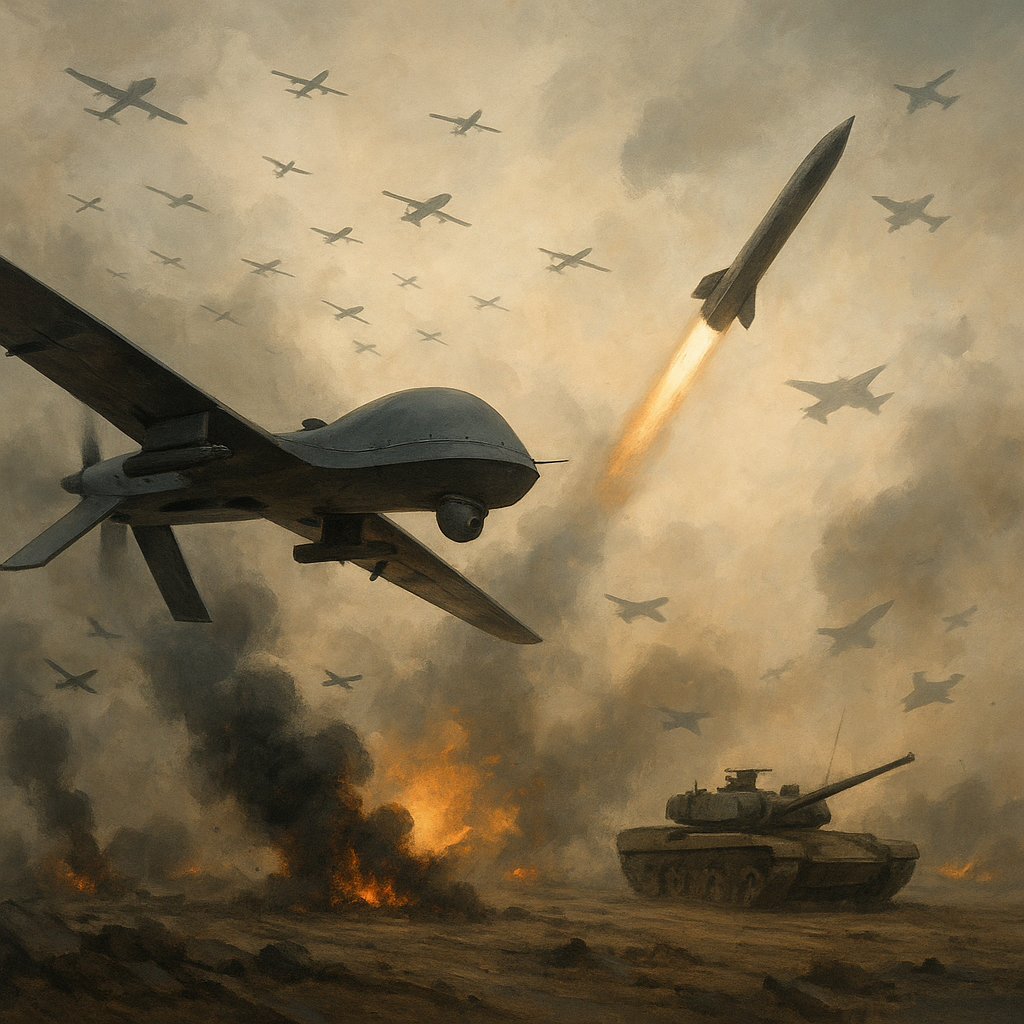
The current India-Pakistan conflict has entered its second phase, featuring a new characteristic of "high intensity with low threshold." The confrontation has shifted from traditional jet and missile exchanges to a hybrid model involving drones, electronic warfare, and information warfare—highlighting a profound evolution in modern warfare.
🔥 Escalation: From Missile Exchanges to Drone Swarms
At dawn on May 10, Pakistan launched "Operation Bunyan-ul-Marsoos," targeting multiple Indian military sites, including missile depots and airbases in the north. Previously, under “Operation Sindoor,” India had attacked three Pakistani airbases, prompting Pakistan to close its airspace nationwide and convene a high-level defense meeting—underscoring the severity of the situation.
Even more shocking, Pakistan's military claimed that of the six ballistic missiles fired by India, five landed within Indian territory—pointing to a serious failure in its missile systems.
Meanwhile, both sides have heavily employed drones for strikes and reconnaissance. Pakistan claims to have shot down 77 Indian drones in just two days, while India accuses Pakistan of using Turkish-made drones to hit 36 Indian targets.
🧠 New Warfare: Strategic Ambiguity and Information Ops
Both countries are now engaging in “strategic ambiguity,” neither confirming nor denying actions clearly—creating confusion and hindering the opponent's judgment. India insists it is only targeting “terrorist bases,” while Pakistan says its actions are a response to continued Indian provocations.
Information warfare has also emerged as a key battlefield. Social media is flooded with unverified reports, misleading public perception and escalating tension.
⚠️ Nuclear Risks and International Intervention
Although the conflict has not yet escalated into full-scale war, the risk of nuclear engagement remains present. Pakistani Prime Minister Shehbaz Sharif has convened the National Command Authority to discuss nuclear policy.
The international community is closely monitoring the situation. U.S. Secretary of State Marco Rubio has spoken with Pakistan’s military leaders, urging de-escalation and offering support for constructive dialogue.
📊 Viewpoint: A “New Normal” in Regional Conflict
This round of India-Pakistan tension highlights key trends in modern warfare:
- Tech-driven combat: Drones, electronic, and information warfare are now core tools, lowering the threshold for conflict.
- Strategic ambiguity: Vague official narratives hinder clarity, shifting control to whoever dominates perception.
- Information warfare surge: Social media is now a battleground, spreading misinformation at speed.
- Persistent nuclear risk: Despite no use so far, nuclear capabilities loom dangerously over the standoff.
In the current global geopolitical climate, India-Pakistan clashes risk becoming a recurring instability. The world must step in more actively, promoting dialogue to prevent further escalation.
Both sides must act with restraint to avoid full-scale war and safeguard regional peace and stability.