Financial Associated Press, May 14 — In recent days, former U.S. President Donald Trump has been touring three Middle Eastern countries — Saudi Arabia, Qatar, and the UAE — with Tesla CEO Elon Musk accompanying the delegation.
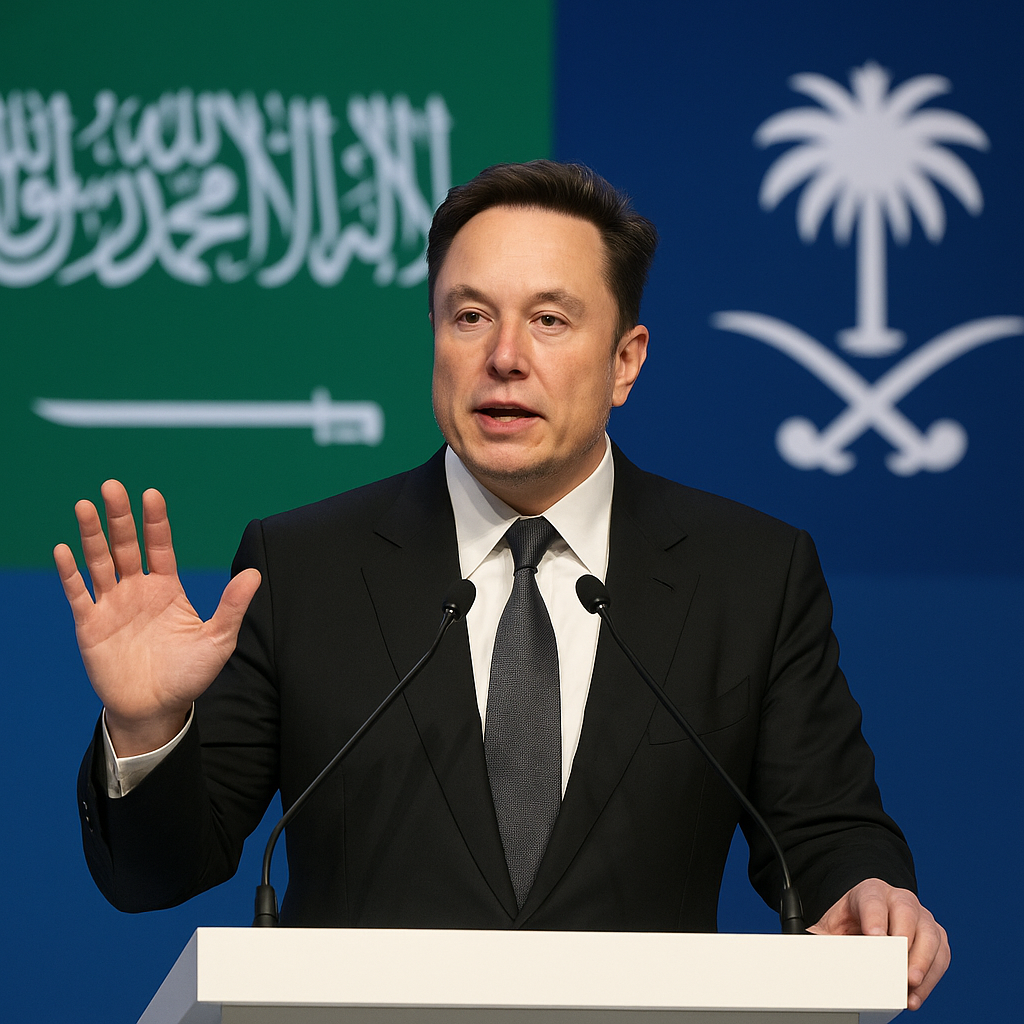
At the Saudi-U.S. Investment Forum held on Tuesday, Musk publicly stated that he hopes to introduce Tesla’s robotaxi services in Saudi Arabia. This comes as Uber had earlier announced plans to launch its autonomous vehicle services in the country later this year.
Musk also announced that his satellite internet provider, Starlink, has received regulatory approval from Saudi Arabia for maritime and aviation applications, and expressed his gratitude.
Speaking to Saudi Minister of Communications and Information Technology Abdullah Alswaha, Musk said, “You can really think of the future car as a robot on four wheels. I think it would be very exciting to have autonomous vehicles in Saudi Arabia, if you agree.”
However, he did not provide further details or a timeline. Notably, Tesla has not yet launched public robotaxi services anywhere in the world. The company previously announced plans for a pilot program in Austin this June. Musk said that expansion should follow quickly thereafter.
Additionally, reports state that Musk presented Tesla’s humanoid robot, Optimus, to both Trump and Saudi Crown Prince Mohammed bin Salman. Tesla has long told investors that autonomous vehicles and robots are key to its future profitability.
Prior to Musk, Uber announced on May 6 that it plans to deploy robotaxis in Saudi Arabia sometime this year through a partnership with China’s Pony.ai. Yet, no specific date has been confirmed.
Uber enjoys a strong user base in Saudi Arabia. Its subsidiary app, Careem, is one of the most popular ride-hailing services in the Middle East, operating in 26 cities across the kingdom.
On Tuesday, Saudi Arabia’s Transport General Authority posted on X (formerly Twitter) that it has signed a memorandum of understanding (MoU) with Uber to introduce autonomous vehicles in the country. However, the MoU is non-binding and merely indicates an intent to collaborate.
“The first autonomous vehicles with safety operators are expected to be launched on Uber’s platform by 2025,” the post stated.
These back-to-back moves by two tech giants have drawn significant attention. Saudi leaders have expressed hopes that autonomous vehicles will play a pivotal role in the country’s broader “Vision 2030” plan, which aims to diversify the economy away from oil through heavy investment in technology. The country also released a regulatory framework for autonomous vehicles last year.