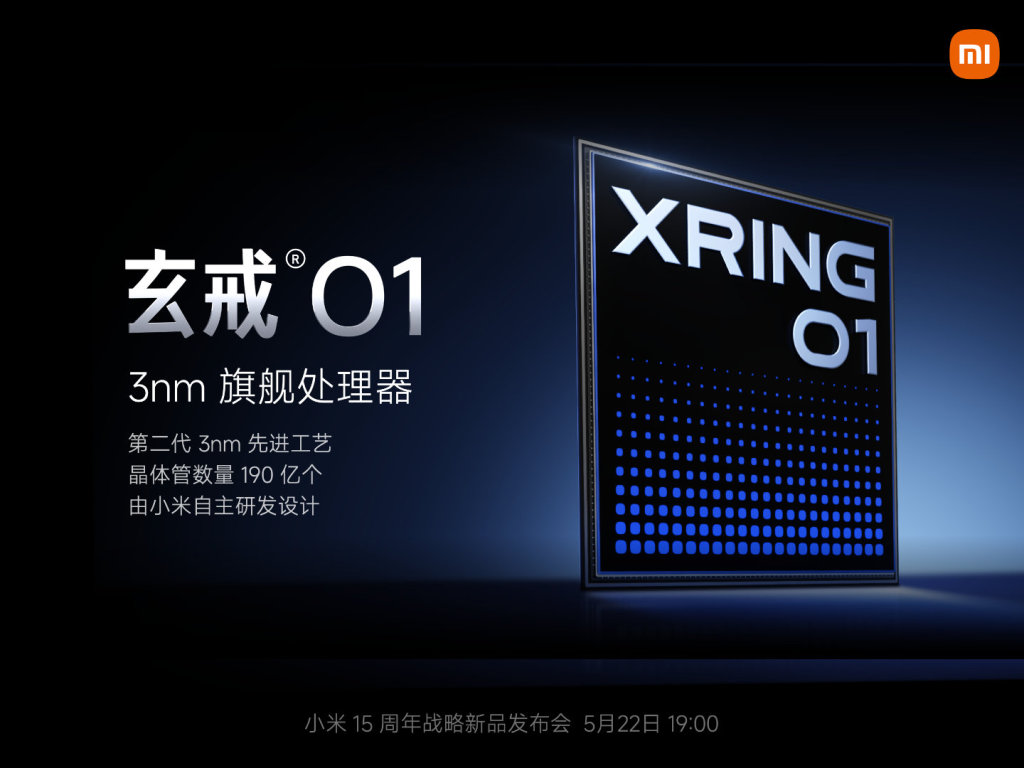
At 7 PM on May 22, Xiaomi will host its strategic product launch event, unveiling multiple key innovations. Among them, the spotlight is on Xiaomi’s first self-developed flagship-grade SoC chip, Surge O1, signaling a major milestone: Xiaomi becomes the second Chinese smartphone maker, after Huawei, to commercialize an in-house flagship SoC.
Four Years, ¥13.5 Billion, 2,500 Engineers — Xiaomi’s Chip Dream Reignited
According to Xiaomi founder and CEO Lei Jun, the Surge project began in early 2021, coinciding with the company’s entry into EV development. At that time, Xiaomi made two pivotal decisions: start building cars and restart its high-end SoC initiative.
After four years of R&D, Xiaomi has successfully developed and mass-produced its own flagship SoC. The company has invested over ¥13.5 billion (~$1.87 billion USD) to date, with the current R&D team surpassing 2,500 members. In 2024 alone, Xiaomi plans to invest over ¥6 billion (~$830 million USD) in chip development, with a long-term commitment to invest ¥50 billion (~$7 billion USD) over the next decade.
Lei Jun stated, "Without deep resolve and strong technical capabilities, we would have never made it this far with Surge O1."
Built on 3nm, Custom AP + Third-Party Modem, Competitive With Market Leaders
The Surge O1 is based on a cutting-edge 3nm process and features Xiaomi’s custom application processor (AP)architecture, paired with a third-party external modem — a practical design choice for a newcomer to mobile communications.
According to Omdia, Surge O1 already delivers performance on par with current flagship SoCs, thanks to a high-frequency super-core architecture and large cache design. Benchmark scores even surpass some mainstream offerings.
From Setbacks to Breakthroughs: Xiaomi’s Second Attempt at Chipmaking
Xiaomi’s chip journey began in 2014 with the “Surge S1”, a mid-to-high-end SoC launched in 2017 that ultimately fell short of expectations. The company later paused high-end SoC development.
While public focus shifted to Xiaomi’s EV ambitions, the SoC program quietly resumed. One insider described the chip project as having been "highly secretive, even within the company."
Why Xiaomi Uses an External Modem: A Practical and Strategic Move
According to Omdia, Xiaomi’s choice to use an external modem is the optimal solution at this stage. Developing a baseband in-house poses huge patent barriers, high costs, and complex global compatibility requirements — challenges even Apple has yet to overcome. Today, only Huawei and Samsung integrate their own modems; others, including Apple, rely on external suppliers.
First to Power Xiaomi 15S Pro and Mi Pad 7 Ultra
Surge O1 will debut in two high-end products: the upcoming Xiaomi 15S Pro and Mi Pad 7 Ultra. Omdia notes that, as a first-generation chip, it primarily serves as a technical validation platform.
Initial production will be kept under a million units, with high costs and limited short-term financial contributionexpected.
Crucially, Omdia says Surge O1 won’t disrupt Xiaomi’s relationship with suppliers like Qualcomm.
Strategic Dual-Track: Xiaomi Renews Long-Term Partnership with Qualcomm
Just days before the Surge O1 launch, on May 20, Xiaomi signed a new multi-year strategic partnership with Qualcomm. The agreement ensures Xiaomi’s future flagships will continue using the Snapdragon 8 series, with broad adoption across smartphones, tablets, wearables, smart vehicles, and more.
This shows that Xiaomi is not replacing its supply chain — instead, it is building in-house capability while maintaining strong vendor partnerships.
Concerns Over 3nm Foundry Access Remain, But Surge O1 Is a Strategic Signal
Some market watchers have raised concerns about Xiaomi’s use of 3nm process nodes, especially given China’s current foundry limitations. For now, no explicit restrictions are in place, but future geopolitical or IP risks remain uncertain.
Still, the release of Surge O1 is a significant symbolic breakthrough for China’s tech self-reliance.
Toward a “Hardcore Tech” Brand: Xiaomi Lays Down a New Strategic Map
With the launch of Surge O1 and the expansion into EVs, Xiaomi is clearly pushing toward the high-end segment, reinforcing its ambitions to become a hardcore technology company. Lei Jun emphasized that chip development is not optional:
"To become a truly great tech company, mastering chips is a battle we must win."
If Surge O1 and its successors prove successful, Xiaomi could eventually gain both cost advantages and product differentiation — critical in an era of global tech competition.