[Washington, June 15, early morning local time]
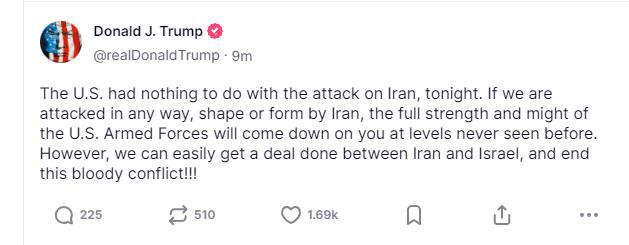
As military tensions between Iran and Israel continue to escalate, U.S. President Donald Trump released a statement on social media declaring that “the United States had nothing to do with the recent Iran-Israel attacks.” However, his tone quickly turned uncompromising:
“If Iran launches any form of attack on the U.S., the U.S. armed forces will retaliate with unprecedented force.”
Though Trump denies direct U.S. involvement, his remarks send a clear message: any threat to American interests will be met with maximum retaliation.
💬 Dual Message: Threat & “Deal-Making”
Interestingly, Trump also hinted that the U.S. could “easily broker a deal to end this bloody conflict,” without revealing further details.
This “carrot and stick” approach suggests Trump aims to retain strategic leverage while keeping the door to diplomacy slightly open.
🇮🇷 Iran’s Response: Dialogue Is “Meaningless,” Focus Is on “Countering Aggression”
Iran has clearly rejected the idea of renewed dialogue with the U.S. Since Israel’s surprise airstrike on June 13, Tehran officially withdrew from the sixth round of nuclear negotiations with Washington.
- On June 14, Iranian President Pezeshkian declared:
“As long as Israel continues its attacks, Iran will not resume any talks with the United States.”
- Iran’s Foreign Ministry added:
- “While claiming diplomacy, the U.S. continues to support Israel’s aggression, including strikes on peaceful Iranian nuclear sites.”
- “Negotiating with the main backer of our enemy is pointless as long as the aggression continues.”
Iran has since stated that its top priority is retaliating against aggression, and warned that any attack on its military bases or infrastructure will trigger direct action — including targeting U.S. military sites.
🧨 Escalation Risk: Are Iran and the U.S. Heading for Direct Conflict?
Iranian Defense Minister Aziz Nasirzadeh previously warned that if nuclear talks fail, Tehran might directly strike U.S. bases in the Middle East.
Now, with Trump promising "unprecedented" military retaliation, a critical question looms:
If Iran acts, will the U.S. respond militarily? And if so, is a wider war in the Middle East about to unfold?
🧭 Final Thoughts:
The current crisis isn’t just a bilateral conflict between Iran and Israel — it is rapidly becoming a global geopolitical flashpoint.
Trump’s threat is bold, but Iran remains defiant.
With diplomatic talks frozen and missiles flying, the next turning point might not come from negotiations — but from a single miscalculation on the battlefield.
The world now watches closely: who will act first, who will retreat, and who will pay the ultimate price?