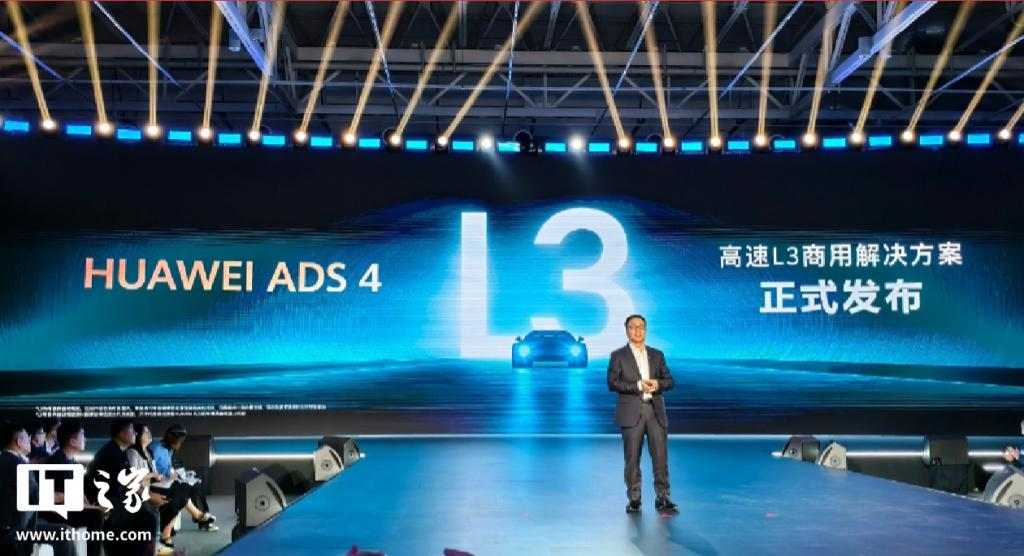
As intelligent driving technology evolves rapidly, Huawei is stepping up its efforts to enhance its autonomous driving system. In a recent interview with AutoLab, Li Wenguang, President of Huawei’s Intelligent Driving Product Line, discussed the advances of ADS 4, challenges in active safety, and his perspective on Tesla’s Full Self-Driving (FSD) technology.
ADS 4 Sees Major Safety Upgrades, Better Handling in Complex Scenarios
According to Li, Huawei’s QianKun ADS 4 system—released earlier this year—has seen a significant leap in safety, driven by both hardware and software improvements. The system now performs better under harsh weather conditions and shows improved capabilities in identifying and responding to small objects, laying the groundwork for commercial deployment of L3 autonomous driving on highways.
Active Safety Still in Early Stages: Edge Cases Like Accidental Acceleration Need Further R&D
While ADS 4 can already handle challenging scenarios such as floating obstacles and negative height differentials, Li acknowledged that in cases like accidental pedal misapplication, the system currently only supports emergency braking for vehicles and pedestrians—not for barriers or trees. These edge cases, he said, are critical targets for ongoing development.
Tesla’s FSD Earns Praise, But Pure Vision Alone May Not Suffice for Future Autonomy
Li commended Tesla’s FSD system for its excellence in road perception and smooth vehicle control, calling it “a benchmark for pure vision.” However, he questioned whether a vision-only approach can meet the ultra-high reliability and safety standards required for fully autonomous driving in the future.
“Huawei isn’t against vision, but we believe that in more complex scenarios, a more comprehensive safety net is essential,” Li said. He explained that Huawei’s choice to adopt a multi-sensor fusion strategy stems from the company’s core mission: “to reduce accidents and free up human time.”
ADS 4 Introduces World Model and AI-to-AI Learning
Huawei’s ADS 4, launched in April, comes in four versions: SE (Standard Edition), Pro (Enhanced), Max (Advanced), and Ultra (Flagship), with the Ultra version offering L3 capabilities on highways.
At the May 30 launch event for the Huawei-AITO S800 model, the company revealed that ADS 4 integrates a "World Engine" and "World Behavior Model," enabling an “AI teaches AI” framework. This allows vehicles to perform with human-like finesse in challenging scenarios such as narrow parking, tight turns, pedestrian yielding, and multi-level navigation—advancing the goal of smart driving from enhanced perception to stable decision-making.