I. Rapid Expansion: Where the Talent Comes From
- Headcount & Credentials
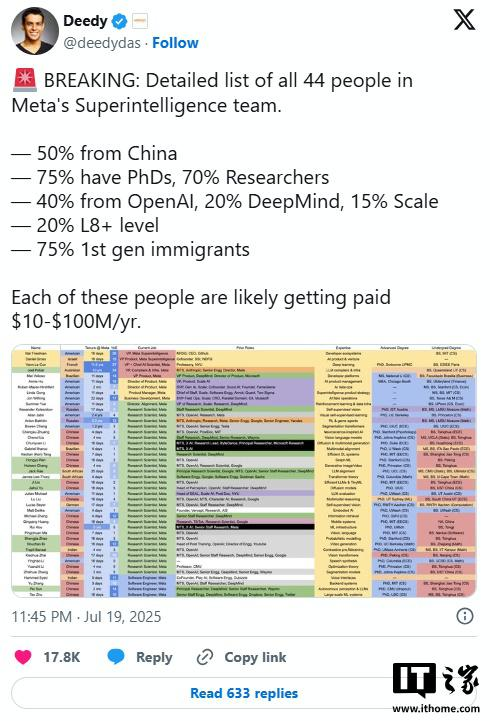
The lab now has 44 members; 75% hold PhDs and 70% serve as researchers, reflecting a highly qualified team. - Geographic & Corporate Origins
- 50% from China: Meta tapped leading academics in machine learning and large-model research at top Chinese institutions.
- 40% from OpenAI: Core engineers experienced in deep-learning frameworks and large-scale pre-training.
- 20% from DeepMind & 15% from Scale: Specialists in reinforcement learning and data-labeling platforms, respectively.
II. Lucrative Pay and Sign-On Bonuses
- Eye-Popping Bonuses
To lure a former Apple foundational-model lead, Meta offered a $200 million sign-on bonus. Earlier, several OpenAI veterans reportedly received nearly $100 million each. - Estimated Salaries
Though unconfirmed, insiders say annual pay could range from $10 million to $100 million—demonstrating Meta’s urgency to dominate core AI technologies.
III. Strategic Importance: Securing the AI “High Ground”
- Learning from the Metaverse Miss
Having invested $46 billion in the metaverse without the desired return, Zuckerberg now bets on talent and technology to close AI gaps. - Battle of Foundation Models
Superintelligence Labs focuses on developing large-scale base models to rival those at Google and OpenAI, aiming for next-gen AI with superior compute and multimodal capabilities. - Global Research Network
With half the team from China, Meta bridges Silicon Valley and Asia’s leading research hubs, accelerating cross-cultural innovation.
IV. Challenges & Outlook
- Team Integration
Harmonizing experts from diverse national and corporate backgrounds and removing technical silos will be a management priority. - From Lab to Market
Translating foundational research into commercial products remains the crucial “last mile.” - Regulation & Ethics
As governments tighten AI safety and compliance rules globally, Meta must innovate responsibly to maintain trust and control.
Conclusion
By amassing 44 of the world’s top AI talents in its Superintelligence Labs, Meta demonstrates its ambition to lead the AI era. But assembling the team is only a first step—rapidly applying breakthroughs and delivering real-world applications will determine Meta’s standing in the next wave of technological competition.