From a casual chat to a talent arms race—how Mark Chen’s advice triggered Meta’s aggressive AI team-building, targeting OpenAI’s core with Chinese researchers leading the charge.
The AI arms race in Silicon Valley has reached new heights.
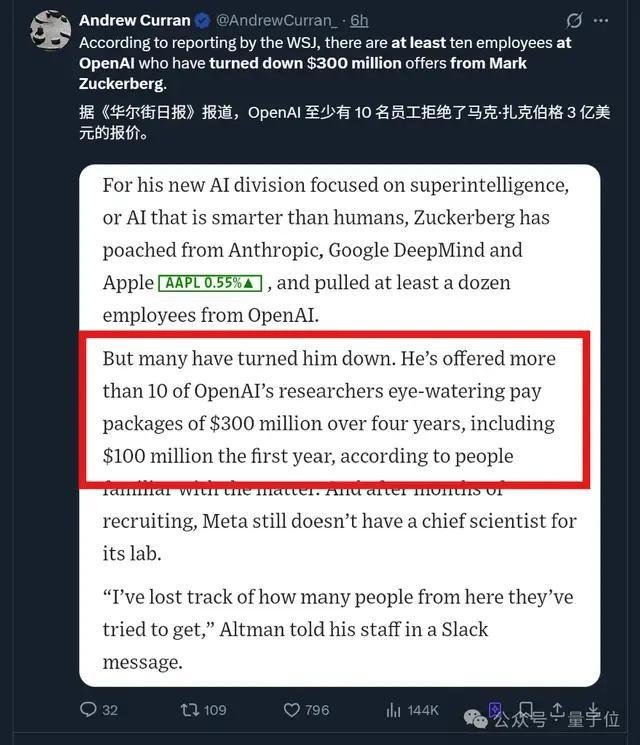
According to The Wall Street Journal, at least 10 OpenAI employees have reportedly turned down $300 million compensation packages from Meta CEO Mark Zuckerberg. One of them was OpenAI’s Chief Scientist Mark Chen, whose one-liner unexpectedly sparked what insiders are calling “Silicon Valley’s most aggressive hiring spree.”
01. One Casual Comment, One Super Team Born
Earlier this spring, Zuckerberg reached out to Mark Chen for a casual chat about improving Meta’s generative AI strategy. Chen simply suggested: "Invest more in top talent."
Zuckerberg took the advice to heart—literally. Soon after, he extended a personal invitation to Chen to join Meta, asking, “What would it take to convince you?” But Chen politely declined: “I’m really happy at OpenAI.”
Rebuffed but inspired, Zuckerberg compiled a global AI talent list and began quietly recruiting. As of now, about 40% of Meta’s 44-person new AI dream team are former OpenAI staff, according to a leaked list from a Meta employee via VC Deedy.
02. Chinese Researchers Shine, Tsinghua and Peking Grads Dominate
Another striking fact: 50% of this team are Chinese researchers, many with roots in Tsinghua and Peking University. From foundational models to multi-modal vision-language tasks, they’re dominating Meta’s core efforts:
- Chengxu Zhuang (Tsinghua → MIT → OpenAI): Expert in NLP and vision.
- Chenxi Liu (Tsinghua → DeepMind): Ex-Waymo, now focused on VLMs at Meta.
- Chunyuan Li (HUST → xAI → Meta): Veteran in diffusion & multi-modal generation.
- Others like Ji Lin, Hongyu Ren, and Shengjia Zhao were key creators of GPT-4o and have also joined Meta.
Even OpenAI’s Zurich lab—home to ViT's original authors—was nearly “acquired wholesale” by Meta.
03. It’s Not Just About the Money—It’s About GPU Power
Zuckerberg insists that salary alone wasn’t the hook. What truly lured these talents was “unlimited GPU access”—a promise of computational freedom rarely found elsewhere.
Meta plans to invest tens of billions of dollars in building gigawatt-scale AI clusters, such as Prometheus and Hyperion. This pushed OpenAI CEO Sam Altman to respond with his own aggressive move: launching 1 million GPUs by year’s end.
This is no longer just a hiring war—it’s now a compute war.
04. From Meme to Reality: Join OpenAI, Jump to Meta
A joke circulating on tech forums now reads: “The only reason to join OpenAI… is to get poached by Meta.”
But behind the joke is a truth: for top-tier researchers, the pathway now often goes OpenAI for experience, Meta for ambition. With compute power as the new currency, the AI era has officially entered its industrialized elite phase.