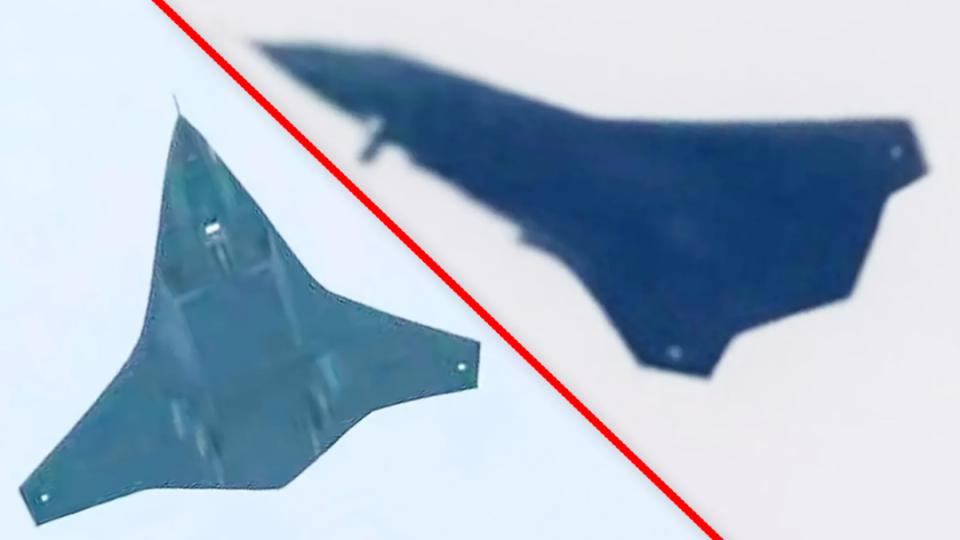
Recent photos circulating on social media have sparked intense debate in military circles — a suspected third Chinese sixth-generation fighter has been spotted in the skies over China. Its unique design blends features from both northern and southern sixth-gen prototypes, prompting some netizens to joke that “the PLA is preparing for an alien invasion,” while leaving U.S. media puzzled.
Design Features Point to Stealth Optimization and Twin-Engine Layout
According to an August 4 report by The Drive’s “War Zone” channel, the new aircraft features a sharp forward fuselage and nose, highly swept lambda wings mid-fuselage, no vertical tail fins, and a wide body to accommodate internal fuel and weapons bays. These characteristics share similarities with the Shenyang J-50 previously seen, but differ from the much larger Chengdu J-36.
U.S. analysts suggest the aircraft could compete with the J-50 as a more “traditional” sixth-generation manned fighter, or it might be a carrier-based variant — photos appear to show a dual-wheel nose landing gear, consistent with heavier, navalized designs built to withstand carrier operations.
Possibility of a High-End Unmanned Combat Aircraft
Another theory is that the aircraft may lack a cockpit altogether, making it a highly autonomous unmanned combat aircraft, similar in concept to the U.S. Air Force’s Collaborative Combat Aircraft (CCA) “loyal wingman” program, but positioned far above it in capability.
If this is indeed a high-autonomy UCAV, the twin-engine design makes sense — allowing greater payload and fuel capacity, improved maneuverability, and sufficient electrical power for advanced radar and sensor systems. This would distinguish it from the low-cost, expendable CCA drones intended mainly for munitions delivery or reconnaissance.
Reflecting China’s Rapid Aerospace Advancements
Regardless of its true role, U.S. media acknowledge that this mysterious aircraft highlights China’s “breakneck pace” in military aviation development — from multiple sixth-generation fighter programs running in parallel to extensive investments in advanced drone platforms, China is expanding its advantage in future air combat capabilities.
By contrast, the U.S. F-47 sixth-generation fighter project remains stuck at the concept and presentation stage, underscoring growing interest in the U.S.-China competition for next-generation air superiority.