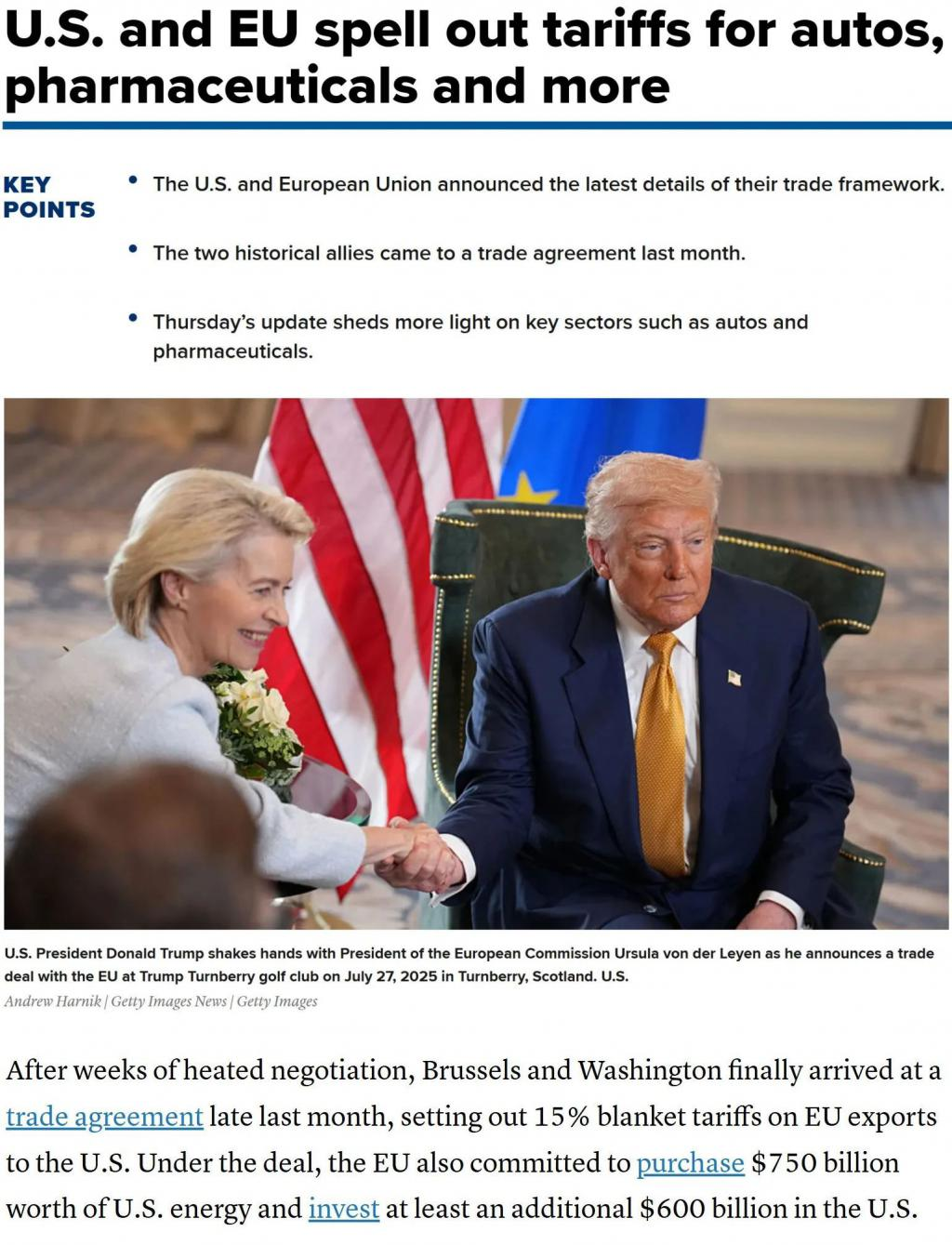
August 21, 2025 – The European Union and the United States officially released a joint statement detailing the trade agreement reached in July. While it appears to be a “mutually beneficial” pact that avoids a full-scale trade war, a closer look reveals significant EU concessions that have sparked internal criticism and market concerns.
Tariff Reset: EU Concedes, US Retains Leverage
Under the new framework, starting in 2025, the US will impose a 15% flat tariff on most EU exports—including automobiles, pharmaceuticals, semiconductors, and timber. Some strategic goods such as cork, aircraft parts, and generic drug ingredients will benefit from MFN (Most Favored Nation) rates or full exemption.
In exchange, the EU has pledged to:
- Remove all tariffs on US industrial goods;
- Grant broader access to EU markets for US agricultural and seafood products;
- Import $750 billion worth of US energy (LNG, oil, nuclear) by 2028;
- Purchase $40 billion worth of US AI chips;
- Invest $600 billion in “strategic industries” within the US.
Essentially, while the US maintains tariff tools, the EU has offered market access, energy deals, tech orders, and capital commitments as bargaining chips.
Internal Backlash: Negotiated Deal or Political Retreat?
EU Commission President Ursula von der Leyen called the deal "the best outcome we could achieve." However, EU lawmakers sharply criticized the agreement as being “heavily skewed in favor of the US,” citing:
- Wine and spirits excluded from tariff relief—affecting major producers like France and Italy;
- No resolution on energy pricing, with US LNG still nearly twice as expensive as Russian supply;
- Digital sovereignty upheld—EU rejected US requests to ease regulations like the Digital Markets Act and Digital Services Act.
Trade Commissioner Maroš Šefčovič reaffirmed that digital regulation is a “non-negotiable red line,” signaling long-term tension in the tech policy front.
Rebound or Illusion? Economic Warnings Emerge
While eurozone GDP grew 1.4% YoY in Q2 and August PMI rose to 51.1 (a 15-month high), economists caution that underlying risks are building:
- PIMCO estimates the deal could cut eurozone growth by 1 percentage point in the coming quarters;
- June exports to the US fell 10.3% YoY, and the EU's trade surplus was halved to €9.6 billion;
- Manufacturers lack room to raise prices, risking further “de-Europeanization” of production.
ECB President Christine Lagarde recently warned that inventory cycles are reversing, with signs of weaker Q3 performance ahead.
Editor’s Note: A “Costly Deal” and a Test of Industrial Resilience
This agreement may not be the worst-case scenario, but it undeniably forces the EU to reassess its global competitiveness.
With strategic concessions on trade, industry, market access, and technology, the EU has essentially traded peace for flexibility. In the short term, we may see internal subsidies or tax relief to offset pressures. In the long run, however, this pact signals the beginning—not the end—of a new wave of challenges for European manufacturing and economic autonomy.