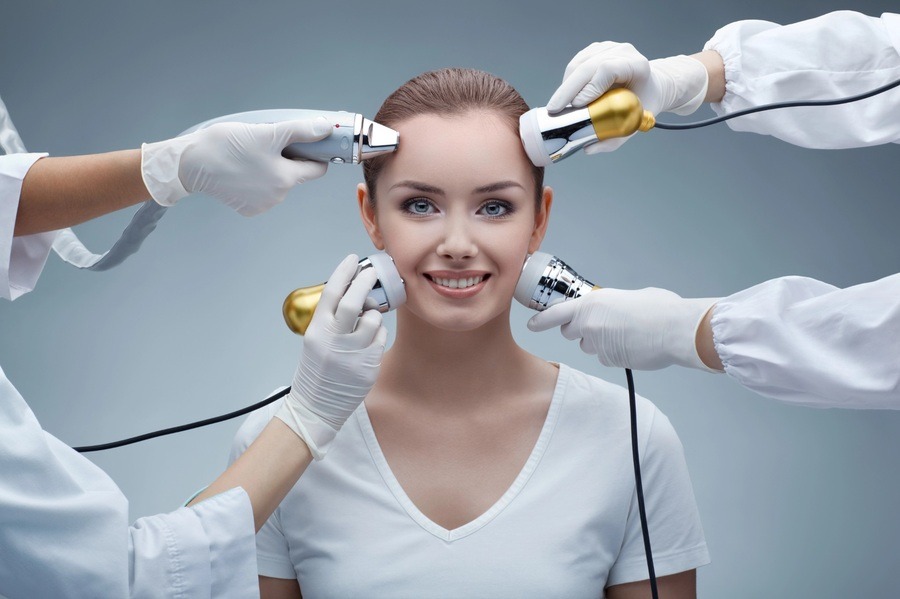
More and more clinical doctors and nurses are transitioning into the medical aesthetics field. Behind this career shift lies the explosive expansion of the medical aesthetics market: public hospitals are establishing aesthetic departments as new revenue pillars under healthcare reforms, while private aesthetic institutions are racing to capture market share at unprecedented speed.
Yet for those making the transition, the experience varies dramatically. Some step into the center of a booming industry and watch their incomes surge. Others hover in calmer outer circles. Still others face new challenges and uncertainties, continuing their pursuit for something beyond the present reality.
Opportunity
At 9 a.m., Zhang Qinghe unlocks the glass door of her clinic and begins by watering the potted plants inside. Having just transitioned into the field, she’s still adapting: the pace is relaxed, tasks include inventorying medicine, maintaining equipment, logging procedures, and preparing for a maximum of three or four client treatments per day. By 6 p.m., she’s clocked out and heading to the gym.
This life stands in stark contrast with her work two years ago at a public orthopedic hospital, where her time was sliced by never-ending rotations of surgeries — constantly “on table” and “off table.” At the most hectic points, she participated in sixteen surgeries in a single day, sometimes operating past 2:00 a.m. Now, she can cook her meals calmly, read books in her downtime, and live in a way she once considered impossible.
Similarly, ENT physician Zhou Rui in a county hospital in Sichuan began considering a shift to aesthetics. During an interview at a private clinic, he was struck by the scene in the parking area: two Rolls-Royces, a Porsche, several Mercedes-G wagons, BMWs that seemed commonplace by comparison. For a doctor raised in a small town, the moment felt like a TV drama suddenly becoming real. Eventually, Zhou joined the clinic with the most expensive cars outside the door.
According to the 2025 Medical Aesthetics Industry White Paper, the market has been expanding at a 17.4% annual growth rate since 2020 and is expected to approach 370 billion yuan by 2025, still maintaining growth above 13%.
Consumer view has evolved: “light aesthetics” has become mainstream. In 2025, average user age is 32.8, with individuals aged 26–35 accounting for 60%. Light procedures — laser brightening, hydrating injections, hyaluronic fillers — have grown from 47.7% of procedures in 2022 to 55.3% in 2024.
In Ningbo alone, Zhang discovered over 300 private clinics. Meanwhile, more than 200 top-tier public hospitals nationwide have now established dedicated aesthetic departments — a 320% increase compared to 2019.
At the same time, fluctuating public-hospital revenue has triggered downward pressure on performance-linked salaries. Aesthetic services have become not only a market-aligned offering, but also a practical financial lifeline for public hospitals.
Dr. Liu Xue, who worked for eight years in a top-tier hospital, saw the shift clearly. Previously peripheral departments — cosmetic surgery, dermatology — are now among the hospital’s most profitable. Some colleagues have even returned from private practice to the public system for the improved incentives.
For Zhou Rui, the driving force was income ceiling. When he was still a student, he assumed doctors earned significant margins from prescriptions after seeing a 100-yuan ointment applied to a skinned knee. Years later, wearing the white coat himself, he learned that doctors receive only a minimal fraction of such costs.
In 2022, after joining a hospital post-graduation, he saw the real numbers: a department head barely surpassing a 20,000-yuan monthly salary. As a junior doctor, he would need 5–8 years of exhausting work at modest wages before reaching that level. Near the end of his tenure, he even heard that salaries might drop further by 30–40%.
With heavy duties and decreasing compensation, many medical professionals began reevaluating their future and pivoting toward aesthetics.
Unlike traditional medical services, aesthetic treatment pricing is independent and mostly not covered by public healthcare insurance. Payroll examples circulate online: 10,000 yuan base salary, over 100,000 yuan in commissions. These stories suggest a new possibility: higher income, balanced workload, easier scheduling.
For Dr. Liu Xue, the turning point was an advanced training program at Zhongshan Hospital affiliated with Fudan University, where expert surgeons presented highly refined cases. That experience opened a new vision of what her medical expertise could become.
But leaving was difficult. After ten years rising through the ranks to attending surgeon, and with relatives initially opposing her desire to “leave a stable system job,” she deliberated for over two years before submitting her resignation. “The lack of personal time became unbearable. I wanted agency over my life — not an unchanging routine.”
Transition
In late 2023, when Zhang formally resigned, she had just donated blood and felt weak, requesting a short rest from her supervisor. The response: “There are five more surgeries today — no one can replace you.”
Her parents, business owners in Zhejiang, once believed she had a good job: stable conditions, no outdoor labor, assisting doctors indoors, and potential upward progression. But years of demanding schedules and emotional stress began taking a toll. When a mental-health specialist recommended she change environments for well-being, her parents — witnessing her fatigue and tension — shifted from skepticism to support.
For Zhou Rui, the decision was even sharper. After months of night shifts interrupted by urgent cases — airway obstructions, trauma injuries, uncontrolled nosebleeds — the strain accumulated. A colleague quietly joined multiple aesthetic-industry groups. Zhou wished to explore the same pathway but simply could not find spare time alongside clinical responsibilities.
Before resigning, he asked the administrative medical director about entering aesthetics. The reply: “It depends whether you want stability or rapid earnings. Aesthetics has strong prospects.” A friend in a private clinic confirmed: “It’s good working here.” The idea solidified.
The final trigger was a remark during a staff meeting: “You should appreciate your stable position. Don’t think about hopping around.” The comment struck deep — not because of disrespect — but because it highlighted how little growth potential existed there. The very next day, he resigned.
For Dr. Liu Xue, now in her early 30s, physical stamina was increasingly mismatched with emergency workloads. Her resignation was initially delayed for three months — the hospital did not want to lose a highly experienced surgeon. But she persisted and left decisively.
Doctors transitioning from public hospitals into aesthetics generally take one of two routes: transferring to an aesthetic department within a public hospital, or joining a private aesthetic institution. As the industry matures, entry thresholds increase. Surgeons in related fields — ophthalmology, ENT, orthopedics — transition more smoothly. Others may need fresh credentials.
Zhou Rui noticed hiring standards rising quickly. In 2022, clinics often accepted candidates with associate degrees. By 2023, full-time bachelor’s degrees. By 2024, most new hires — master’s graduates.
After leaving the hospital, Zhang researched transition paths online. One result caught her attention: “medical aesthetics nurse.” With the required nursing certifications and experience, she applied to a private institution’s newly-established aesthetics department.
Having spent years racing against time in operating rooms, Zhang suddenly found herself with idle hours. After one slow week, she moved again into a busier clinic with more client-facing injection-based procedures. Sessions often took just an hour, with rapid workflow and high completion throughput.
Her compensation increased significantly. For hyaluronic injections, she earned a commission per unit. Large procedures could use 20 units — generating as much income in one appointment as she once made in an entire day. Bonuses were far higher than before.
In addition to surgical assistance, she now also learned product knowledge and client presentation. “What is the brand? What materials? What effect? Which facial zones?” She also had to develop confidence recommending suitable treatments.
Negotiating the New Reality
“Should I make the jump?” This is a question that many still inside hospitals ask Liu Xue. Her early hesitation also began with concerns about aesthetics as a client-facing sales domain. “My medical skill was solid — but I wondered if I would fit the culture,” she explained.
In public hospitals, clinicians treat patients and hold inherent professional authority. In aesthetics, clients are customers making beauty-driven purchases. Their expectations can override medical judgment.
Yet she soon found her surgical training was valuable. Detailed knowledge of anatomical structures became a strategic advantage. The challenge arose when clients brought requests that contradicted safe practice. She recalls a request to refill an already-operated facial area: “I advised postponement, but she insisted. That can be difficult.”
Zhou had similar experiences. “One woman came in wanting to look exactly like a specific celebrity — I politely declined.” A key skill in this field is expectation management. While appearance can be enhanced, there are biological limits. Transforming a 60-quality baseline appearance into a 90 rarely happens.
Industry veterans agree: the real differentiating factor is aesthetic instinct. “Skill matters — but aesthetic intuition matters more,” Zhou says. Small dosage differences — 0.05 ml vs. 0.1 ml vs. 0.2 ml — can dramatically affect whether a face looks refined, enhanced, or overfilled.
Some doctors remain mediocre after seven years. Others become industry names after just two — because their artistic sensibility resonates.
Meanwhile, industry competitiveness intensifies. In 2018, Liu encouraged her cousin to pursue cosmetic-surgery graduate studies — he refused, believing the field too niche. He is now finishing his PhD — and is asking whether he should transition into aesthetics. Her answer now is no.
After two years in aesthetics, Zhou has already seen volatility. He has worked in clinics in Chengdu and Xi’an, now specializing in facial refinement for high-net-worth clients. Spending over 500,000 yuan in one session is not unusual. But in April last year, his income dropped sharply — down 6,000 yuan — and rarely returned to earlier peaks.
At the top of the industry, Liu Xue recognizes its ruthlessness. In a public hospital, the system absorbs risk and professionals can rely on teamwork. In aesthetics, performance is exposed. “If you’re excellent, you’re celebrated. If you falter, you can be quickly replaced.”
Competition is fierce. Entry-level opportunities shrink. Institutions are reluctant to place inexperienced doctors — with clients spending tens of thousands per session, there is little tolerance for trial-and-error learning.
On this fast-moving track, different people experience very different climates. For Zhang, following a former deputy head surgeon to launch a new clinic seemed promising — until reality struck. The lead doctor lacked salesperson instinct, often discouraging borderline-optional procedures. “Clients were coming — and we were turning them away.”
With no existing client pipeline and limited marketing reach, income stalled. Ultimately, Zhang resigned.
Whether one thrives in aesthetics, Liu believes, depends on personal disposition and holistic capability. She herself has both: strong personal grooming, authentic interest in beauty, and exceptional medical training. Years of head-and-neck surgical experience distinguished her early, placing her among the top 10% of doctors in a leading clinic.
As Liu transitions from operating scalpel to injection needle, her vision of professional fulfillment evolves. She still remembers moments of life-and-health impact in hospitals: saving a critical-risk patient and receiving heartfelt gratitude. Those experiences strengthened her sense of meaning.
In aesthetics, the gratification is quieter and more personal: “This is the most confident I’ve ever felt about my appearance — and you’ve kept it natural,” one client said. Liu treasures that too. Her long-term goal is time-freedom — the ability to pause for weeks or months to travel.
After years inside the hospital system, Zhou now feels no anxiety watching peers pursue graduate studies or struggle in academic paths. He enjoys autonomy: finishing early, taking ten days off and driving on spontaneous trips.
At 25, Zhang finally found her ideal role in medical aesthetics — medical-product sales. Raised around her parents’ retail business, she is naturally skilled at customer engagement. The more she works, the more she earns. She now feels grounded and confident. Previously confined to a singular identity — “just a nurse” — she now sees branching paths ahead. Even if one direction stalls, “I know I can always return to medicine — that remains an option.”
At the request of interviewees, certain personal identifiers have been adapted to preserve privacy.