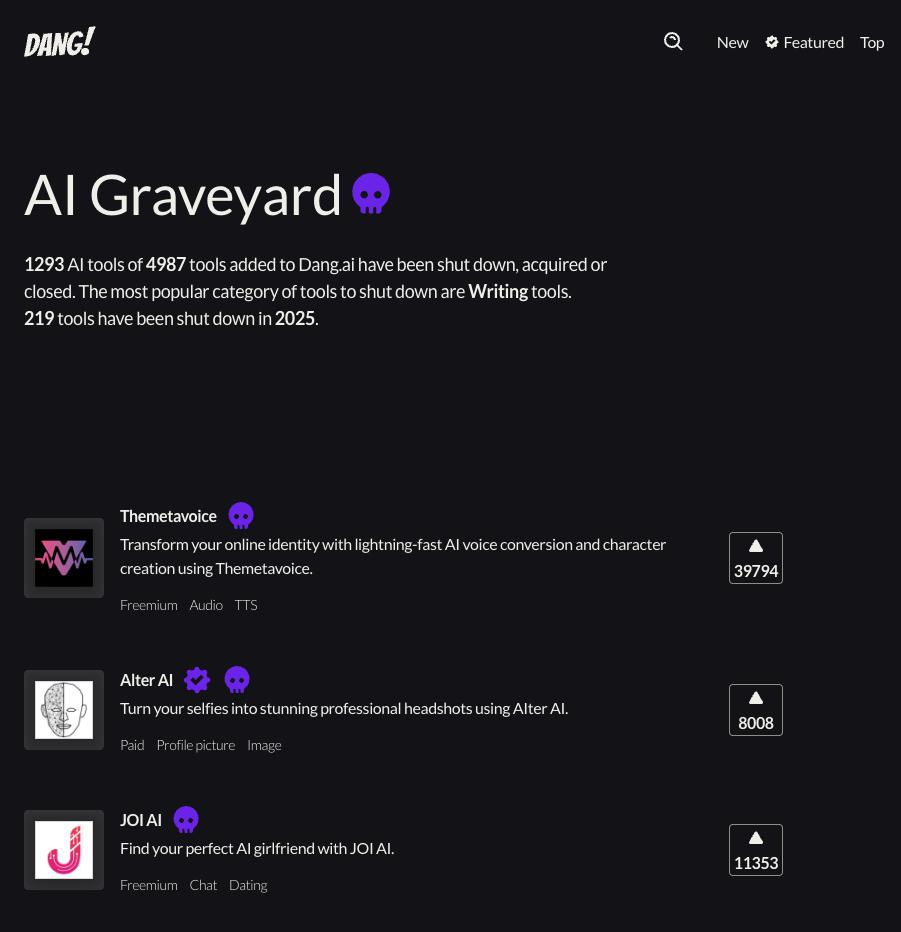
In recent years, the AI industry has seen a flood of innovative products, but alongside the boom, there is a graveyard of 1,289 AI products that have shut down or ceased operation—a stark reminder of the high attrition rate and brutal competition in the field. In 2025 alone, over 200 new closures were added, highlighting the fierce market realities.
The “AI graveyard” includes diverse categories such as tools, generative apps, and chatbots, with chatbots making up nearly 40% and coding assistants over 20%. Even once-promising projects like Neeva, which challenged Google’s dominance in search, have shuttered.
Most failures share a common cause: “rebranded” or “skin-deep” products targeting very narrow and specific scenarios. For example, the AI Pickup Lines generator initially gained attention for its novelty but quickly shut down within months due to lack of sustained value and market depth. Similarly, AI hardware projects, despite promising technology, often fall short because their entertainment value outweighs practical utility.
While rebranded products have some market value, they face intense competition not only from peer products but also from continual updates of foundational AI models, making survival difficult.
Even tech giants with in-house models and ample computing power are not immune. Neeva, despite raising $77.5 million, struggled to compete in a market dominated by Google and Microsoft.
In China, AI products face similar hurdles. Minimax’s AI companion Glow was removed due to inappropriate content; ByteDance’s Maoxiang tightened content controls; and Dream Island, backed by Yuewen Group, was ordered to rectify borderline content. Regulatory scrutiny and complex operations pose challenges even for big players.
The emotional companionship AI sector is particularly challenging. Despite attracting many startups, few survive long-term. AI companions were once hailed as the next “killer app” after general conversational AI, yet most remain niche or transient.
Globally, Replika and Character.AI are flagship emotional AI apps. Replika’s high paid-user ratio has secured steady revenue, whereas Character.AI, despite millions of users, struggled with monetization and was acquired by Google. This shows emotional AI apps face a dilemma between deep niche users willing to pay and large casual users hard to monetize.
The core value of AI companionship isn’t replacing human connection but filling temporary emotional voids. Emotional resonance and bonding remain inherently human experiences that technology cannot fully replicate.
For entrepreneurs, the AI space offers vast opportunities but is fiercely competitive. The large number of failed products in the “AI graveyard” is a sobering reminder: only by deeply understanding real needs and innovating business models can startups survive this brutal race.