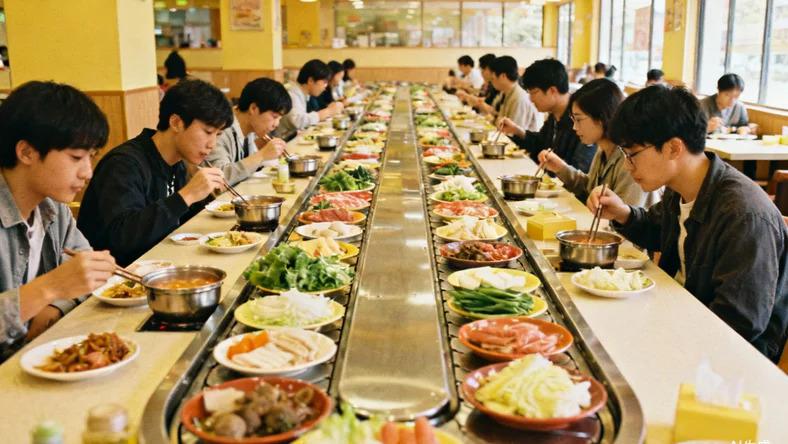
Hotpot as a Top-3 Category: Why Self-Service Mini Hotpot Is Exploding
Hotpot is one of the top three categories in China’s restaurant industry.
Today, the industry is undergoing a clear structural shift, and the most visible sign is:
The rise of self-service mini hotpot.
According to Qichacha data, there are about 23,000 mini hotpot companies nationwide, with a 2.8% CAGR from 2019 to 2023.
Major chains such as Banu, Nan Cheng Xiang, Yoshinoya and LaoXiangJi have all tested mini hotpot formats.
In 2024 alone:
- Haidilao launched its “Jugaogao” self-service mini hotpot brand in Changsha and Ningbo
- Yang Guofu Malatang opened its first self-service mini hotpot store in Qingdao
- Some Xiabuxiabu stores have also switched to a self-service model
Data from the Sichuan Hotpot Association shows that by July 2024:
- China had over 50,000 mini hotpot outlets
- Mini hotpot now accounts for about 10% of all hotpot stores
However:
- 81.6% of mini hotpot brands have 5 or fewer stores
- Less than 1% have more than 100 stores
The market is highly fragmented with very low chain penetration, which creates opportunities for regional startups:
- Qijia, Longge in Qingdao
- Nongxiaoguo, Quexiaoguo in Zhengzhou
- Manshuan, Lekai Xin, Guoyoudu in Xi’an
- Achuanjia in Chongqing
In other words, while the outside world thinks “mini hotpot is just emerging,”
the track is already crowded.
Among them, Longge Self-Service Mini Hotpot, originating in Qingdao, has grown particularly fast.
- In August 2023, founder Yin Peng announced on Douyin that store count exceeded 100 and aimed for 300 by 2025
- Recruitment posts on BOSS Zhipin show a plan to open 288 new stores in 2025
Note:
Longge spent 8 years reaching the first 100 stores, and only had 3 stores in its first 4 years.
In the pure self-service mini hotpot segment, Longge is now the largest chain by store count.
So the key question is:
How did Longge manage such rapid expansion?
Yin Peng’s answer:
Scale and profit are results.
Behind them lie two things:
- A strong single-store model
- A business model that can scale that single-store model
1. Building a Strong Single-Store Model
A single-store profit model means repeatedly refining how one store operates until you get a:
- Market-proven,
- Low-cost-to-replicate
template.
It usually consists of:
- Target customer positioning
- Product & service mix
- Site-selection logic
- Operational strategy
Longge learned these the hard way.
- Their first store was on a street location
- The team believed they did everything right
- But within 6 months, they lost 1 million RMB
Then they moved a nearly 1:1 copy of that store into a mall in Laoshan District.
Unexpectedly, the new site became an instant hit—and stayed hot for 8 straight years.
Lesson: site selection + customer base can make or break a store from day one.
In 2016, when Meituan and Dianping had just merged and reviews were gaining influence,
Yin noticed many customers complaining that:
“A large plate of dishes running on the conveyor belt and being picked by everyone feels unhygienic.”
So Longge tried single-portion dishes.
The downside?
Labor cost shot up.
According to the China Hospitality Association,
labor costs in F&B average 21.35% of revenue,
and are growing at 3.69% annually, the fastest-rising cost item.
After trial and error, Yin summarized an “ideal” single-store into three principles:
(1) Customer Satisfaction
Everyone says they want to “delight customers,”
then they go study Haidilao or Xibei,
only to conclude:
“You can’t copy Haidilao.”
Yin’s view:
- A startup’s resources are limited
- You must focus on the core factors that truly drive satisfaction
- Nice-to-have features can come later
After visiting many top brands, he realized the fundamentals haven’t changed:
They are still about QSC:
- Q: Quality of products
- S: Service
- C: Cleanliness
McDonald’s scaled globally on “standardization + speed + QSC”.
For Longge, the “Q” is where they made the biggest upgrade:
- Most traditional mini self-service hotpot outlets are mom-and-pop shops
- Their control over ingredient quality is limited
- Longge, as a chain, partners with Shuhai, Haidilao’s supply-chain arm
They also added an unusual star product: fried chicken.
- The team found a delicious fried chicken while traveling
- They bought out the recipe
- Built live-fry stations in each store
Now, fried chicken has become one of Longge’s signature items.
On Xiaohongshu and Weibo, many customers recommend it as:
“As good as KFC.”
A key indicator:
Monthly repurchase rate exceeds 30%.
(2) Simplicity for Staff
“Simple for employees” = highly standardized operations.
Examples:
- Exact oil temperature and fry time for chicken
- The number of steps to prepare tomato broth
- How many bowls a staff member carries per run
Mini hotpot with conveyor belts is basically high-standardization hotpot.
Compare:
- Sichuan cuisine: over 340,000 restaurants nationwide, but chain rate only about 18% due to non-standard kitchens
- Hotpot: chain rate ~23.5% overall, Sichuan-style hotpot over 33%
Self-service conveyor-belt mini hotpot pushes standardization even further.
In Longge’s stores:
- Staff only need to set up broth once
- Bussers clear plates occasionally
- Food delivery is handled by the conveyor system
Result: fewer people, simpler training, lower error rates.
(3) Profitability
The third piece is straightforward: the store must make money.
You can’t call it a successful model if:
- Customers are happy
- Staff work easily
- But the store fails to generate profit
From 2015 to 2019, Longge only ran 3 stores,
focused entirely on refining:
- Store size
- Seating layout
- Average ticket
- Cost structure
- Labor efficiency
to get a sustainable single-store unit model.
2. Designing a Scalable Business Model
Once the single-store model works, the next step is:
How do we go from 1 store, to 10, to 100?
This is where the “business model” comes in.
For a long time, Yin felt that “business model” sounded too abstract.
Until he heard consultant Liu Run say:
“A business model is simply how you distribute value among stakeholders.”
So he started mapping:
- Who are the stakeholders?
- How is value shared between them?
In a typical restaurant group, stakeholders include:
- Upstream: suppliers, logistics, warehouses, possibly a trading subsidiary
- Headquarters: marketing, operations, finance, legal
- Stores: city managers, store managers, staff, store partners, investors
In late 2019, Yin drafted his first profit-sharing design and invited his friend Lao Ma to join.
Example store:
- ~200 sqm, ~100 seats
- Total investment: ~1.2 million RMB
- External investor: 65%
- Company: 35%
Then split that 35% across key roles:
- Store manager: 7%
- Store manager’s mentor: 3%
- City manager: 6%
- HQ staff pool: 10%
- Remaining: founding team
Meaning:
Everyone along the chain—HQ to frontline—has a chance to become a shareholder in every store.
This is similar to the “mass partnership” trend since 2019:
- Xijiade’s 3-5-8 model
- Xibei’s “venture division + arena system”
- Haidilao’s master-apprentice partner scheme
- Wallace’s Fuzhou model
But Longge differs in one crucial way:
External investors who hold 65% only receive dividends for 4 years.
After 4 years, the store fully belongs to the brand.
Based on performance so far:
- Most investors recoup in 2 years
- Then earn another 2 years of profit
- After that, they exit the equity structure
In essence, Longge treats each store as a 4-year financial product for investors.
It’s not meant for everyone.
Investors must accept the time-bound nature of the deal.
From 2019 onward, Longge has opened more than 80 stores under this model,
showing that some investors fully accept this logic.
The earliest stores using the “4-year model” completed their term in 2024,
meaning those store assets now belong 100% to Longge.
From a capital-market perspective, this gradually increases the brand’s asset base and valuation.
For the 288 planned openings in 2025:
- It’s said that the cooperation term is 3 years, with an option to renew
As the brand moves into a new competitive phase,
the structure of stakeholder interests—and thus the business model—will continue to evolve.