After reports of large-scale store closures, 85°C (85 Degrees C) is wasting no time charting its next move—and it’s aiming straight at a fresh new business opportunity.
In recent days, the brand has quietly launched a brand-new donut specialty concept: 85°C DONUt. The debut has been anything but quiet on the ground. Crowds have surged, with lines stretching from the storefront all the way to the street corner.
According to official information, 85°C DONUt currently has one store each in Quanzhou, Shanghai, and Suzhou.
What makes the timing especially notable is that this rollout comes just over a month after 85°C became the center of renewed store-closure discussions, signaling a clear intent: streamline the core business, but keep experimenting with new growth engines.
01. A “Side-by-Side” Kiosk Concept Built Around One Hero Product
In the broader bakery landscape, donut-only stores have traditionally been a relatively low-profile niche. International brands have tested the waters in China before, but many struggled to establish long-term traction.
In 2019, Japan’s Duskin announced that Mister Donut would exit the China market. In 2023, Dunkin’ Donuts, once operating around 40 stores across cities including Beijing and Shanghai, shut down its last mainland location. Since then, donut chain brands have been rarely seen at scale.
So as a latecomer, what is 85°C DONUt doing differently?
1) “Store-in-Store” + Kiosk Format, Designed to Grab Attention Fast
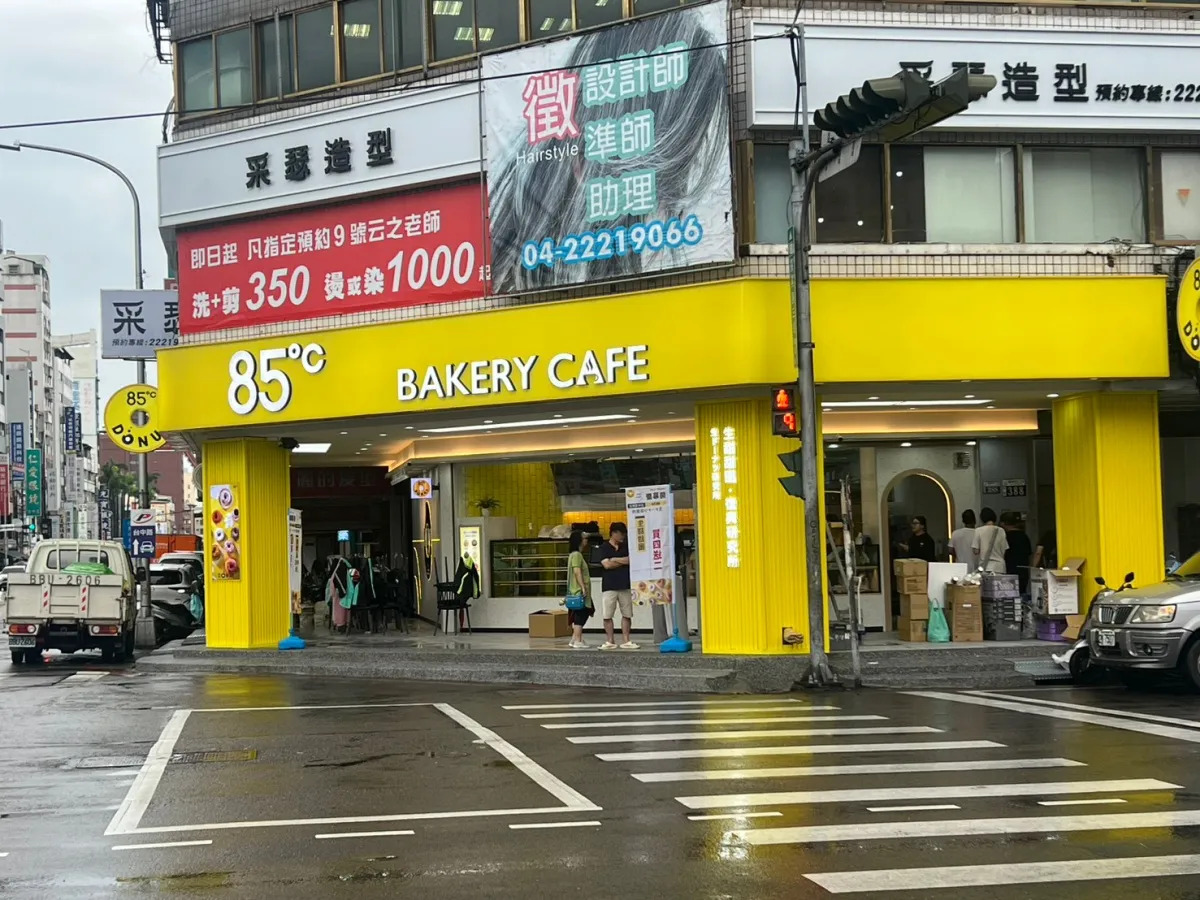
The three current locations vary in format: the Quanzhou store sits inside a shopping mall, while the Shanghai and Suzhou locations are street-facing. But they share a key common feature: each DONUt outlet is built inside an existing 85°C store.
The concept carves out roughly 10 square meters as a kiosk, with much of the space dedicated to donut preparation. Products are displayed primarily in a window setup, allowing customers to purchase quickly and leave—built for speed, convenience, and high turnover.
This “shoulder-to-shoulder” opening strategy mirrors the playbook of major fast-food chains launching new sub-brands within existing footprints: shared space, shared costs, and shared traffic. For 85°C—currently optimizing its store network—this approach reduces rent pressure, leverages existing infrastructure, and enables low-cost testing of a new category.
Visually, DONUt also makes sure it cannot be ignored. From signage and interior design to packaging, the concept leans heavily into a high-saturation, energetic yellow—minimal, bold, and highly “attention-grabbing.” In other words, it’s a brand built to win the battle of being noticed.
Interestingly, the original 85°C stores hosting these kiosks have also been refreshed, shifting toward a more refined French Rococo-inspired style. The contrast—vibrant “yellow kiosk” paired with an elegant upgraded café—creates a layered aesthetic that aligns well with younger consumers’ preference for variety and visual storytelling.
2) A Tight Menu: 14 SKUs, Starting at 6 RMB
In terms of product strategy, DONUt keeps it focused. The menu includes 14 SKUs in total: 13 donuts and 1 sandwich.
The donut lineup spans multiple styles—filled “raw” donuts, raw donuts, crispy raw donuts, and crispy filled raw donuts—with flavors ranging from classics like chocolate and original to more playful, localized innovation such as “Boya Juexian” and preserved plum-inspired options.
Unlike traditional donuts, 85°C DONUt emphasizes “raw donuts.” Here, “raw” doesn’t mean unbaked—it highlights a texture positioning: fresh, moist, and ultra-soft.
Pricing sits largely between 6 and 10.8 RMB, keeping the trial barrier low. On top of that, DONUt has launched aggressive customer acquisition promotions, such as 1 RMB open-day deals and buy-four-get-two offers in the first month, helping fuel the long queues and early buzz.
02. A Changing Market: Taiwanese Food Brands Face a Tougher Mainland Reality
85°C’s push into a new category isn’t happening in isolation—it reflects a broader challenge facing many Taiwanese food and beverage brands in mainland China over the past few years: growth has slowed, and competitive pressure has intensified.
On October 9, 85°C’s parent company Gourmet Master (KY) announced it would adjust its mainland China strategy, optimize operating scale, and close stores in certain regions where profitability has continued to fall below expectations.
Financially, the logic is clear. In the first half of the year, Gourmet Master (KY)’s overall revenue rose slightly, but mainland China revenue declined 11.08% to NT$3.522 billion (about RMB 822 million).
Looking back, the company’s mainland business once achieved profitability in 2021, but revenue has since slid—dropping from NT$10.348 billion (about RMB 2.337 billion) in 2023 to NT$8.053 billion (about RMB 1.818 billion) in 2024.
Even with declining performance and store closures across multiple regions, 85°C has continued to emphasize that it remains confident in the mainland market. The launch of 85°C DONUt is positioned as a key step toward building a new growth curve.
Meanwhile, 85°C isn’t the only Taiwanese brand under pressure.
The once wildly popular Taiwanese milk tea brand Cunei Xiaojun Village, often remembered as a “college-era favorite,” reportedly peaked at nearly 500 stores in mainland China. Today, according to its ordering mini-program, only a little over 10 stores remain.
machimachi, a brand boosted by celebrity exposure—its “Jay Chou-style” tea famously became a resale sensation at one point—also appears to have shrunk significantly. Based on the brand’s official membership mini-program, only six mainland locations are currently operating.
Other brands have also pulled back. Late last year, Zhenghao “Big Chicken Cutlet” announced plans to gradually close all mainland stores. Premium vegetarian concept DASHU WUJIE, after more than 20 years in the market, completed a full closure as early as 2022.
The rise and fall of these brands is closely tied to one major shift: the market has changed.
Around 2010, mainland China’s dining industry was still in the early stages of brand-building. Competition was relatively moderate, and Taiwanese brands—often equipped with mature product systems and polished branding—were able to capture the early wave of opportunity.
Today, the industry is in what can only be described as fast-forward evolution. By 2024, China had 16.601 million catering-related enterprises nationwide. Across snacks, quick service, new tea, and bakery, a new generation of highly capable brands has emerged—strong products, sharp marketing, constantly upgraded store experiences, and in some cases, global expansion.
At the same time, consumer expectations have become more layered. It’s no longer just about taste. Shoppers increasingly look for brand identity, health-oriented thinking, and social-sharing value. Some Taiwanese brands struggled to keep pace—slower innovation, weaker localization, and limited adaptation—gradually losing their edge.
That said, the mainland market still holds massive potential. Many niche categories remain without a dominant leader, and lower-tier markets are far from fully unlocked.
For brands like 85°C, the question isn’t whether opportunity exists—it’s whether they can identify the right track, respond quickly to shifting demand, and build a sustainable path forward. With 85°C DONUt, the company is clearly betting that a focused, visually bold, low-cost experiment might be exactly the kind of move that keeps it in the game—and puts it back on offense.