Ziyan Foods has once again found itself at the center of public attention after a recent incident was widely circulated online and described as “a staff member taking part of a customer’s beef.” The controversy quickly reignited debates around consumer trust, store-level management, and how well brands can supervise rapidly expanding franchise networks.
On December 25, Ziyan Foods issued a public apology regarding the incident. In its statement, the company said the employee involved had been dismissed, and the store in question was ordered to suspend operations for rectification.
Ziyan also announced compensation measures: the customer shown in the video would receive a cash payout equivalent to ten times the amount spent, along with a no-minimum spending card worth RMB 1,000. In addition, the company said it would provide compensation to customers who had made purchases at the same store since December.
While the response was swift and comprehensive, the incident has still raised broader questions—particularly about oversight at the franchise end of the business. Critics argue that fast expansion can expose weak points in day-to-day supervision, especially at the last mile where customer experience is shaped.
Public reports have also noted that Ziyan Foods has previously faced food-safety-related controversies, including claims of rodents seen in stores and past product test results involving excessive E. coli indicators. These recurring headlines have continued to pressure the brand’s reputation.
Financially, the company has also been navigating a challenging period. In the first three quarters of the year, Ziyan reported revenue of RMB 2.514 billion, down 6.43% year-on-year, while net profit attributable to shareholders fell 44.37% to RMB 194 million—showing pressure on both revenue and profitability.
According to Tianyancha, Ziyan Foods listed on China’s A-share market in 2022. As of the close on December 26, its share price stood at RMB 19.53, giving the company a market capitalization of approximately RMB 8.076 billion.
Notably, the 2025 Hurun Rich List released in late October showed founder Zhong Huaijun and his family with an estimated wealth of RMB 8.5 billion, ranking 847th—representing a significant increase compared with the previous year.
Alleged “Beef Shortchanging” Sparks Online Outcry
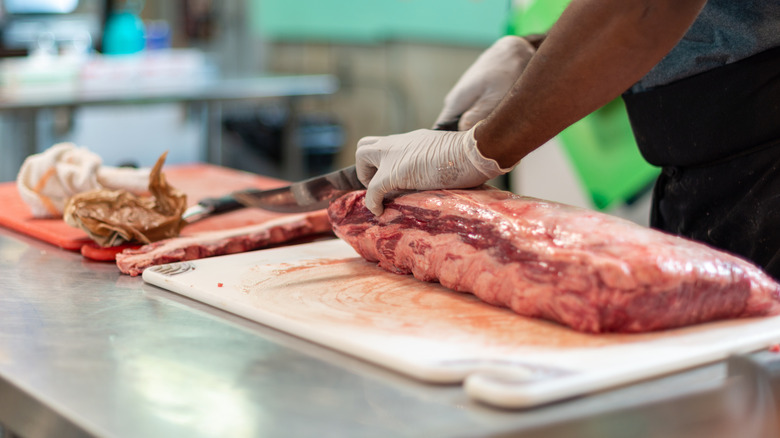
According to reports, a video posted online on December 24 drew widespread attention. The uploader claimed that at a Ziyan Baiweiji store in the Kexuan Road Market in Qidong, Nantong, they witnessed a staff member allegedly removing a portion of beef after it had already been weighed and was about to be packed.
In the footage, the staff member appears to turn slightly to the side and discreetly take some of the product, while continuing to chat with the customer—an action viewers described as practiced and deliberate. The uploader said this was not the first time they had noticed similar issues and claimed they had filed a complaint with local market regulators, who were said to have opened an inquiry.
The video triggered intense discussion online, with some commenters claiming they had experienced “short weight” situations as well.
In its December 25 statement, Ziyan said it treated the matter seriously, formed a special task force immediately, and conducted an overnight investigation. The company stated that the employee’s behavior was confirmed to be improper, violated company rules, and harmed consumer rights.
To address the situation, Ziyan reiterated its compensation plan for the affected customer and said it would run a 10-day compensation initiative for customers who purchased from the store after December.
The company also said it had issued a nationwide internal notice to reinforce service rules and operating standards, aiming to prevent a repeat of such incidents. It added that it would strengthen “transparent sales” training across stores and welcomed ongoing public supervision.
Repeated Controversies and Rising Prices Draw Continued Attention
Beyond this incident, Ziyan Baiweiji has previously faced multiple rounds of negative publicity. Media reports last year cited third-party testing content claiming that several Ziyan products did not meet certain microbiological standards, including elevated colony counts and excessive coliform indicators in specific items.
Ziyan responded at the time by removing relevant products from its online store, launching investigations, reviewing monitoring footage and production processes, and checking logistics conditions. The company also stated that its internal factory-exit inspection results met regulatory requirements, and that it would further strengthen full-process safety controls.
However, some earlier public reporting pointed to previous official sampling results years ago that flagged certain Ziyan products as non-compliant due to coliform-related indicators, suggesting the brand has faced repeated scrutiny in this area.
In 2021, the company also responded to an incident involving a customer’s claim of seeing rodents in a store display area—an episode that became a trending topic and further heightened public concern.
In its interim report, Ziyan emphasized that food safety remains a top operational priority, especially for short-shelf-life fresh products, and highlighted controls across raw materials, processing, transportation, storage, and front-end sales. At the same time, the company acknowledged that any lapse in any part of the chain could negatively affect brand image and operating results.
Separately, Ziyan’s pricing strategy has also become a talking point in recent years. Some consumers have shared records of rising prices for the same set meals or popular products over time, and recent platform checks have shown high per-jin equivalent pricing for certain items—fueling debate around affordability and value.
Distributor-Franchise Model Under the Microscope as Store Count Shrinks
Some observers believe the root of recurring store-level issues may lie in Ziyan’s distributor-led franchise structure. According to the company’s interim report, Ziyan primarily operates through a distribution-based chain model, supplemented by e-commerce, supermarket channels, group purchasing, and other sales networks.
Under this structure, Ziyan operates a two-tier sales network: “Company → Distributors → Franchise Stores → Consumers.” Distributors purchase products from the company and then establish or expand downstream franchise stores. Responsibilities such as store decoration standards, pricing guidance, and staff training are generally carried out by distributors.
Ziyan notes that it does not directly control distributors or their stores. Each distributor and franchise store operates as an independent accounting entity, bearing its own profit and loss—though the company provides business guidance and oversight.
The company argues this model can reduce the uncertainty and management complexity of developing stores directly, lower operating costs, and allow Ziyan to focus on product development, quality control, and supply chain management—supporting faster scaling.
This approach did help Ziyan expand rapidly. Brand monitoring data shows that the chain grew from fewer than 2,000 stores in 2018 to 6,205 stores by the end of 2023, according to figures disclosed on the company’s website.
More recently, however, that momentum appears to have eased. Data platforms tracking restaurant chains indicate that as of December 15, the number of Ziyan stores had declined to 5,144, suggesting a contraction from earlier peaks.
Meanwhile, profitability has remained under pressure. In Q3, Ziyan’s revenue returned to modest growth year-on-year, but net profit attributable to shareholders fell sharply. Across the first three quarters, both revenue and profit declined, and operating cash flow also dropped significantly—indicating weaker cash-generation capacity.
The company attributed the profit decline to lower revenue and reduced gross margin. It said the decrease in operating cash flow was mainly due to reduced cash received from sales as revenue fell.
From the perspective of market observers, the latest “beef” incident underscores a critical challenge for Ziyan: ensuring consistent service integrity and reliable store-level operations across a broad franchise footprint. Strengthening everyday supervision, protecting consumer trust, and improving the value-and-experience balance remain central tasks the brand will need to keep advancing.