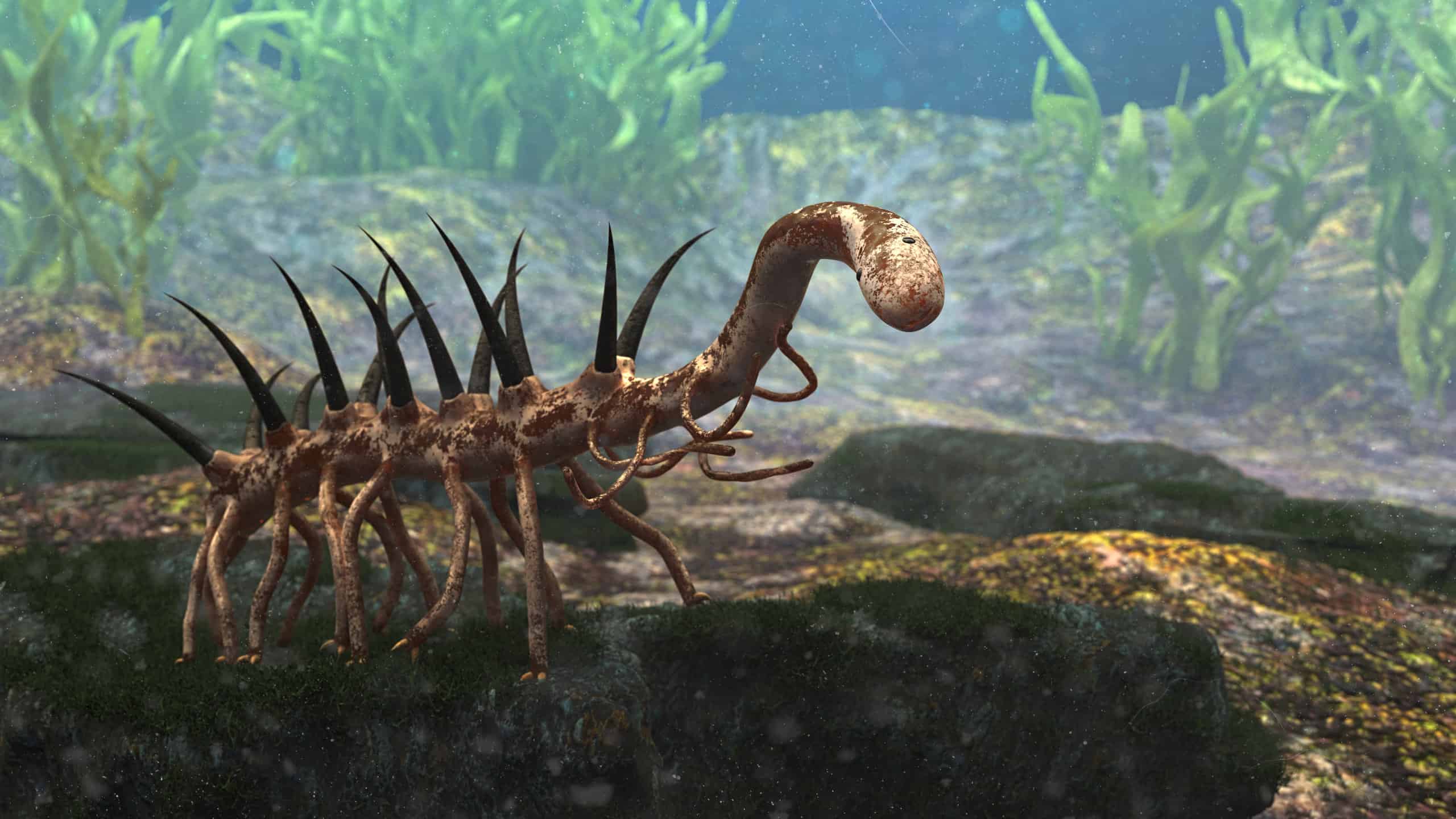
According to a U.S. media report on January 1, after decades of confusion—and more than a few wrong turns—scientists have finally reconstructed the face of one of the most bizarre creatures in Earth’s history: Hallucigenia. New evidence from Canada’s Burgess Shale shows that this tiny animal was never “headless” at all. Its facial features were simply hidden in plain sight, waiting for the right tools and careful observation to bring them into focus.
This ancient marine organism measured less than two centimeters long, and since it was first described more than a century ago, it has repeatedly puzzled researchers. A new study published in Nature presents the first complete view of Hallucigenia’s head, reshaping how scientists think about early animal evolution and correcting a long-standing anatomical mistake.
The “Upside-Down” Fossil That Kept Fooling Scientists
The breakthrough comes from painstaking fossil preparation and high-resolution microscopic analysis led by Dr. Martin Smith of the University of Cambridge and Dr. Jean-Bernard Caron of the University of Toronto.
For much of its research history, Hallucigenia became a scientific synonym for “confusing.” When it was first formally described, even its basic orientation was wrong: scientists mistook its legs for dorsal spines and reconstructed the entire animal upside down.
Only in recent years did researchers confidently determine which side was up—but the location and shape of its head remained uncertain. A strange dark patch at one end of many specimens was widely interpreted as the head, until newly examined fossils showed that assumption didn’t hold up.
A Surreal “Smile” and Teeth You’d Never Expect
The turning point arrived when researchers identified a spoon-shaped head with clear facial features. Using electron microscopy, they spotted two tiny eyes and, beneath them, a curved structure that gave the animal an unexpectedly expressive look.
“It’s as if the fossil is grinning at us—amused that it kept its secret for so long,” Dr. Smith said, describing the semicircular feature that creates a nearly comical “smile.”
The mouth revealed even more surprises. Scientists found a ring of teeth around the opening, followed by another set extending deeper toward the throat. This unusual arrangement may have helped Hallucigenia grip and swallow food on the seafloor. The structure also hints at a suction-feeding strategy—pulling food in and sending it straight into the gut—different from many other Cambrian animals.
A Decades-Long Misread, Finally Corrected
Just as significant as the discovery itself is what it clarifies. The dark, round feature long believed to be Hallucigenia’s head has now been shown to be something else entirely. Chemical analysis suggests it does not match the composition of the animal’s body.
Instead, the research team concludes it represents decayed bodily fluids—material forced out from the gut during burial and fossilization. This reinterpretation changes how scientists understand older specimens and underscores how easy it is to misread soft-bodied animals in the fossil record.
“Our work shows that this part has a different composition from the animal itself,” Dr. Smith explained. “It isn’t anatomy. It actually represents decaying fluids—gut contents that were squeezed out as the organism was buried and fossilized.”
A New Evolutionary Link to Velvet Worms
With a clearer picture of its anatomy, Hallucigenia’s position on the evolutionary tree is also coming into sharper focus. Researchers now suggest it may be among the earliest ancestors of modern velvet worms (onychophorans), small soft-bodied invertebrates still found today in tropical environments. The proposed link is supported by shared traits, including paired claws and non-jointed limbs.
Dr. Xiaoya Ma of the Natural History Museum in London supports this view, noting that while velvet worms lack Hallucigenia’s prominent dorsal spines, similarities in limb development strengthen the evolutionary connection.
“I think revisiting these worms and carefully tracing how their mouthparts are constructed could reveal exciting insights into the broader evolutionary history of ecdysozoans,” Dr. Smith added.
(Original headline: “Scientists Just Found the Face of a 500-Million-Year-Old Creature, And It’s Smiling”)