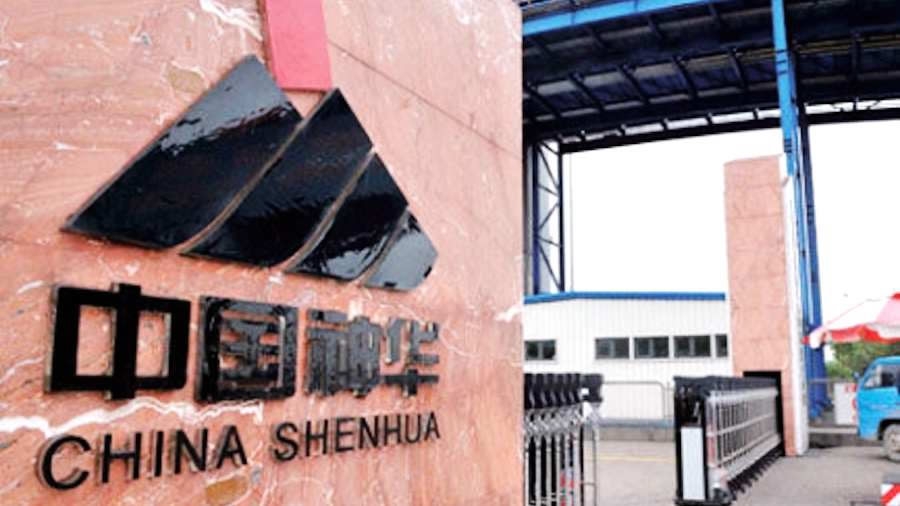
Even for a “super-sized heavyweight” and “China’s biggest coal boss,” China Shenhua cannot stand still at a critical turning point in the energy transition. To secure its position for the next era, the company is preparing to deploy its deepest reserves of real cash in an acquisition of unprecedented scale.
In a recent announcement, China Shenhua said it plans to acquire several core assets held by China Energy Investment Corporation (CHN Energy) and its wholly owned subsidiary, Western Energy. The deal involves a cash payment of RMB 93.5 billion—enough to consume roughly three-quarters of the cash on China Shenhua’s books. Including the share component, the total consideration is set to approach RMB 133.6 billion.
Put plainly, this is a transaction of historic magnitude.
It surpasses landmark restructurings such as China Shipbuilding’s absorption of China Heavy Industry and Guotai Junan’s share-swap merger with Haitong Securities, effectively becoming the largest M&A deal in A-share history. Once completed, China Shenhua’s asset base is expected to rise from just over RMB 600 billion to nearly RMB 900 billion.
But for China Shenhua, scale has never been the endgame.
What the market truly cares about is the stability of cash flow—and the company’s ability to keep delivering sustainable, predictable dividends across cycles. Over the past few years, China Shenhua’s share price was underpinned by consistent operating cash flow and hundreds of billions of yuan returned to shareholders annually. The stock climbed steadily from the teens to above RMB 40.
A key pillar of that model was simple: operating cash flow consistently covered net cash outflows from financing activities. Yet in the first three quarters of this year, that balance was broken for the first time.
Against this backdrop, executing a record-breaking acquisition forces a hard question onto the table: is China Shenhua strengthening the foundation for the future, or is it being pushed to manually downshift the engine of its “dividend machine”?
A-Share’s Largest M&A Deal
From a structural standpoint, this “once-in-a-generation” transaction spans almost every critical link in the coal value chain: coal mining, mine-mouth coal power, coal chemicals, and port shipping logistics.
Four targets carry price tags above RMB 10 billion: Guoyuan Power, the Chemicals Company, Wuhai Energy, and Xinjiang Energy, with respective valuations of RMB 44.6 billion, RMB 29.9 billion, RMB 14.2 billion, and RMB 12.1 billion. Guoyuan Power reinforces a classic “coal-power integration” model. The Chemicals Company strengthens the coal chemical segment. Wuhai Energy and Xinjiang Energy are more directly tied to coal resource consolidation.
After the merger, what China Shenhua gains is not simply a larger pile of assets, but a tightly coupled heavy-asset system built around “resources–power–chemicals–logistics.”
The expansion in scale is substantial.
China Shenhua’s coal resources in place are expected to rise from 41.58 billion tons to 68.49 billion tons, a jump of 64.72%. Recoverable reserves will increase from 17.45 billion tons to 34.50 billion tons—nearly doubling. Approved coal production capacity will lift to 512 million tons per year, up 56.57%.
Power assets will also see a clear expansion. Post-deal, the company’s controlled and operated installed generation capacity will rise from 47.632 million kW to 60.881 million kW, an increase of about 27.82%. More importantly, many of these assets sit in coal-rich regions, enabling efficient absorption of China Shenhua’s own coal output.
Based on July 2025 calculations, total assets would increase from RMB 635.9 billion to RMB 896.6 billion, approaching the RMB 900 billion threshold.
Across the A-share market, only a small number of companies operate at this level of balance-sheet size. Using 2025 third-quarter data as a reference point, the combined China Shenhua could even edge past CATL (total assets RMB 896.1 billion), becoming the 16th-largest non-financial company in A-shares by total assets.
On a seven-month pro forma basis, revenue would rise from RMB 162.3 billion to RMB 206.5 billion, while net profit excluding non-recurring items would increase from RMB 29.3 billion to RMB 32.6 billion. The earnings base remains solid.
Yet the market’s hesitation is not without reason.
From 2021 to 2024, China Shenhua distributed nearly RMB 190 billion in dividends. Annual cash payouts of RMB 40–50 billion made investors feel the company’s “coal tycoon generosity” in real terms—and became the strongest anchor in its valuation framework. In price terms, China Shenhua’s adjusted share price rose from RMB 12.19 at the end of 2020 to a peak of RMB 43.88 in October 2024, and it still trades above RMB 40 despite fluctuations.
This acquisition, however, requires close to RMB 100 billion in cash—an undeniable short-term squeeze on dividend flexibility.
Timing makes the pressure sharper. At the end of the third quarter, China Shenhua held RMB 124.418 billion in cash, while the transaction calls for RMB 93.519 billion in cash payment. That would drain roughly three-quarters of the cash reserve and even exceed the company’s full-year operating cash flow net inflow for 2024.
To ease the cash burden and “optimize the capital structure,” China Shenhua also plans a private placement to no more than 35 specific investors to raise up to RMB 20 billion in supporting funds.
More concerning is the recent cash-flow trend.
By the third quarter this year, both monetary funds and operating cash flow hit five-year lows. The critical indicator behind the high-dividend model—whether operating cash flow can comfortably cover net financing outflows—has begun to crack.
From 2021 to 2024 (first three quarters), “operating cash flow net amount minus net financing cash outflow” remained positive: RMB 28.424 billion, RMB 33.845 billion, RMB 1.411 billion, and RMB 33.457 billion. That pattern supported market confidence in generous dividends year after year. But in the first three quarters of 2025, the figure turned negative, showing a gap of more than RMB 9 billion.
Layer onto that a one-time RMB 90+ billion cash outlay, plus an estimated RMB 230 billion increase in liabilities after the deal, pushing the debt-to-asset ratio from 25.11% up to 43.55%, along with potential new financing costs—and it is easy to see why investors worry that the space for “ultra-high dividends” may steadily shrink.
Behind the Profit Pressure: A Coal Price Roller Coaster
For investors who treat China Shenhua like a bond substitute, the risk is not only the near-RMB 100 billion cash spend. The deeper concern is whether the earnings that support the “high-dividend safety” will remain under pressure.
In the first three quarters of 2025, China Shenhua reported revenue of RMB 213.2 billion, down 16.57% year-on-year, and net profit attributable to shareholders of RMB 39.05 billion, down 10%. In 2024, revenue was RMB 338.38 billion, down 1.4%, while attributable net profit was RMB 58.671 billion, down 1.7%.
China Shenhua has attributed the profit decline to lower coal selling prices and lower electricity selling prices. The issue, however, is not simply “prices fell,” but that this downturn is rooted in a largely structural backdrop.
On the supply side, falling overseas coal prices reopened import economics. Domestically, policy continued to emphasize supply security, keeping capacity high and production reaching new highs. With supply staying loose and demand not expanding at the same pace, a coal price pullback became almost inevitable.
By the end of June this year, the Qinhuangdao spot price for 5,500 kcal thermal coal was RMB 619 per ton, down roughly 28% year-on-year, back to 2020 levels. For resource-driven businesses, that is not a gentle “correction”—it is direct pressure on the income statement, which ultimately flows into dividend capacity.
There was a more subtle twist in the second half of the year. Qinhuangdao 5,500 kcal coal rose from RMB 621 per ton on July 1 to a peak of RMB 834 per ton on November 12, briefly signaling “coal prices are warming up, the cycle might be turning.”
But the rally, once dissected, appeared driven more by policy expectations, short-term disruptions, and seasonal effects than by a true reversal in supply-demand fundamentals. As capacity recovered, renewables output increased, and power demand remained soft, prices returned to more rational levels.
Last month, coal prices turned downward again, briefly dropping back below RMB 800 per ton. This underscores a broader transition underway: the coal sector is moving from a “high-boom windfall period” into a new phase defined by supply security and returns reverting toward the mean.
For China Shenhua, a down-cycle does not just compress margins—it tests the company’s ability to build resilience through scale, cost control, and industrial chain coordination.
The System’s Ballast Stone
To truly understand this acquisition, it helps to step beyond short-term dividend yield and place it within the long-term narrative of China’s energy transition.
The recent Central Economic Work Conference has, in effect, outlined the “base script” for the coal industry over the coming years. After the meeting, a senior official from the Central Financial and Economic Affairs Commission Office put it plainly: under the “dual-carbon” goals, the country will push energy-saving and carbon-reduction upgrades in key industries, steadily drive coal and oil consumption toward peaking, and continue raising the share of renewables on the supply side—accelerating clean energy bases so that incremental power demand is increasingly met by renewable generation.
In everyday language: coal remains important, but its role is shifting—from the main engine of output toward the backstop that stabilizes the system. The real driver of incremental growth—and the force shaping the future structure—is increasingly wind and solar.
Macro signals have already reinforced this direction.
Kpler forecasts that global seaborne thermal coal exports in 2025 will be about 946 million tons, nearly 50 million tons lower than 2024, a decline of roughly 5%, and even below the pre-pandemic level of 963 million tons in 2019. In other words, coal’s influence in the global power system is quietly fading.
Since 2025 began, four of the world’s top five thermal coal importing countries have recorded year-on-year declines in coal-fired generation. This is less a single-country policy choice and more a shared outcome of changing energy structures.
China’s domestic power mix is even more representative. Data from energy think tank Ember shows that in 2025, coal’s share of China’s power generation fell to a historic low of 55.3%, noticeably below the near-59% level in 2024.
The divergence in generation growth is also becoming clearer. In the first half of 2025, power generation from above-scale plants grew only 0.8% year-on-year. Within that, thermal power declined 2.4% and hydropower fell 2.9%, while wind, solar, and nuclear generation rose 10.6%, 20.0%, and 11.3% respectively.
Under this backdrop—where coal is gradually making room for renewables—China Shenhua’s central challenge is no longer just defending its coal base. It is how to re-anchor its strategic position in the national energy transition.
The National Energy Administration’s latest guidance on promoting integrated development between coal and renewables sketches a clear pathway. The document’s core logic is not “weaken coal,” but to ensure coal does not fall out of the system while renewables scale faster—pushing the two to operate in an integrated manner.
Viewed through that policy lens, the so-called “century merger” looks less like asset accumulation for its own sake, and more like a systemic restructuring aligned with the coal–renewables integration agenda.
By consolidating previously dispersed coal resources, mine-mouth coal power, renewable projects, and port-shipping assets within a listed platform that has higher management efficiency and stronger capital-market discipline, internal bargaining and coordination costs could fall materially. Investments and execution for mine-site solar and wind projects, as well as electrification upgrades, may also accelerate with more unified decision-making.
Yes, this merger may compress the space for sustaining the “high dividend” narrative in the near term—especially for investors who treat China Shenhua as a bond-like cash machine. But across a longer cycle, it resembles a trade: asset integration in exchange for greater certainty in an evolving energy system.
As renewables sprint forward, what becomes truly scarce is not speed, but the willingness and capacity to stabilize the base, absorb volatility, and hold the system steady.
If wind and solar determine how fast China’s energy transition can run, then China Shenhua is being positioned to play a less glamorous but irreplaceable role—providing ballast and support for the entire system.
It may no longer be viewed only as a “lie back and collect interest” dividend stock. In the renewable era, China Shenhua is increasingly becoming one of the most critical foundations in China’s energy system—precisely because it cannot afford to fail.
And that, perhaps, is the most valuable logic behind this trillion-yuan deal.